
Ch. 07 - Work and Energy
Giancoli Douglas - Physics for Scientists and Engineers 5th edition
Giancoli Douglas5th editionPhysics for Scientists and EngineersISBN: 9780137488179당신이 사용하는 게 아니라요?교과서 변경
7장, 문제 7.100d

A 2.0-kg block slides across a rough surface with a constant coefficient of kinetic friction of 0.50 (Fig. 7–38a). The block starts at x= 0 with an initial velocity of 4.9 m/s. Pushing the block is a force directed at 36.8° below the horizontal and whose magnitude increases with position as shown in Fig. 7–38b.
<IMAGE>
(d) Draw a line on the graph showing the magnitude of the friction force versus distance x.

검증된 단계별 안내
1
Identify the forces acting on the block: The gravitational force (weight) acting downwards, the normal force acting upwards, the kinetic friction force acting opposite to the direction of motion, and the applied force which has a horizontal component pushing the block and a vertical component acting downwards.
Calculate the normal force on the block. The normal force is equal to the weight of the block minus the vertical component of the applied force. Use the equation: Normal Force = Weight - Vertical Component of Applied Force. The weight is calculated as the mass times the acceleration due to gravity (9.8 m/s^2). The vertical component of the applied force can be found using trigonometric functions (sine of the angle times the magnitude of the force).
Determine the frictional force using the coefficient of kinetic friction and the normal force. The frictional force can be calculated by multiplying the coefficient of kinetic friction by the normal force. Use the equation: Frictional Force = Coefficient of Kinetic Friction × Normal Force.
Since the problem states that the magnitude of the applied force increases with position, you need to consider how this affects the normal force and consequently the frictional force as the block moves. The frictional force will vary depending on the changing normal force.
Plot the frictional force versus distance on the graph. Start from the initial position (x = 0) with the initial frictional force calculated and extend the line considering the increase in the applied force and its effect on the normal and frictional forces as the block moves along the surface.

비슷한 문제에 대한 검증된 영상 답변:

이 영상 해법은 위 문제에 도움이 된다고 튜터들이 추천한 것입니다.
도움이 되었나요?

주요 개념

질문에 올바르게 답하기 위해 반드시 이해해야 하는 핵심 개념들은 다음과 같습니다.

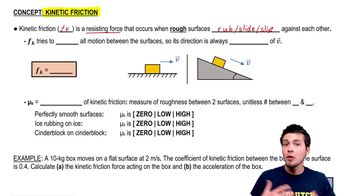
Kinetic Friction

Kinetic friction is the force that opposes the motion of two surfaces sliding past each other. It is characterized by the coefficient of kinetic friction (μk), which is a dimensionless value representing the ratio of the frictional force to the normal force. In this scenario, the coefficient is given as 0.50, meaning the frictional force can be calculated as F_friction = μk * N, where N is the normal force acting on the block.
추천 영상:
가이드 코스
06:18
Kinetic Friction Problems

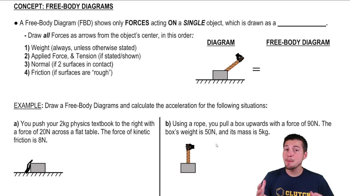
Free Body Diagram

A free body diagram (FBD) is a graphical representation used to visualize the forces acting on an object. In this case, it would include the gravitational force, the normal force, the applied force at an angle, and the frictional force. Analyzing the FBD helps in understanding how these forces interact and affect the block's motion, which is crucial for determining the friction force as a function of distance.
추천 영상:
가이드 코스
08:42
Free-Body Diagrams

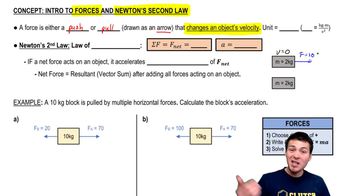
Newton's Second Law

Newton's Second Law states that the acceleration of an object is directly proportional to the net force acting on it and inversely proportional to its mass, expressed as F_net = m * a. This principle is essential for analyzing the block's motion, as it allows us to calculate the net force by considering all acting forces, including friction and the applied force, to determine how the block's velocity changes over distance.
추천 영상:
가이드 코스
06:54
Intro to Forces & Newton's Second Law