Ch. 07 - Work and Energy
Giancoli Douglas - Physics for Scientists and Engineers 5th edition
Giancoli Douglas5th editionPhysics for Scientists and EngineersISBN: 9780137488179당신이 사용하는 게 아니라요?교과서 변경
7장, 문제 4

The head of a hammer with a mass of 1.2 kg is allowed to fall onto a nail from a height of 0.65 m. What is the maximum amount of work it could do on the nail? Why do people not just “let it fall” but add their own force to the hammer as it falls?

검증된 단계별 안내
1
Determine the potential energy of the hammer at the initial height using the formula for gravitational potential energy: Epi = mgh, where m is the mass of the hammer (1.2 kg), g is the acceleration due to gravity (9.8 m/s²), and h is the height (0.65 m).
Recognize that the maximum work the hammer can do on the nail is equal to the initial potential energy of the hammer, assuming no energy is lost to air resistance or other factors. This is because the potential energy is fully converted into kinetic energy at the moment of impact, which is then transferred to the nail.
Substitute the given values into the potential energy formula: Epi = (1.2 \, kg)(9.8 \, m/s²)(0.65 \, m). This will give the maximum work the hammer can do on the nail.
Understand why people add their own force to the hammer as it falls: By applying an additional force, they increase the total energy of the system. This added force increases the hammer's kinetic energy at the moment of impact, allowing it to do more work on the nail than it would if it were simply allowed to fall under gravity alone.
Conclude that the maximum work calculated assumes ideal conditions (no energy losses), but in real-world scenarios, adding force compensates for energy losses and increases the efficiency of driving the nail into the material.

비슷한 문제에 대한 검증된 영상 답변:

이 영상 해법은 위 문제에 도움이 된다고 튜터들이 추천한 것입니다.
영상 길이:
4m

주요 개념

질문에 올바르게 답하기 위해 반드시 이해해야 하는 핵심 개념들은 다음과 같습니다.

Work and Energy

Work is defined as the transfer of energy that occurs when a force is applied over a distance. In this context, the work done by the hammer on the nail can be calculated using the formula W = F × d, where W is work, F is the force applied, and d is the distance over which the force is applied. The maximum work done by the hammer is equal to its potential energy at the height from which it falls, which can be calculated using the formula PE = mgh, where m is mass, g is the acceleration due to gravity, and h is height.
추천 영상:
가이드 코스
04:10
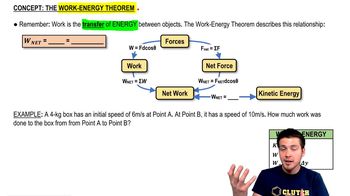
The Work-Energy Theorem

Potential Energy

Potential energy is the energy stored in an object due to its position in a gravitational field. For the hammer, as it is raised to a height of 0.65 m, it accumulates gravitational potential energy, which is given by the equation PE = mgh. When the hammer falls, this potential energy is converted into kinetic energy and ultimately into work done on the nail upon impact, illustrating the conservation of energy principle.
추천 영상:
가이드 코스
07:24
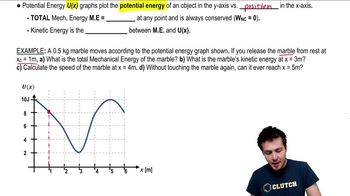
Potential Energy Graphs

Force Addition in Hammering

When people swing a hammer, they apply additional force to increase the hammer's speed and momentum before it strikes the nail. This added force not only increases the kinetic energy of the hammer but also enhances the work done on the nail upon impact. By applying their own force, users can ensure that the hammer delivers a greater impact, making it more effective in driving the nail compared to simply letting it fall under gravity.
추천 영상:
가이드 코스
07:30
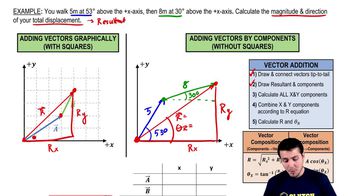
Vector Addition By Components