Ch. 07 - Work and Energy
Giancoli Douglas - Physics for Scientists and Engineers 5th edition
Giancoli Douglas5th editionPhysics for Scientists and EngineersISBN: 9780137488179당신이 사용하는 게 아니라요?교과서 변경
7장, 문제 64

A 3.5-kg object moving in two dimensions initially has a velocity v1\(\overrightarrow{v_1}\)_{} = (10.0 î + 20.0 ĵ) m/s. A net force F\(\overrightarrow{F}\) then acts on the object for 2.0 s, after which the object’s velocity is v2\(\overrightarrow{v_2}\)_{} = (15.0 î + 30.0 ĵ) m/s. Determine the work done by F\(\overrightarrow{F}\) on the object.

검증된 단계별 안내
1
Step 1: Start by calculating the initial kinetic energy (KE₁) of the object using the formula for kinetic energy: KE = (1/2)mv². Here, m = 3.5 kg and the initial velocity vector is v₁→ = (10.0 î + 20.0 ĵ) m/s. First, find the magnitude of v₁→ using the formula |v₁→| = √(v₁x² + v₁y²), where v₁x = 10.0 m/s and v₁y = 20.0 m/s.
Step 2: Similarly, calculate the final kinetic energy (KE₂) of the object using the same formula KE = (1/2)mv². The final velocity vector is v₂→ = (15.0 î + 30.0 ĵ) m/s. Find the magnitude of v₂→ using |v₂→| = √(v₂x² + v₂y²), where v₂x = 15.0 m/s and v₂y = 30.0 m/s.
Step 3: Determine the change in kinetic energy (ΔKE) of the object. The work-energy theorem states that the net work done on an object is equal to the change in its kinetic energy. Use the formula ΔKE = KE₂ - KE₁.
Step 4: Substitute the values of KE₁ and KE₂ into the formula ΔKE = KE₂ - KE₁ to find the work done by the net force F→ on the object. This value represents the total work done.
Step 5: Verify the units of your calculations to ensure consistency. The work done should be expressed in joules (J), as it is the standard unit of work in the SI system.

비슷한 문제에 대한 검증된 영상 답변:

이 영상 해법은 위 문제에 도움이 된다고 튜터들이 추천한 것입니다.
영상 길이:
6m
도움이 되었나요?

주요 개념

질문에 올바르게 답하기 위해 반드시 이해해야 하는 핵심 개념들은 다음과 같습니다.

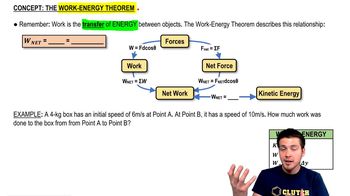
Work-Energy Principle

The Work-Energy Principle states that the work done on an object is equal to the change in its kinetic energy. This principle is fundamental in physics as it connects the forces acting on an object to its motion. In this scenario, the work done by the net force can be calculated by finding the difference in kinetic energy before and after the force acts on the object.
추천 영상:
가이드 코스
04:10
The Work-Energy Theorem

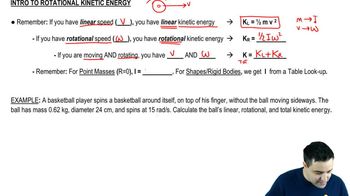
Kinetic Energy

Kinetic energy is the energy an object possesses due to its motion, calculated using the formula KE = 0.5 * m * v², where m is the mass and v is the velocity. In this problem, the initial and final velocities of the object are given, allowing us to compute the initial and final kinetic energies. The difference between these values will provide the work done by the net force.
추천 영상:
가이드 코스
06:07
Intro to Rotational Kinetic Energy

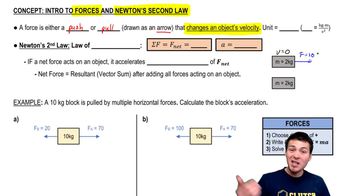
Newton's Second Law

Newton's Second Law states that the acceleration of an object is directly proportional to the net force acting on it and inversely proportional to its mass, expressed as F = m * a. This law is crucial for understanding how the net force affects the object's motion. In this case, while the question focuses on work, understanding the force's role in changing the object's velocity is essential for a complete analysis.
추천 영상:
가이드 코스
06:54
Intro to Forces & Newton's Second Law
관련 실천
교과서 질문

At room temperature, an oxygen molecule, with mass of 5.31 x 10⁻²⁶ kg, typically has a kinetic energy of about 6.21 x 10⁻²¹ J . How fast is it moving?

2119
views

교과서 질문

A 2800-kg space vehicle, initially at rest, falls vertically from a height of 2900 km above the Earth’s surface. Determine how much work is done by the force of gravity in bringing the vehicle to the Earth’s surface.

1683
views
교과서 질문

A 3.0-m-long steel chain is stretched out along the top level of a horizontal scaffold at a construction site, in such a way that 2.0 m of the chain remains on the top level and 1.0 m hangs vertically, Fig. 7–27. At this point, the force on the hanging segment is sufficient to pull the entire chain over the edge. Once the chain is moving, the kinetic friction is so small that it can be neglected. How much work is performed on the chain by the force of gravity as the chain falls from the point where 2.0 m remains on the scaffold to the point where the entire chain has left the scaffold? (Assume that the chain has a linear weight density of 24 N/m.)

1738
views
교과서 질문

A car traveling at a velocity v can stop in a minimum distance d. What would be the car’s minimum stopping distance if it were traveling at a velocity of 2v?

2120
views
교과서 질문

In the game of paintball, players use guns powered by pressurized gas to propel 33-g gel capsules filled with paint at the opposing team. Game rules dictate that a paintball cannot leave the barrel of a gun with a speed greater than 85 m/s. Model the shot by assuming the pressurized gas applies a constant force F to a 33-g capsule over the length of the 32-cm barrel. Determine F by using the work-energy principle.

1811
views
교과서 질문

The force required to compress an “imperfect” horizontal spring (doesn’t follow Hooke’s law) an amount x is given by F = 150x + 12x³, where x is in meters and F in newtons. If the spring is compressed 2.0 m, what speed will it give to a 3.0-kg ball held against it and then released?

1181
views