Ch. 07 - Work and Energy
Giancoli Douglas - Physics for Scientists and Engineers 5th edition
Giancoli Douglas5th editionPhysics for Scientists and EngineersISBN: 9780137488179당신이 사용하는 게 아니라요?교과서 변경
7장, 문제 52

A 2800-kg space vehicle, initially at rest, falls vertically from a height of 2900 km above the Earth’s surface. Determine how much work is done by the force of gravity in bringing the vehicle to the Earth’s surface.

검증된 단계별 안내
1
Determine the gravitational potential energy at the initial height (2900 km above the Earth's surface) using the formula: U=-GMmr, where G is the gravitational constant, M is the mass of the Earth, m is the mass of the space vehicle, and r is the distance from the center of the Earth to the vehicle (Earth's radius + 2900 km).
Calculate the gravitational potential energy at the Earth's surface using the same formula: U=-GMmr, where r is now the Earth's radius.
Find the work done by gravity by calculating the change in gravitational potential energy: W=Ui-Uf, where Ui is the initial potential energy and Uf is the final potential energy.
Substitute the known values for the gravitational constant G, Earth's mass M, Earth's radius, and the mass of the space vehicle into the equations to compute the initial and final potential energies.
Subtract the final potential energy from the initial potential energy to determine the total work done by gravity. Ensure that the units are consistent throughout the calculation (e.g., meters for distance, kilograms for mass).

비슷한 문제에 대한 검증된 영상 답변:

이 영상 해법은 위 문제에 도움이 된다고 튜터들이 추천한 것입니다.
영상 길이:
10m
도움이 되었나요?

주요 개념

질문에 올바르게 답하기 위해 반드시 이해해야 하는 핵심 개념들은 다음과 같습니다.

Work Done by Gravity

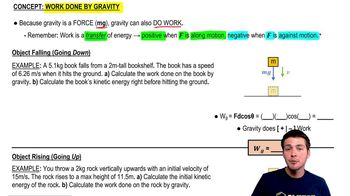
Work done by a force is defined as the product of the force and the distance over which it acts, in the direction of the force. In the case of gravity, the work done can be calculated using the formula W = F * d, where F is the gravitational force and d is the distance fallen. For an object falling under gravity, this work is equal to the change in gravitational potential energy.
추천 영상:
가이드 코스
06:34
Work Done By Gravity

Gravitational Potential Energy

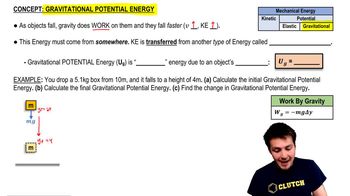
Gravitational potential energy (U) is the energy an object possesses due to its position in a gravitational field, calculated as U = m * g * h, where m is mass, g is the acceleration due to gravity, and h is the height above a reference point. As the vehicle falls, its potential energy decreases, and this energy is converted into kinetic energy and work done by gravity.
추천 영상:
가이드 코스
06:35
Gravitational Potential Energy

Acceleration Due to Gravity

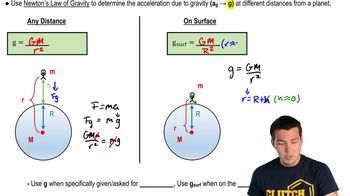
The acceleration due to gravity (g) is the rate at which an object accelerates towards the Earth when in free fall, approximately 9.81 m/s² near the Earth's surface. However, this value decreases with altitude. For large heights, such as 2900 km, the average gravitational acceleration must be considered, which can be calculated using the formula g = G * M / r², where G is the gravitational constant, M is the mass of the Earth, and r is the distance from the center of the Earth.
추천 영상:
가이드 코스
05:20
Acceleration Due to Gravity
관련 실천
교과서 질문

At room temperature, an oxygen molecule, with mass of 5.31 x 10⁻²⁶ kg, typically has a kinetic energy of about 6.21 x 10⁻²¹ J . How fast is it moving?

2119
views

교과서 질문

A 3.5-kg object moving in two dimensions initially has a velocity v1\(\overrightarrow{v_1}\)_{} = (10.0 î + 20.0 ĵ) m/s. A net force F\(\overrightarrow{F}\) then acts on the object for 2.0 s, after which the object’s velocity is v2\(\overrightarrow{v_2}\)_{} = (15.0 î + 30.0 ĵ) m/s. Determine the work done by F\(\overrightarrow{F}\) on the object.

2236
views
교과서 질문

Consider a force F₁ = A/xA/\(\sqrt{x}\) which acts on an object during its journey along the x axis from x = 0.0 to x = 1.0m, where A = 3.0 Nm¹⸍². Show that during this journey, even though F₁ is infinite at x = 0.0, the work W done on the object by this force is finite, and determine W.

1788
views
교과서 질문

A 3.0-m-long steel chain is stretched out along the top level of a horizontal scaffold at a construction site, in such a way that 2.0 m of the chain remains on the top level and 1.0 m hangs vertically, Fig. 7–27. At this point, the force on the hanging segment is sufficient to pull the entire chain over the edge. Once the chain is moving, the kinetic friction is so small that it can be neglected. How much work is performed on the chain by the force of gravity as the chain falls from the point where 2.0 m remains on the scaffold to the point where the entire chain has left the scaffold? (Assume that the chain has a linear weight density of 24 N/m.)

1738
views
교과서 질문

If the hill in Example 7–2 (Fig. 7–4) was not an even slope but rather an irregular curve as in Fig. 7–23, show that the same result would be obtained as in Example 7–2: namely, that the work done by gravity depends only on the height of the hill and not on its shape or the path taken.

1699
views
교과서 질문

The net force exerted on a particle acts in the positive x direction. Its magnitude increases linearly from zero at x = 0, to 380 N at x = 3.0m. It remains constant at 380 N from x = 3.0m to x = 7.0m, and then decreases linearly to zero at x = 12.0m. Determine the work done to move the particle from x = 0 to x = 12.0m graphically, by determining the area under the Fₓ versus x graph.

2197
views