Ch. 07 - Work and Energy
Giancoli Douglas - Physics for Scientists and Engineers 5th edition
Giancoli Douglas5th editionPhysics for Scientists and EngineersISBN: 9780137488179당신이 사용하는 게 아니라요?교과서 변경
7장, 문제 38

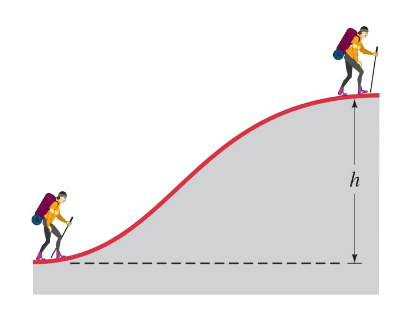
If the hill in Example 7–2 (Fig. 7–4) was not an even slope but rather an irregular curve as in Fig. 7–23, show that the same result would be obtained as in Example 7–2: namely, that the work done by gravity depends only on the height of the hill and not on its shape or the path taken.
Two hikers ascend an irregularly curved hill, with a height labeled 'h' indicating the vertical distance.

검증된 단계별 안내
1
Understand the concept: The work done by gravity is path-independent and depends only on the vertical displacement (height) of the object. This is because gravity is a conservative force, meaning the work done by gravity depends only on the initial and final positions, not the path taken.
Express the work done by gravity mathematically: The work done by gravity is given by \( W = F \cdot d \cdot \cos(\theta) \), where \( F \) is the gravitational force, \( d \) is the displacement, and \( \theta \) is the angle between the force and displacement vectors. For vertical motion, \( \cos(\theta) = 1 \).
Relate gravitational force to weight: The gravitational force \( F \) is equal to \( mg \), where \( m \) is the mass of the object and \( g \) is the acceleration due to gravity. Substituting \( F \) into the work formula gives \( W = mg \cdot h \), where \( h \) is the vertical height.
Explain why the path does not matter: Since the work done by gravity depends only on the change in height \( h \), the shape of the hill or the path taken does not affect the result. The work is determined solely by the difference in the initial and final vertical positions.
Conclude with the result: The work done by gravity is \( W = mg \cdot h \), which matches the result from Example 7–2. This demonstrates that the work done by gravity is independent of the irregular shape of the hill or the path taken.

비슷한 문제에 대한 검증된 영상 답변:

이 영상 해법은 위 문제에 도움이 된다고 튜터들이 추천한 것입니다.
영상 길이:
6m
도움이 되었나요?

주요 개념

질문에 올바르게 답하기 위해 반드시 이해해야 하는 핵심 개념들은 다음과 같습니다.

Work Done by Gravity

The work done by gravity on an object is defined as the force of gravity acting on the object multiplied by the distance it moves in the direction of the force. This work is independent of the path taken, as it only depends on the vertical displacement of the object. In the context of hills, this means that regardless of the shape of the hill, the work done by gravity is determined solely by the change in height.
추천 영상:
가이드 코스
06:34
Work Done By Gravity

Conservative Forces

Gravity is a conservative force, meaning that the work done by gravity on an object moving between two points is the same regardless of the path taken. This property implies that the energy associated with gravitational force can be fully recovered, and the work done depends only on the initial and final positions. This concept is crucial for understanding why the shape of the hill does not affect the work done by gravity.
추천 영상:
가이드 코스
06:43
Energy Conservation with Non-Conservative Forces

Potential Energy

Gravitational potential energy is the energy stored in an object due to its height above a reference point, typically the ground. It is calculated using the formula PE = mgh, where m is mass, g is the acceleration due to gravity, and h is height. The principle of conservation of energy states that the work done by gravity will convert potential energy into kinetic energy, reinforcing that the work done is dependent only on the height change, not the path taken.
추천 영상:
가이드 코스
07:24
Potential Energy Graphs
관련 실천
교과서 질문

A 2800-kg space vehicle, initially at rest, falls vertically from a height of 2900 km above the Earth’s surface. Determine how much work is done by the force of gravity in bringing the vehicle to the Earth’s surface.

1683
views

교과서 질문

Estimate the work you do to mow a lawn 10 m by 20 m with a 50-cm-wide mower. Assume you push with a horizontal force of about 15 N.

1756
views
1
rank
교과서 질문

In a certain library the first shelf is 15.0 cm off the ground, and the remaining four shelves are each spaced 38.0 cm above the previous one. If the average book has a mass of 1.25 kg with a height of 22.0 cm, and an average shelf holds 28 books (standing vertically), how much work is required to fill all the shelves, assuming the books are all laying flat on the floor to start?

1786
views
교과서 질문

A grocery cart with mass of 16 kg is pushed at constant speed up a 12° ramp by a force FP which acts at an angle of 17° below the horizontal. Find the work done by each of the forces (mg\(\overrightarrow{g}\), FN\(\overrightarrow{F_{N}\)}_{}, FN\(\overrightarrow{F_{N}\)}) on the cart if the ramp is 7.5 m long.

1486
views
교과서 질문

Consider a force F₁ = A/xA/\(\sqrt{x}\) which acts on an object during its journey along the x axis from x = 0.0 to x = 1.0m, where A = 3.0 Nm¹⸍². Show that during this journey, even though F₁ is infinite at x = 0.0, the work W done on the object by this force is finite, and determine W.

1788
views
교과서 질문

The net force exerted on a particle acts in the positive x direction. Its magnitude increases linearly from zero at x = 0, to 380 N at x = 3.0m. It remains constant at 380 N from x = 3.0m to x = 7.0m, and then decreases linearly to zero at x = 12.0m. Determine the work done to move the particle from x = 0 to x = 12.0m graphically, by determining the area under the Fₓ versus x graph.

2197
views