
Ch. 09 - Linear Momentum
9์žฅ, ๋ฌธ์ œ 85a

A 5.5-kg object moving in the +๐“ direction at 6.5 m/s collides head-on with an 8.0-kg object moving in the โ€•๐“ direction at 4.0 m/s. Determine the final velocity of each object if the objects stick together.

๊ฒ€์ฆ๋œ ๋‹จ๊ณ„๋ณ„ ์•ˆ๋‚ด
1
Step 1: Identify the type of collision. Since the objects stick together after the collision, this is an inelastic collision. In such cases, momentum is conserved, but kinetic energy is not.
Step 2: Write the equation for the conservation of momentum. The total momentum before the collision equals the total momentum after the collision. Mathematically, this is expressed as: m1v1i + m2v2i = (m1 + m2)vf, where m1 and m2 are the masses of the two objects, v1i and v2i are their initial velocities, and vf is their final velocity after sticking together.
Step 3: Substitute the given values into the momentum conservation equation. Use m1 = 5.5 kg, v1i = 6.5 m/s, m2 = 8.0 kg, and v2i = -4.0 m/s (negative because it is in the opposite direction). The equation becomes: (5.5)(6.5) + (8.0)(-4.0) = (5.5 + 8.0)vf.
Step 4: Simplify the left-hand side of the equation to calculate the total initial momentum. Then, divide by the combined mass (5.5 + 8.0) to solve for vf, the final velocity of the combined object.
Step 5: Interpret the result. The final velocity vf will indicate the direction and speed of the combined object after the collision. A positive value means it moves in the +๐“ direction, while a negative value means it moves in the โ€•๐“ direction.

๋น„์Šทํ•œ ๋ฌธ์ œ์— ๋Œ€ํ•œ ๊ฒ€์ฆ๋œ ์˜์ƒ ๋‹ต๋ณ€:

์ด ์˜์ƒ ํ•ด๋ฒ•์€ ์œ„ ๋ฌธ์ œ์— ๋„์›€์ด ๋œ๋‹ค๊ณ  ํŠœํ„ฐ๋“ค์ด ์ถ”์ฒœํ•œ ๊ฒƒ์ž…๋‹ˆ๋‹ค.
์˜์ƒ ๊ธธ์ด:
6m
๋„์›€์ด ๋˜์—ˆ๋‚˜์š”?

์ฃผ์š” ๊ฐœ๋…

์งˆ๋ฌธ์— ์˜ฌ๋ฐ”๋ฅด๊ฒŒ ๋‹ตํ•˜๊ธฐ ์œ„ํ•ด ๋ฐ˜๋“œ์‹œ ์ดํ•ดํ•ด์•ผ ํ•˜๋Š” ํ•ต์‹ฌ ๊ฐœ๋…๋“ค์€ ๋‹ค์Œ๊ณผ ๊ฐ™์Šต๋‹ˆ๋‹ค.

Conservation of Momentum

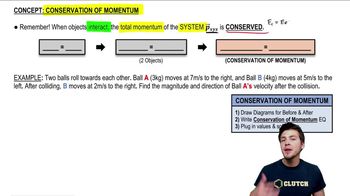
The principle of conservation of momentum states that the total momentum of a closed system remains constant if no external forces act on it. In collisions, the momentum before the collision equals the momentum after the collision. This principle is crucial for solving problems involving collisions, as it allows us to relate the velocities and masses of the colliding objects.
์ถ”์ฒœ ์˜์ƒ:

Elastic vs. Inelastic Collisions

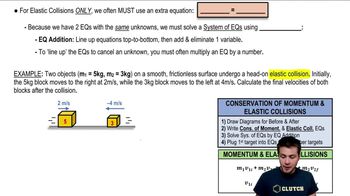
Collisions can be classified as elastic or inelastic. In elastic collisions, both momentum and kinetic energy are conserved, while in inelastic collisions, momentum is conserved but kinetic energy is not. The scenario described in the question involves an inelastic collision, where the two objects stick together after the collision, allowing us to use the conservation of momentum to find their final velocity.
์ถ”์ฒœ ์˜์ƒ:

Calculating Final Velocity

To find the final velocity of objects after a collision, we can use the formula derived from the conservation of momentum: (m1 * v1 + m2 * v2) = (m1 + m2) * v_final. Here, m1 and m2 are the masses of the objects, and v1 and v2 are their initial velocities. This equation allows us to solve for the final velocity when the objects stick together, combining their masses and initial momenta.
์ถ”์ฒœ ์˜์ƒ:
๊ฐ€์ด๋“œ ์ฝ”์Šค
05:53
Calculating Velocity Components
๊ด€๋ จ ์‹ค์ฒœ
๊ต๊ณผ์„œ ์งˆ๋ฌธ

A gun fires a bullet vertically into a 1.40-kg block of wood at rest on a thin horizontal sheet, Fig. 9โ€“54. If the bullet has a mass of 15.0 g and a speed of 230 m/s, how high will the block rise into the air after the bullet becomes embedded in it?

1646
views
๊ต๊ณผ์„œ ์งˆ๋ฌธ

A 0.145-kg baseball pitched horizontally at 35.0 m/s strikes a bat and pops straight up to a height of 31.5 m. If the contact time between bat and ball is 2.5 ms, calculate the average force between the ball and bat during contact.

1960
views
๊ต๊ณผ์„œ ์งˆ๋ฌธ

A rocket traveling 1950 m/s away from the Earth at an altitude of 6400 km fires its rockets, which eject gas at a speed of 1200 m/s (relative to the rocket). If the mass of the rocket at this moment is 25,000 kg and an acceleration of 1.5 m/sยฒ is desired, at what rate must the gases be ejected?

130
views
๊ต๊ณผ์„œ ์งˆ๋ฌธ

A rifle is aimed at a 2.0-kg block of wood along an inclined plane making an angle of 25ยฐ, as shown in Fig. 9โ€“59. A 9.5-g bullet is fired at 760 m/s and becomes embedded in the block. How far up the incline does the block/bullet slide?

(a) Ignore the friction.

(b) Assume ฮผโ‚– = 0.33.

82
views
๊ต๊ณผ์„œ ์งˆ๋ฌธ

A 5.5-kg object moving in the +๐“ direction at 6.5 m/s collides head-on with an 8.0-kg object moving in the โ€•๐“ direction at 4.0 m/s. Determine the final velocity of each object if the 5.5-kg object is at rest after the collision.

1172
views
๊ต๊ณผ์„œ ์งˆ๋ฌธ

A 5.5-kg object moving in the +๐“ direction at 6.5 m/s collides head-on with an 8.0-kg object moving in the โ€•๐“ direction at 4.0 m/s. Determine the final velocity of each object if the collision is elastic.

1284
views