Ch. 09 - Linear Momentum
Giancoli Douglas - Physics for Scientists and Engineers 5th edition
Giancoli Douglas5th editionPhysics for Scientists and EngineersISBN: 9780137488179당신이 사용하는 게 아니라요?교과서 변경
9장, 문제 80

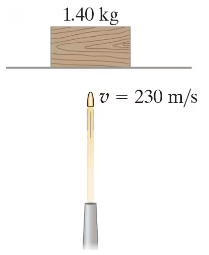
A gun fires a bullet vertically into a 1.40-kg block of wood at rest on a thin horizontal sheet, Fig. 9–54. If the bullet has a mass of 15.0 g and a speed of 230 m/s, how high will the block rise into the air after the bullet becomes embedded in it?
Illustration showing a 1.40 kg block of wood at rest above a gun firing a bullet at 230 m/s vertically.

검증된 단계별 안내
1
Convert the mass of the bullet from grams to kilograms. Since 1 g = 0.001 kg, the mass of the bullet is \( m_b = 15.0 \times 10^{-3} \, \text{kg} \).
Apply the principle of conservation of momentum to find the velocity of the block and bullet system immediately after the collision. The total momentum before the collision is \( p_{\text{initial}} = m_b v_b \), where \( v_b = 230 \, \text{m/s} \) is the velocity of the bullet. After the collision, the momentum is \( p_{\text{final}} = (m_b + m_w) v_f \), where \( m_w = 1.40 \, \text{kg} \) is the mass of the block and \( v_f \) is the final velocity of the combined system. Set \( p_{\text{initial}} = p_{\text{final}} \) and solve for \( v_f \).
Use the final velocity \( v_f \) of the block and bullet system as the initial velocity for vertical motion. Apply the conservation of energy principle to determine the maximum height \( h \) the system will reach. The initial kinetic energy \( KE = \frac{1}{2} (m_b + m_w) v_f^2 \) is converted entirely into gravitational potential energy \( PE = (m_b + m_w) g h \), where \( g = 9.8 \, \text{m/s}^2 \) is the acceleration due to gravity. Set \( KE = PE \) and solve for \( h \).
Substitute the known values for \( m_b \), \( m_w \), \( g \), and \( v_f \) into the equation derived in the previous step to calculate \( h \).
Verify the units in your calculations to ensure consistency (e.g., mass in kilograms, velocity in meters per second, and height in meters). This step ensures the solution is dimensionally correct.

비슷한 문제에 대한 검증된 영상 답변:

이 영상 해법은 위 문제에 도움이 된다고 튜터들이 추천한 것입니다.
영상 길이:
7m
도움이 되었나요?

주요 개념

질문에 올바르게 답하기 위해 반드시 이해해야 하는 핵심 개념들은 다음과 같습니다.

Conservation of Momentum

The principle of conservation of momentum states that in a closed system, the total momentum before an event must equal the total momentum after the event. In this scenario, when the bullet embeds itself in the block, we can apply this principle to find the combined velocity of the block and bullet immediately after the collision.
추천 영상:
가이드 코스
05:58
Conservation Of Momentum

Kinetic Energy and Potential Energy

Kinetic energy is the energy of an object due to its motion, while potential energy is the energy stored in an object due to its position in a gravitational field. After the bullet embeds in the block, the kinetic energy of the block-bullet system will convert into potential energy as it rises, allowing us to calculate the maximum height reached using energy conservation principles.
추천 영상:
가이드 코스
06:35
Gravitational Potential Energy

Gravitational Potential Energy

Gravitational potential energy is the energy an object possesses due to its height above the ground, calculated as PE = mgh, where m is mass, g is the acceleration due to gravity, and h is height. This concept is crucial for determining how high the block will rise after the bullet embeds in it, as the potential energy at the peak will equal the kinetic energy just after the collision.
추천 영상:
가이드 코스
06:35
Gravitational Potential Energy
관련 실천
교과서 질문

A 0.145-kg baseball pitched horizontally at 35.0 m/s strikes a bat and pops straight up to a height of 31.5 m. If the contact time between bat and ball is 2.5 ms, calculate the average force between the ball and bat during contact.

1960
views

교과서 질문

A rocket traveling 1950 m/s away from the Earth at an altitude of 6400 km fires its rockets, which eject gas at a speed of 1200 m/s (relative to the rocket). If the mass of the rocket at this moment is 25,000 kg and an acceleration of 1.5 m/s² is desired, at what rate must the gases be ejected?

130
views
교과서 질문

A 5.5-kg object moving in the +𝓍 direction at 6.5 m/s collides head-on with an 8.0-kg object moving in the ―𝓍 direction at 4.0 m/s. Determine the final velocity of each object if the 5.5-kg object is at rest after the collision.

1172
views
교과서 질문

A 5.5-kg object moving in the +𝓍 direction at 6.5 m/s collides head-on with an 8.0-kg object moving in the ―𝓍 direction at 4.0 m/s. Determine the final velocity of each object if the collision is elastic.

1284
views
교과서 질문

A 5.5-kg object moving in the +𝓍 direction at 6.5 m/s collides head-on with an 8.0-kg object moving in the ―𝓍 direction at 4.0 m/s. Determine the final velocity of each object if the objects stick together.

1395
views
교과서 질문

A huge balloon and its gondola, of mass M, are in the air and stationary with respect to the ground. A passenger, of mass m, then climbs out and slides down a rope with speed v, measured with respect to the balloon. With what speed and direction (relative to Earth) does the balloon then move? What happens if the passenger stops?

1592
views