Ch. 09 - Linear Momentum
Giancoli Douglas - Physics for Scientists and Engineers 5th edition
Giancoli Douglas5th editionPhysics for Scientists and EngineersISBN: 9780137488179당신이 사용하는 게 아니라요?교과서 변경
9장, 문제 15

A mass mₐ = 2.0 kg, moving with velocity va\(\overrightarrow{v_{a}\)} = (4.0 î + 5.0 ĵ ― 2.0 k̂) m/s, collides with mass m₈ = 3.0 kg, which is initially at rest. Immediately after the collision, mass mₐ is observed traveling at velocity va\(\overrightarrow{v_{a}\)^{\(\prime\)}} = (― 2.0 î + 3.0 k̂) m/s. Find the velocity of mass m₈ after the collision. Assume no outside force acts on the two masses during the collision.

검증된 단계별 안내
1
Step 1: Understand the principle of conservation of momentum. In the absence of external forces, the total momentum of a system before and after a collision remains constant. Mathematically, this is expressed as: mv + mv = mv'ₐ + mv'₈, where v is the initial velocity of mass m (which is zero in this case), and v'₈ is the velocity of mass m after the collision.
Step 2: Write the momentum conservation equation for each component (x, y, and z) separately. Since momentum is a vector quantity, we must conserve momentum in all three directions. For the x-component: mvₐₓ = mv'ₐₓ + mv'₈ₓ. For the y-component: mvₐᵧ = mv'ₐᵧ + mv'₈ᵧ. For the z-component: mvₐz = mv'ₐz + mv'₈z.
Step 3: Substitute the given values into the equations. For the x-component: 2.0(4.0) = 2.0(-2.0) + 3.0v'₈ₓ. For the y-component: 2.0(5.0) = 2.0(0) + 3.0v'₈ᵧ. For the z-component: 2.0(-2.0) = 2.0(3.0) + 3.0v'₈z.
Step 4: Solve each equation for the components of v'₈. For the x-component, isolate v'₈ₓ: v'₈ₓ = (expression after simplification). Repeat for the y- and z-components.
Step 5: Combine the components to express the final velocity of mass m as a vector: v'₈ = v'₈ₓî + v'₈ᵧĵ + v'₈z. Substitute the calculated values for v'₈ₓ, v'₈ᵧ, and v'₈z.

비슷한 문제에 대한 검증된 영상 답변:

이 영상 해법은 위 문제에 도움이 된다고 튜터들이 추천한 것입니다.
영상 길이:
8m
도움이 되었나요?

주요 개념

질문에 올바르게 답하기 위해 반드시 이해해야 하는 핵심 개념들은 다음과 같습니다.

Conservation of Momentum

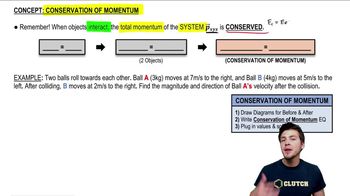
The principle of conservation of momentum states that in a closed system with no external forces, the total momentum before a collision is equal to the total momentum after the collision. Momentum is a vector quantity, calculated as the product of mass and velocity. In this scenario, the momentum of both masses before and after the collision must be equated to find the unknown velocity of mass m₈.
추천 영상:
가이드 코스
05:58
Conservation Of Momentum

Vector Addition

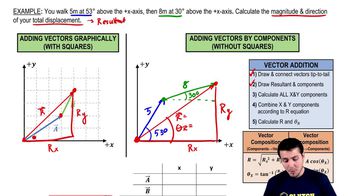
Vector addition is the process of combining two or more vectors to determine a resultant vector. In this problem, the velocities of the masses are represented as vectors, and their components must be added separately in the x, y, and z directions. Understanding how to manipulate these vectors is crucial for accurately calculating the final velocity of mass m₈ after the collision.
추천 영상:
가이드 코스
07:30
Vector Addition By Components

Elastic vs. Inelastic Collisions

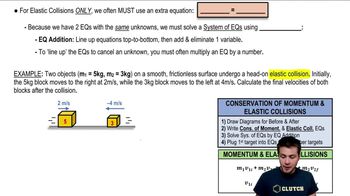
Collisions can be classified as elastic or inelastic based on whether kinetic energy is conserved. In this case, since the problem does not specify that kinetic energy is conserved, it is likely an inelastic collision, where the two masses may stick together or simply exchange momentum. Recognizing the type of collision helps in applying the correct principles to solve for the unknowns in the problem.
추천 영상:
가이드 코스
08:56
Intro To Elastic Collisions