Ch. 09 - Linear Momentum
Giancoli Douglas - Physics for Scientists and Engineers 5th edition
Giancoli Douglas5th editionPhysics for Scientists and EngineersISBN: 9780137488179당신이 사용하는 게 아니라요?교과서 변경
9장, 문제 2

A 7150-kg railroad car travels alone on a level frictionless track with a constant speed of 15.0 m/s. A 3650-kg load, initially at rest, is dropped onto the car. What will be the car’s new speed?

검증된 단계별 안내
1
Identify the principle to use: This is a conservation of momentum problem because no external forces act on the system (the railroad car and the load). The total momentum before the load is dropped must equal the total momentum after the load is dropped.
Write the equation for conservation of momentum: \( m_1 v_1 + m_2 v_2 = (m_1 + m_2) v_f \), where \( m_1 \) and \( v_1 \) are the mass and velocity of the railroad car, \( m_2 \) and \( v_2 \) are the mass and velocity of the load, and \( v_f \) is the final velocity of the combined system.
Substitute the known values into the equation: \( (7150 \ \text{kg})(15.0 \ \text{m/s}) + (3650 \ \text{kg})(0 \ \text{m/s}) = (7150 \ \text{kg} + 3650 \ \text{kg}) v_f \).
Simplify the equation: Calculate the total momentum on the left-hand side and the total mass on the right-hand side. This will leave you with an equation in terms of \( v_f \).
Solve for \( v_f \): Divide the total momentum by the total mass to find the final velocity of the railroad car and load system.

비슷한 문제에 대한 검증된 영상 답변:

이 영상 해법은 위 문제에 도움이 된다고 튜터들이 추천한 것입니다.
영상 길이:
4m

주요 개념

질문에 올바르게 답하기 위해 반드시 이해해야 하는 핵심 개념들은 다음과 같습니다.

Conservation of Momentum

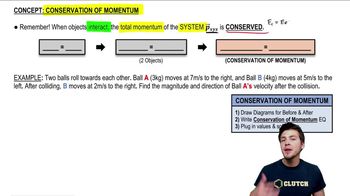
The principle of conservation of momentum states that in a closed system, the total momentum before an event must equal the total momentum after the event, provided no external forces act on it. In this scenario, the momentum of the railroad car before the load is dropped must equal the combined momentum of the car and the load after the load is added.
추천 영상:
가이드 코스
05:58
Conservation Of Momentum

Momentum Calculation

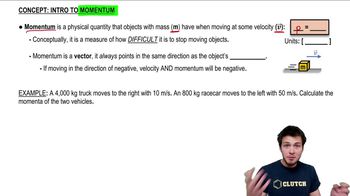
Momentum is calculated as the product of an object's mass and its velocity (p = mv). For the railroad car and the load, we will calculate the initial momentum of the car and then set it equal to the final momentum of the car plus the load to find the new speed after the load is dropped.
추천 영상:
가이드 코스
05:17
Intro to Momentum

Inelastic Collision

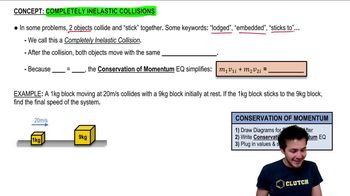
An inelastic collision occurs when two objects collide and stick together, resulting in a loss of kinetic energy but conservation of momentum. In this problem, the dropping of the load onto the car can be treated as an inelastic collision, where the car and load move together after the load is added, affecting the final speed.
추천 영상:
가이드 코스
04:18
Completely Inelastic Collisions