
Ch. 09 - Linear Momentum
Giancoli Douglas - Physics for Scientists and Engineers 5th edition
Giancoli Douglas5th editionPhysics for Scientists and EngineersISBN: 9780137488179당신이 사용하는 게 아니라요?교과서 변경
9장, 문제 103a

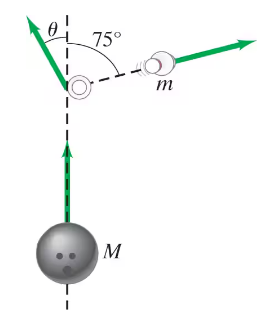
In order to convert a tough split in bowling, it is necessary to strike the pin a glancing blow as shown in Fig. 9–64. Assume that the bowling ball, traveling at 14.0 m/s just before it strikes the pin, has five times the mass of a pin and that the pin goes off at 75° from the original direction of the ball. Calculate the speed of the pin and (b) of the ball just after collision.
Bowling ball colliding with a pin, showing angles and directions of motion after impact.

검증된 단계별 안내
1
Identify the type of collision: This is a two-dimensional elastic collision, as the bowling ball and pin move in different directions after the collision. Both momentum and kinetic energy are conserved.
Set up the conservation of momentum equations: Momentum is conserved in both the x-direction (original direction of the ball) and the y-direction (perpendicular to the original direction). Let the mass of the pin be m and the mass of the ball be 5m. Let the final velocity of the pin be v_p and the final velocity of the ball be v_b. The equations are: mv=mv

비슷한 문제에 대한 검증된 영상 답변:

이 영상 해법은 위 문제에 도움이 된다고 튜터들이 추천한 것입니다.
영상 길이:
12m
도움이 되었나요?

주요 개념

질문에 올바르게 답하기 위해 반드시 이해해야 하는 핵심 개념들은 다음과 같습니다.

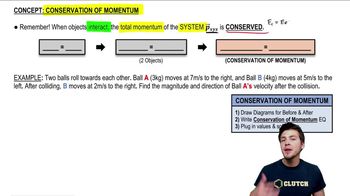
Conservation of Momentum

The principle of conservation of momentum states that in a closed system, the total momentum before an event must equal the total momentum after the event, provided no external forces act on it. In this bowling scenario, the momentum of the bowling ball and the pin must be analyzed before and after the collision to determine their respective speeds.
추천 영상:
가이드 코스
05:58
Conservation Of Momentum

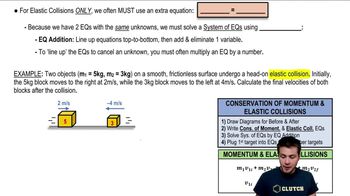
Elastic and Inelastic Collisions

Collisions can be classified as elastic or inelastic based on whether kinetic energy is conserved. In this case, the collision between the bowling ball and the pin is inelastic, meaning that while momentum is conserved, kinetic energy is not. This affects how we calculate the final velocities of the objects involved.
추천 영상:
가이드 코스
08:56
Intro To Elastic Collisions

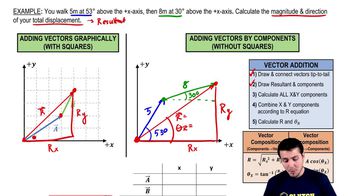
Vector Components

When analyzing collisions, it is essential to break down velocities into their vector components, typically along the x (horizontal) and y (vertical) axes. This allows for the application of conservation laws in each direction separately, facilitating the calculation of the final speeds and directions of the bowling ball and pin after the collision.
추천 영상:
가이드 코스
07:30
Vector Addition By Components