Ch. 10 - Rotational Motion
Giancoli Douglas - Physics for Scientists and Engineers 5th edition
Giancoli Douglas5th editionPhysics for Scientists and EngineersISBN: 9780137488179당신이 사용하는 게 아니라요?교과서 변경
10장, 문제 26b

The angular acceleration of a wheel, as a function of time, is α = 4.2 t² ― 9.0 t , where α is in rad/s² and t in seconds. If the wheel starts from rest (θ = 0 , ω = 0, at t = 0), determine a formula for the angular position θ, both as a function of time.

검증된 단계별 안내
1
Start by recalling the relationship between angular acceleration (α), angular velocity (ω), and angular position (θ). Angular acceleration is the derivative of angular velocity with respect to time, and angular velocity is the derivative of angular position with respect to time. Mathematically: α = dω/dt and ω = dθ/dt.
Integrate the given angular acceleration function α = 4.2t² - 9.0t with respect to time to find the angular velocity ω(t). Use the initial condition ω(0) = 0 to determine the constant of integration.
After finding ω(t), integrate it with respect to time to find the angular position θ(t). Use the initial condition θ(0) = 0 to determine the constant of integration.
Write the final expression for θ(t) after performing the integrations and applying the initial conditions. Ensure that the units are consistent throughout the process.
Verify the derived formula for θ(t) by checking its consistency with the given initial conditions (θ = 0 and ω = 0 at t = 0) and the relationship between α, ω, and θ.

비슷한 문제에 대한 검증된 영상 답변:

이 영상 해법은 위 문제에 도움이 된다고 튜터들이 추천한 것입니다.
영상 길이:
9m
도움이 되었나요?

주요 개념

질문에 올바르게 답하기 위해 반드시 이해해야 하는 핵심 개념들은 다음과 같습니다.

Angular Acceleration

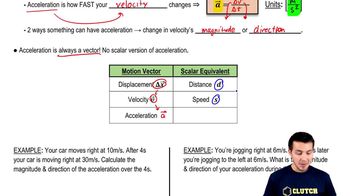
Angular acceleration (α) is the rate of change of angular velocity over time. It is measured in radians per second squared (rad/s²). In this problem, the angular acceleration is given as a function of time, indicating how it varies as the wheel spins. Understanding this concept is crucial for determining how the wheel's motion evolves over time.
추천 영상:
가이드 코스
05:47
Intro to Acceleration

Kinematics of Rotational Motion

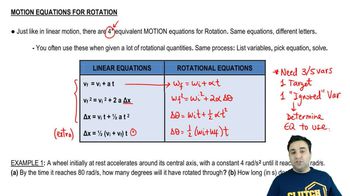
The kinematics of rotational motion describes the relationships between angular displacement, angular velocity, and angular acceleration. Similar to linear motion, these quantities are related through equations of motion. For a wheel starting from rest, the angular position can be derived by integrating the angular velocity, which itself is obtained by integrating the angular acceleration over time.
추천 영상:
가이드 코스
07:18
Equations of Rotational Motion

Integration in Physics

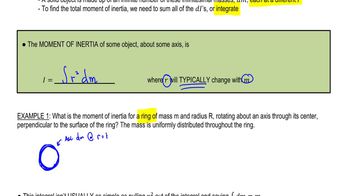
Integration is a mathematical process used to find the total accumulation of a quantity. In the context of this problem, integrating the angular acceleration function will yield the angular velocity function, and further integration will provide the angular position function. This process is essential for transitioning from acceleration to velocity and then to position in rotational dynamics.
추천 영상:
가이드 코스
11:43
Finding Moment Of Inertia By Integrating
관련 실천
교과서 질문

The bolts on the cylinder head of an engine require tightening to a torque of 95 m-N. If the six-sided bolt head is 15 mm across (Fig. 10–55), estimate the force applied near each of the six points by a wrench.

1146
views

교과서 질문

Determine the net torque on the 2.0-m-long uniform beam shown in Fig. 10–56. All forces are shown. Calculate about point P at one end.

1756
views
교과서 질문

The axle of a wheel is mounted on supports that rest on a rotating turntable as shown in Fig. 10–52. The wheel has angular velocity ω₁ = 48.0 rad/s about its axle, and the turntable has angular velocity ω₂ = 35.0 rad/s about a vertical axis. (Note arrows showing these motions in the figure? What is the resultant angular velocity of the wheel, as seen by an outside observer, at the instant shown? Give the magnitude and direction.

1204
views
교과서 질문

The forearm in Fig. 10–57 accelerates a 3.6-kg ball at 7.0 m/s² by means of the triceps muscle, as shown. Calculate the torque needed.

1640
views
교과서 질문

Pilots can be tested for the stresses of flying high-speed jets in a whirling “human centrifuge,” which takes 1.0 min to turn through 26 complete revolutions before reaching its final speed. What was its final angular speed in rpm?

1498
views
교과서 질문

The axle of a wheel is mounted on supports that rest on a rotating turntable as shown in Fig. 10–52. The wheel has angular velocity ω₁ = 48.0 rad/s about its axle, and the turntable has angular velocity ω₂ = 35.0 rad/s about a vertical axis. (Note arrows showing these motions in the figure.) What is the magnitude and direction of the angular acceleration of the wheel at the instant shown? Take the 𝒵 axis vertically upward and the direction of the axle at the moment shown to be the 𝓍 axis pointing to the right.

1276
views