Ch. 10 - Rotational Motion
Giancoli Douglas - Physics for Scientists and Engineers 5th edition
Giancoli Douglas5th editionPhysics for Scientists and EngineersISBN: 9780137488179당신이 사용하는 게 아니라요?교과서 변경
10장, 문제 18b

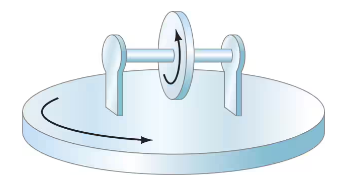
The axle of a wheel is mounted on supports that rest on a rotating turntable as shown in Fig. 10–52. The wheel has angular velocity ω₁ = 48.0 rad/s about its axle, and the turntable has angular velocity ω₂ = 35.0 rad/s about a vertical axis. (Note arrows showing these motions in the figure? What is the resultant angular velocity of the wheel, as seen by an outside observer, at the instant shown? Give the magnitude and direction.

검증된 단계별 안내
1
Understand the problem: The wheel has two angular velocities. One is due to its rotation about its own axle (ω₁ = 48.0 rad/s), and the other is due to the turntable's rotation about a vertical axis (ω₂ = 35.0 rad/s). We need to find the resultant angular velocity vector, which combines these two angular velocities.
Represent the angular velocities as vectors: The angular velocity of the wheel about its axle (ω₁) is along the axle of the wheel. The angular velocity of the turntable (ω₂) is along the vertical axis. Assume a coordinate system where the vertical axis is the z-axis, and the axle of the wheel lies in the x-y plane.
Decompose the vectors: Express ω₁ and ω₂ in terms of their components. If the axle of the wheel makes an angle θ with the horizontal (x-y plane), then ω₁ can be decomposed into components: ω₁x = ω₁ * cos(θ) and ω₁y = ω₁ * sin(θ). The turntable's angular velocity ω₂ is purely along the z-axis, so ω₂z = ω₂.
Combine the components: Add the components of ω₁ and ω₂ to find the resultant angular velocity vector. The resultant vector ω_res has components: ω_res_x = ω₁x, ω_res_y = ω₁y, and ω_res_z = ω₂z. Mathematically, ω_res = (ω₁ * cos(θ)) î + (ω₁ * sin(θ)) ĵ + (ω₂) k̂.
Find the magnitude and direction: The magnitude of the resultant angular velocity is given by |ω_res| = √((ω_res_x)^2 + (ω_res_y)^2 + (ω_res_z)^2). The direction can be described by the angles the vector makes with the coordinate axes, which can be calculated using trigonometric relationships (e.g., tan⁻¹(ω_res_y / ω_res_x) for the angle in the x-y plane).

비슷한 문제에 대한 검증된 영상 답변:

이 영상 해법은 위 문제에 도움이 된다고 튜터들이 추천한 것입니다.
영상 길이:
5m
도움이 되었나요?

주요 개념

질문에 올바르게 답하기 위해 반드시 이해해야 하는 핵심 개념들은 다음과 같습니다.

Angular Velocity

Angular velocity is a vector quantity that represents the rate of rotation of an object around an axis. It is measured in radians per second (rad/s) and indicates both the speed of rotation and the direction of the axis of rotation. In this problem, the wheel has its own angular velocity (ω₁) about its axle, while the turntable has a separate angular velocity (ω₂) about a vertical axis.
추천 영상:
가이드 코스
06:18
Intro to Angular Momentum

Resultant Angular Velocity

The resultant angular velocity is the combined effect of multiple angular velocities acting on an object. To find it, vector addition is used, taking into account both the magnitudes and directions of the individual angular velocities. In this scenario, the resultant angular velocity of the wheel must consider both its rotation about its axle and the rotation of the turntable.
추천 영상:
가이드 코스
12:12
Conservation of Angular Momentum

Vector Addition

Vector addition is a mathematical operation used to combine two or more vectors to determine a resultant vector. This involves adding the components of the vectors in each direction. In the context of angular velocities, it is essential to decompose the angular velocities into their respective components and then sum them to find the overall angular velocity as perceived by an outside observer.
추천 영상:
가이드 코스
07:30
Vector Addition By Components
관련 실천
교과서 질문

How fast (in rpm) must a centrifuge rotate if a particle 8.0 cm from the axis of rotation is to experience an acceleration of 100,000 g’s?

1321
views

교과서 질문

The axle of a wheel is mounted on supports that rest on a rotating turntable as shown in Fig. 10–52. The wheel has angular velocity ω₁ = 48.0 rad/s about its axle, and the turntable has angular velocity ω₂ = 35.0 rad/s about a vertical axis. (Note arrows showing these motions in the figure.) What are the directions of ω1\(\overrightarrow{\omega_1}\) and ω2\(\overrightarrow{\omega_2}\) at the instant shown?

1332
views
교과서 질문

A turntable of radius R₁ is turned by a circular rubber roller of radius R₂ in contact with it at their outer edges. What is the ratio of their angular velocities, ω₁/ω₂?

1439
views
교과서 질문

The angular acceleration of a wheel, as a function of time, is α = 4.2 t² ― 9.0 t , where α is in rad/s² and t in seconds. If the wheel starts from rest (θ = 0 , ω = 0, at t = 0), determine a formula for the angular position θ, both as a function of time.

1478
views
교과서 질문

Pilots can be tested for the stresses of flying high-speed jets in a whirling “human centrifuge,” which takes 1.0 min to turn through 26 complete revolutions before reaching its final speed. What was its final angular speed in rpm?

1498
views
교과서 질문

The axle of a wheel is mounted on supports that rest on a rotating turntable as shown in Fig. 10–52. The wheel has angular velocity ω₁ = 48.0 rad/s about its axle, and the turntable has angular velocity ω₂ = 35.0 rad/s about a vertical axis. (Note arrows showing these motions in the figure.) What is the magnitude and direction of the angular acceleration of the wheel at the instant shown? Take the 𝒵 axis vertically upward and the direction of the axle at the moment shown to be the 𝓍 axis pointing to the right.

1276
views