Ch. 11 - Angular Momentum; General Rotation
Giancoli Douglas - Physics for Scientists and Engineers 5th edition
Giancoli Douglas5th editionPhysics for Scientists and EngineersISBN: 9780137488179당신이 사용하는 게 아니라요?교과서 변경
11장, 문제 36a

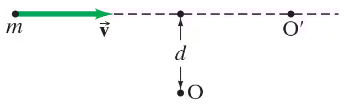
Calculate the angular momentum of a particle of mass m moving with constant velocity υ for two cases (see Fig. 11–34): about origin O.
Diagram illustrating a point mass m moving with velocity v, with distances d to points O and O'.

검증된 단계별 안내
1
Understand the concept of angular momentum: Angular momentum (L) is a vector quantity defined as the cross product of the position vector (r) and the linear momentum (p) of the particle. Mathematically, it is expressed as: L=r×p, where p=mυ (mass times velocity).
Identify the position vector (r): The position vector r is the vector from the origin (O) to the particle's location. In this case, the problem does not specify the exact coordinates, so we will represent it as r=(x,y,z).
Express the linear momentum: The linear momentum p is given by p=mυ, where υ is the velocity vector of the particle. Represent the velocity vector as υ=(υ_x,υ_y,υ_z).
Set up the cross product: The angular momentum is calculated as the cross product of r and p. Using the determinant method, the cross product can be written as: L=|||i j k||||||x y z||||||mυ_x mυ_y mυ_z|||.
Simplify the determinant: Expand the determinant to compute the components of the angular momentum vector. The result will be a vector L=(L_x,L_y,L_z), where each component is determined by the cross product formula. This gives the angular momentum about the origin O.

비슷한 문제에 대한 검증된 영상 답변:

이 영상 해법은 위 문제에 도움이 된다고 튜터들이 추천한 것입니다.
영상 길이:
5m
도움이 되었나요?

주요 개념

질문에 올바르게 답하기 위해 반드시 이해해야 하는 핵심 개념들은 다음과 같습니다.

Angular Momentum

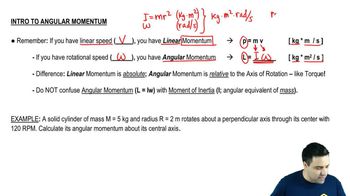
Angular momentum is a vector quantity that represents the rotational motion of an object. It is defined as the product of the object's moment of inertia and its angular velocity. For a particle, angular momentum (L) can be calculated using the formula L = r × p, where r is the position vector from the point of rotation to the particle, and p is the linear momentum of the particle (p = mv).
추천 영상:
06:18
Intro to Angular Momentum

Position Vector

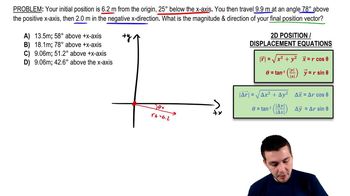
The position vector is a vector that describes the location of a point in space relative to a reference point, often the origin. In the context of angular momentum, the position vector (r) is crucial as it determines the distance and direction from the point of rotation to the particle. The magnitude and direction of this vector directly influence the calculated angular momentum.
추천 영상:
07:07
Final Position Vector

Conservation of Angular Momentum

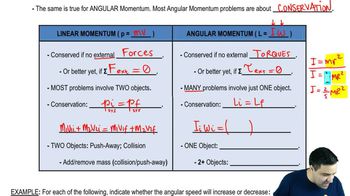
The conservation of angular momentum states that if no external torque acts on a system, the total angular momentum of that system remains constant. This principle is fundamental in analyzing rotational motion and can be applied to various scenarios, including particles moving in circular paths. Understanding this concept helps in predicting the behavior of systems when forces are applied.
추천 영상:
12:12
Conservation of Angular Momentum