Ch. 11 - Angular Momentum; General Rotation
Giancoli Douglas - Physics for Scientists and Engineers 5th edition
Giancoli Douglas5th editionPhysics for Scientists and EngineersISBN: 9780137488179당신이 사용하는 게 아니라요?교과서 변경
11장, 문제 30

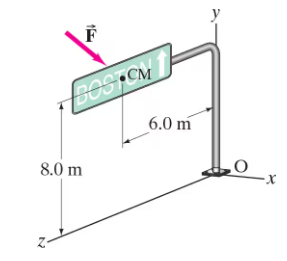
An engineer estimates that under the most adverse expected weather conditions, the total force on the highway sign in Fig. 11–33 will be F\(\overrightarrow{F}\) = (± 2.4 î - 4.1 ĵ) kN, acting at the cm. What torque does this force exert about the base O?
Diagram of a highway sign labeled "BOSTON" with force vector acting on it, showing dimensions and coordinate axes.

검증된 단계별 안내
1
Identify the given quantities: The force vector is \( \mathbf{F} = (\pm 2.4 \mathbf{i} - 4.1 \mathbf{j}) \ \text{kN} \), and the position vector from the base \( O \) to the center of mass (cm) of the sign is \( \mathbf{r} \). The exact position vector \( \mathbf{r} \) should be determined from the diagram in Fig. 11–33.
Recall the formula for torque: \( \mathbf{\tau} = \mathbf{r} \times \mathbf{F} \), where \( \mathbf{\tau} \) is the torque, \( \mathbf{r} \) is the position vector, and \( \mathbf{F} \) is the force vector. The cross product \( \mathbf{r} \times \mathbf{F} \) gives the torque vector.
Express the position vector \( \mathbf{r} \) in component form based on the diagram. For example, if the center of mass is located at \( (x, y) \) relative to the base \( O \), then \( \mathbf{r} = x \mathbf{i} + y \mathbf{j} \).
Set up the cross product \( \mathbf{\tau} = \mathbf{r} \times \mathbf{F} \). Using the determinant method for cross products, \( \mathbf{\tau} = \begin{vmatrix} \mathbf{i} & \mathbf{j} & \mathbf{k} \\ x & y & 0 \\ \pm 2.4 & -4.1 & 0 \end{vmatrix} \). Expand this determinant to find the components of the torque vector.
Simplify the determinant to calculate the torque vector \( \mathbf{\tau} \). The result will be in the form \( \mathbf{\tau} = \tau_z \mathbf{k} \), where \( \tau_z \) is the magnitude of the torque about the \( z \)-axis. Ensure the units are consistent (e.g., \( \text{kN} \cdot \text{m} \)).

비슷한 문제에 대한 검증된 영상 답변:

이 영상 해법은 위 문제에 도움이 된다고 튜터들이 추천한 것입니다.
영상 길이:
8m
도움이 되었나요?

주요 개념

질문에 올바르게 답하기 위해 반드시 이해해야 하는 핵심 개념들은 다음과 같습니다.

Torque

Torque is a measure of the rotational force applied to an object around a pivot point. It is calculated as the cross product of the position vector (from the pivot to the point of force application) and the force vector. The direction of torque is determined by the right-hand rule, and its unit is typically Newton-meters (Nm). Understanding torque is essential for analyzing how forces cause objects to rotate.
추천 영상:
가이드 코스
08:55
Net Torque & Sign of Torque

Vector Components

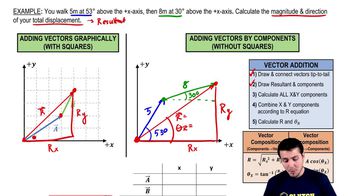
Vector components break down a vector into its individual parts along specified axes, typically the x and y axes in two-dimensional problems. For example, a force vector can be expressed in terms of its horizontal (i) and vertical (j) components. This decomposition simplifies calculations, especially when determining resultant forces or torques, as it allows for the independent analysis of each component.
추천 영상:
가이드 코스
07:30
Vector Addition By Components

Cross Product

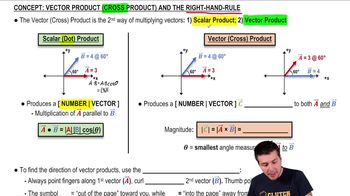
The cross product is a mathematical operation that takes two vectors and produces a third vector that is perpendicular to the plane formed by the original vectors. In the context of torque, the cross product of the position vector and the force vector yields the torque vector. The magnitude of the torque is given by the product of the magnitudes of the two vectors and the sine of the angle between them, which is crucial for understanding rotational effects.
추천 영상:
가이드 코스
10:30
Vector (Cross) Product and the Right-Hand-Rule
관련 실천
교과서 질문

Two identical particles have equal but opposite momenta, p\(\overrightarrow{p}\) and p-\(\overrightarrow{p}\), but they are not traveling along the same line. Show that the total angular momentum of this system does not depend on the choice of origin.

1407
views

교과서 질문

A woman of mass m stands at the edge of a solid cylindrical platform of mass M and radius R. At t = 0, the platform is rotating with negligible friction at angular velocity ω0 about a vertical axis through its center, and the woman begins walking with speed υ (relative to the platform) toward the center of the platform. Determine the angular velocity of the system as a function of time.

1141
views
교과서 질문

Calculate the angular momentum of a particle of mass m moving with constant velocity υ for two cases (see Fig. 11–34): about O′.

1042
views
교과서 질문

A woman of mass m stands at the edge of a solid cylindrical platform of mass M and radius R. At t = 0, the platform is rotating with negligible friction at angular velocity ω0 about a vertical axis through its center, and the woman begins walking with speed υ (relative to the platform) toward the center of the platform. What will be the angular velocity when the woman reaches the center?

1076
views
교과서 질문

Calculate the angular momentum of a particle of mass m moving with constant velocity υ for two cases (see Fig. 11–34): about origin O.

1496
views
교과서 질문

Show that  î x ĵ = k̂ , î x k̂ = - ĵ, and ĵ x k̂ = î.

1359
views