Ch. 11 - Angular Momentum; General Rotation
Giancoli Douglas - Physics for Scientists and Engineers 5th edition
Giancoli Douglas5th editionPhysics for Scientists and EngineersISBN: 9780137488179당신이 사용하는 게 아니라요?교과서 변경
11장, 문제 14a

A woman of mass m stands at the edge of a solid cylindrical platform of mass M and radius R. At t = 0, the platform is rotating with negligible friction at angular velocity ω0 about a vertical axis through its center, and the woman begins walking with speed υ (relative to the platform) toward the center of the platform. Determine the angular velocity of the system as a function of time.

검증된 단계별 안내
1
Understand the problem: The system consists of a woman and a rotating cylindrical platform. The woman moves toward the center of the platform, and we need to determine how the angular velocity of the system changes as a function of time. This is a conservation of angular momentum problem because there is negligible friction, meaning no external torques act on the system.
Write the expression for the total angular momentum of the system. Initially, the angular momentum is given by: L_0 = I_{platform} imes ω_0, where I_{platform} = (1/2) M R^2 is the moment of inertia of the cylindrical platform, and ω_0 is the initial angular velocity. The woman also contributes to the angular momentum, which is L_{woman} = m r^2 ω_0, where r is her distance from the center at any given time.
Apply the conservation of angular momentum: Since there are no external torques, the total angular momentum remains constant. Thus, L_{initial} = L_{final}. Initially, L_0 = (1/2) M R^2 ω_0 + m R^2 ω_0. At a later time, the woman has moved closer to the center, so her contribution to the moment of inertia changes. The final angular momentum is L_{final} = (1/2) M R^2 ω + m r(t)^2 ω, where ω is the new angular velocity and r(t) is her distance from the center as a function of time.
Solve for the angular velocity ω: Equating L_{initial} and L_{final}, we get: (1/2) M R^2 ω_0 + m R^2 ω_0 = (1/2) M R^2 ω + m r(t)^2 ω. Rearrange this equation to isolate ω: ω = \(\frac{(1/2) M R^2 ω_0 + m R^2 ω_0}{(1/2) M R^2 + m r(t)^2}\).
Express r(t): The woman's distance from the center, r(t), decreases as she walks toward the center with speed υ. If she starts at the edge of the platform (r(0) = R), then r(t) = R - υt. Substitute this expression for r(t) into the equation for ω to get the angular velocity as a function of time: ω(t) = \(\frac{(1/2) M R^2 ω_0 + m R^2 ω_0}{(1/2) M R^2 + m (R - υt)^2}\).

비슷한 문제에 대한 검증된 영상 답변:

이 영상 해법은 위 문제에 도움이 된다고 튜터들이 추천한 것입니다.
영상 길이:
9m
도움이 되었나요?

주요 개념

질문에 올바르게 답하기 위해 반드시 이해해야 하는 핵심 개념들은 다음과 같습니다.

Conservation of Angular Momentum

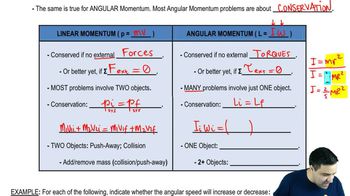
The principle of conservation of angular momentum states that if no external torque acts on a system, the total angular momentum of that system remains constant. In this scenario, as the woman walks toward the center of the rotating platform, her movement affects the distribution of mass and the system's angular velocity, but the total angular momentum must remain unchanged.
추천 영상:
가이드 코스
12:12
Conservation of Angular Momentum

Relative Velocity

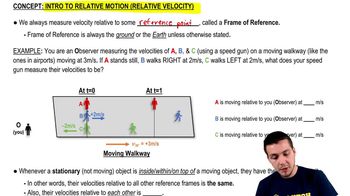
Relative velocity refers to the velocity of an object as observed from a particular reference frame. In this case, the woman's speed is given relative to the platform, which means her actual speed relative to the ground will change as she moves toward the center, affecting the overall dynamics of the rotating system.
추천 영상:
가이드 코스
04:27
Intro to Relative Motion (Relative Velocity)

Moment of Inertia

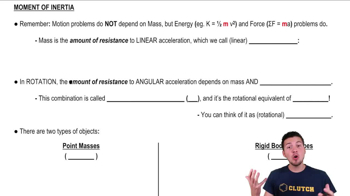
The moment of inertia is a measure of an object's resistance to changes in its rotational motion, depending on the mass distribution relative to the axis of rotation. As the woman moves toward the center of the platform, the moment of inertia of the system changes, which in turn influences the angular velocity according to the conservation of angular momentum.
추천 영상:
가이드 코스
11:47
Intro to Moment of Inertia
관련 실천
교과서 질문

An engineer estimates that under the most adverse expected weather conditions, the total force on the highway sign in Fig. 11–33 will be F\(\overrightarrow{F}\) = (± 2.4 î - 4.1 ĵ) kN, acting at the cm. What torque does this force exert about the base O?

1585
views

교과서 질문

A woman of mass m stands at the edge of a solid cylindrical platform of mass M and radius R. At t = 0, the platform is rotating with negligible friction at angular velocity ω0 about a vertical axis through its center, and the woman begins walking with speed υ (relative to the platform) toward the center of the platform. What will be the angular velocity when the woman reaches the center?

1076
views
교과서 질문

A uniform disk turns at 4.1 rev/s around a frictionless central axis. A nonrotating rod, of the same mass as the disk and length equal to the disk’s diameter, is dropped onto the freely spinning disk, Fig. 11–32. They then turn together around the spindle with their centers superposed. What is the angular frequency in rev/s of the combination?

1170
views
교과서 질문

A person of mass 75 kg stands at the center of a rotating merry-go-round platform of radius 3.0 m and moment of inertia 920. kg·m². The platform rotates without friction with angular velocity 0.95 rad/s. The person walks radially to the edge of the platform. Calculate the rotational kinetic energy of the system of platform plus person before and after the person’s walk.

1099
views
교과서 질문

Show that  î x ĵ = k̂ , î x k̂ = - ĵ, and ĵ x k̂ = î.

1359
views