
Ch. 12 - Static Equilibrium; Elasticity and Fracture
Giancoli Douglas - Physics for Scientists and Engineers 5th edition
Giancoli Douglas5th editionPhysics for Scientists and EngineersISBN: 9780137488179당신이 사용하는 게 아니라요?교과서 변경
12장, 문제 84

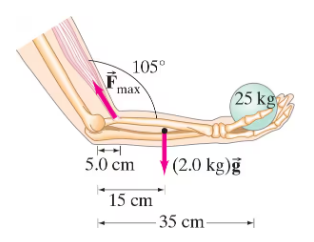
If 25 kg is the maximum mass m that a person can hold in a hand when the arm is positioned with a 105° angle at the elbow as shown in Fig. 12–102, what is the maximum force Fₘₐₓ that the biceps muscle exerts on the forearm? Assume the forearm and hand have a total mass of 2.0 kg with a cg that is 15 cm from the elbow, and that the biceps muscle attaches 5.0 cm from the elbow.
Illustration of a bent arm holding a 25 kg weight, showing angles and distances related to muscle force and equilibrium.

검증된 단계별 안내
1
Identify the forces acting on the forearm: (1) the weight of the object being held (25 kg), (2) the weight of the forearm and hand (2.0 kg), and (3) the force exerted by the biceps muscle (Fₘₐₓ). These forces create torques about the elbow joint.
Write the torque equilibrium condition about the elbow joint. Since the system is in static equilibrium, the sum of the torques about the elbow must be zero. Use the equation: Στ = 0, where τ = r × F × sin(θ).
Calculate the torque due to the weight of the object being held. The weight of the object is Fₒ = mₒ × g, where mₒ = 25 kg and g = 9.8 m/s². The perpendicular distance from the elbow to the line of action of this force is the length of the forearm (assume it is given or can be approximated).
Calculate the torque due to the weight of the forearm and hand. The weight is Fₐ = mₐ × g, where mₐ = 2.0 kg. The perpendicular distance is the distance from the elbow to the center of gravity of the forearm and hand (15 cm or 0.15 m).
Set up the torque equilibrium equation: τ_biceps - τ_object - τ_forearm = 0. Solve for the force exerted by the biceps muscle (Fₘₐₓ). The torque due to the biceps is τ_biceps = r_biceps × Fₘₐₓ × sin(105°), where r_biceps = 5.0 cm or 0.05 m. Substitute all known values and solve for Fₘₐₓ.

비슷한 문제에 대한 검증된 영상 답변:

이 영상 해법은 위 문제에 도움이 된다고 튜터들이 추천한 것입니다.
영상 길이:
5m

주요 개념

질문에 올바르게 답하기 위해 반드시 이해해야 하는 핵심 개념들은 다음과 같습니다.

Torque

Torque is a measure of the rotational force applied around a pivot point, calculated as the product of the force and the distance from the pivot (lever arm). In this scenario, the elbow acts as the pivot, and the forces exerted by the biceps muscle and the weight of the hand create torques that must be balanced for the arm to remain in equilibrium.
추천 영상:
가이드 코스
08:55
Net Torque & Sign of Torque

Equilibrium

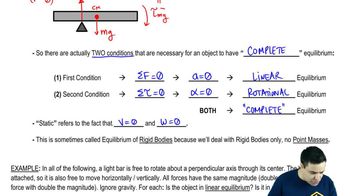
Equilibrium in physics refers to a state where all forces and torques acting on an object are balanced, resulting in no net force or rotation. For the arm holding a weight, the upward torque produced by the biceps must equal the downward torque due to the weight of the hand and forearm, allowing us to solve for the maximum force exerted by the biceps.
추천 영상:
가이드 코스
10:13
Torque & Equilibrium

Center of Gravity (cg)

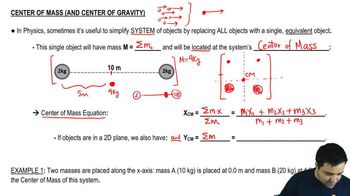
The center of gravity is the point at which the total weight of an object is considered to act. In this problem, the center of gravity of the forearm and hand is crucial for calculating the torque due to their weight, as it determines how far the weight acts from the elbow, influencing the overall balance of forces in the arm.
추천 영상:
가이드 코스
14:02
Intro to Center of Mass