

Ch. 12 - Static Equilibrium; Elasticity and Fracture
Giancoli Douglas - Physics for Scientists and Engineers 5th edition
Giancoli Douglas5th editionPhysics for Scientists and EngineersISBN: 9780137488179당신이 사용하는 게 아니라요?교과서 변경
12장, 문제 95e

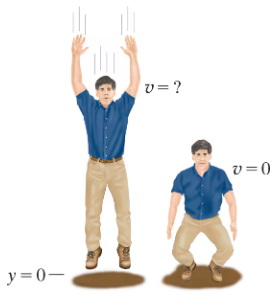
Suppose a 65-kg person jumps from a height of 3.0 m down to the ground. Estimate the stress and determine if the tibia will break in a stiff-legged landing (d = 1.0 cm).
Illustration of a person jumping with arms raised and landing in a crouched position, showing different velocities.

검증된 단계별 안내
1
Determine the force exerted on the tibia during the landing. Start by calculating the velocity just before impact using the equation for free fall: 2gh, where g is the acceleration due to gravity (9.8 m/s²) and h is the height (3.0 m).
Estimate the deceleration during the landing. Assume the stopping distance (compression of the tibia) is approximately equal to the diameter of the tibia, d = 1.0 cm = 0.01 m. Use the kinematic equation v2 = 2ad to solve for the deceleration a.
Calculate the force exerted on the tibia using Newton's second law: F = ma, where m is the mass of the person (65 kg) and a is the deceleration calculated in the previous step.
Determine the stress on the tibia. Stress is defined as force per unit area: σ = F/A. The cross-sectional area of the tibia can be approximated as a circle with diameter d = 1.0 cm, so A = π(d/2)2.
Compare the calculated stress to the breaking stress of the tibia (approximately 1.6 × 10⁸ N/m²). If the calculated stress exceeds this value, the tibia will break; otherwise, it will not.

비슷한 문제에 대한 검증된 영상 답변:

이 영상 해법은 위 문제에 도움이 된다고 튜터들이 추천한 것입니다.
영상 길이:
6m

주요 개념

질문에 올바르게 답하기 위해 반드시 이해해야 하는 핵심 개념들은 다음과 같습니다.

Potential Energy

Potential energy is the energy stored in an object due to its position in a gravitational field. For a person jumping from a height, this energy can be calculated using the formula PE = mgh, where m is mass, g is the acceleration due to gravity, and h is the height. As the person falls, this potential energy is converted into kinetic energy, which is crucial for understanding the forces involved upon landing.
추천 영상:
가이드 코스
07:24
Potential Energy Graphs

Impact Force

Impact force is the force exerted by an object when it comes to a sudden stop after falling. It can be estimated using the impulse-momentum theorem, which relates the change in momentum to the force applied over the time of impact. In a stiff-legged landing, the impact force is concentrated over a short distance, leading to higher stress on the bones, which is essential for assessing the risk of injury.
추천 영상:
가이드 코스
06:48
Intro to Centripetal Forces

Stress and Strain

Stress is defined as the force applied per unit area within materials, while strain is the deformation that occurs as a result of that stress. In the context of the tibia during a landing, calculating the stress involves determining the impact force and the cross-sectional area of the bone. Understanding these concepts helps in evaluating whether the stress exceeds the bone's strength, which could lead to a fracture.
추천 영상:
가이드 코스
07:49
Ray Diagrams for Convex Mirrors