
A fire hose exerts a force on the person holding it due to the water accelerating as it goes from the thicker hose out through the narrow nozzle. How much force is required to hold a 7.0-cm-diameter hose delivering 480 L/min through a 0.75-cm-diameter nozzle?
Ch. 13 - Fluids
Giancoli Douglas5th editionPhysics for Scientists and EngineersISBN: 9780137488179당신이 사용하는 게 아니라요?교과서 변경
13장, 문제 48
A fish tank has dimensions 36 cm wide by 1.0 m long by 0.60 m high. If the filter should process all the water in the tank once every 2.5 h, what should the flow speed be in the 3.0-cm-diameter input tube for the filter?
검증된 단계별 안내1
Calculate the volume of the fish tank. The volume is given by the product of its dimensions: \( V = \text{width} \times \text{length} \times \text{height} \). Convert all dimensions to meters before calculating. For example, the width is \( 36 \; \text{cm} = 0.36 \; \text{m} \).
Determine the flow rate required to process the entire volume of water in the tank every 2.5 hours. The flow rate \( Q \) is given by \( Q = \frac{V}{t} \), where \( V \) is the volume of the tank and \( t \) is the time in seconds (convert 2.5 hours to seconds: \( t = 2.5 \times 3600 \; \text{s} \)).
Relate the flow rate \( Q \) to the flow speed \( v \) in the input tube using the equation \( Q = A \cdot v \), where \( A \) is the cross-sectional area of the tube. The area \( A \) of a circular tube is given by \( A = \pi r^2 \), where \( r \) is the radius of the tube. The diameter of the tube is 3.0 cm, so \( r = \frac{3.0}{2} \; \text{cm} = 0.015 \; \text{m} \).
Rearrange the equation \( Q = A \cdot v \) to solve for the flow speed \( v \): \( v = \frac{Q}{A} \). Substitute the values of \( Q \) (from step 2) and \( A \) (from step 3) into this equation.
Perform the calculations to find the flow speed \( v \). Ensure that all units are consistent (e.g., meters, seconds) throughout the calculations.

비슷한 문제에 대한 검증된 영상 답변:
이 영상 해법은 위 문제에 도움이 된다고 튜터들이 추천한 것입니다.
영상 길이:
5m도움이 되었나요?
주요 개념
질문에 올바르게 답하기 위해 반드시 이해해야 하는 핵심 개념들은 다음과 같습니다.
Volume of the Tank
To determine the flow speed required for the filter, we first need to calculate the volume of the fish tank. The volume can be found using the formula V = width × length × height. In this case, the dimensions must be converted to consistent units, and the volume will be expressed in cubic meters or liters, which is essential for understanding how much water needs to be processed.
추천 영상:
가이드 코스
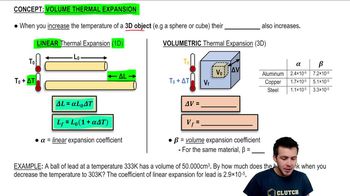
Volume Thermal Expansion
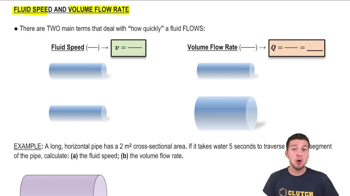
Flow Rate
Flow rate is the volume of fluid that passes through a given surface per unit time. It is typically measured in liters per hour or cubic meters per second. For this problem, we need to calculate the flow rate required to process the entire volume of the tank in the specified time of 2.5 hours, which will help us determine the necessary speed of the water in the input tube.
추천 영상:
가이드 코스
Fluid Speed & Volume Flow Rate
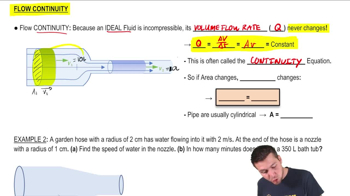
Continuity Equation
The continuity equation in fluid dynamics states that the mass flow rate must remain constant from one cross-section of a pipe to another. For incompressible fluids, this can be simplified to A1V1 = A2V2, where A is the cross-sectional area and V is the flow speed. This principle will be used to relate the flow speed in the input tube to the flow rate calculated from the tank's volume and processing time.
추천 영상:
가이드 코스
Flow Continuity
관련 실천
교과서 질문
1230
views
교과서 질문
What is the volume rate of flow of water from a 1.85-cm-diameter faucet if the pressure head is 12.0 m?
1341
views
교과서 질문
A 12-cm-radius air duct is used to replenish the air of a room 8.2 m x 4.5 m x 3.5 m every 12 min. How fast does the air flow in the duct?
1339
views
교과서 질문
What must be the pressure difference between the two ends of a 1.6-km section of pipe, 29 cm in diameter, if it is to transport oil (ρ = 950 kg/m³, η=0.20 Pa⋅s) at a rate of 650 cm³/s?
1286
views
교과서 질문
How fast does water flow from a hole at the bottom of a very wide, 5.1-m-deep storage tank filled with water? Ignore viscosity.
1305
views
교과서 질문
Estimate the air pressure inside a category 5 hurricane, where the wind speed is 300 km/h (Fig. 13–56).
<IMAGE>
1273
views
