Ch. 13 - Fluids
Giancoli Douglas - Physics for Scientists and Engineers 5th edition
Giancoli Douglas5th editionPhysics for Scientists and EngineersISBN: 9780137488179당신이 사용하는 게 아니라요?교과서 변경
13장, 문제 61

A fire hose exerts a force on the person holding it due to the water accelerating as it goes from the thicker hose out through the narrow nozzle. How much force is required to hold a 7.0-cm-diameter hose delivering 480 L/min through a 0.75-cm-diameter nozzle?

검증된 단계별 안내
1
Step 1: Understand the problem. The force exerted on the person holding the hose is due to the change in momentum of the water as it accelerates from the larger diameter hose to the smaller diameter nozzle. This is a classic application of the principle of conservation of momentum and Newton's second law.
Step 2: Convert the flow rate from liters per minute (L/min) to cubic meters per second (m³/s). Use the conversion factors: 1 L = 0.001 m³ and 1 min = 60 s. The flow rate in m³/s is given by \( Q = \frac{480 \times 0.001}{60} \).
Step 3: Calculate the velocity of water in the hose and the nozzle. Use the continuity equation \( A_1 v_1 = A_2 v_2 \), where \( A_1 \) and \( A_2 \) are the cross-sectional areas of the hose and nozzle, respectively, and \( v_1 \) and \( v_2 \) are the velocities of water in the hose and nozzle. The area of a circle is \( A = \pi r^2 \), where \( r \) is the radius. Compute \( A_1 \) and \( A_2 \) using the diameters provided (7.0 cm for the hose and 0.75 cm for the nozzle).
Step 4: Determine the change in momentum per second (force). The force required to hold the hose is equal to the rate of change of momentum of the water. Momentum is given by \( p = mv \), where \( m \) is mass and \( v \) is velocity. The mass flow rate is \( \dot{m} = \rho Q \), where \( \rho \) is the density of water (approximately 1000 kg/m³). The force is then \( F = \dot{m} (v_2 - v_1) \).
Step 5: Substitute all known values into the equations and simplify. Use the calculated flow rate \( Q \), cross-sectional areas \( A_1 \) and \( A_2 \), velocities \( v_1 \) and \( v_2 \), and the density of water \( \rho \) to compute the force \( F \). Ensure all units are consistent throughout the calculation.

비슷한 문제에 대한 검증된 영상 답변:

이 영상 해법은 위 문제에 도움이 된다고 튜터들이 추천한 것입니다.
영상 길이:
11m
도움이 되었나요?

주요 개념

질문에 올바르게 답하기 위해 반드시 이해해야 하는 핵심 개념들은 다음과 같습니다.

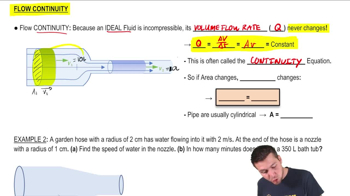
Continuity Equation

The Continuity Equation states that for an incompressible fluid, the mass flow rate must remain constant from one cross-section of a pipe to another. This means that if the diameter of the hose decreases, the velocity of the fluid must increase to maintain the same flow rate. This principle is crucial for understanding how the water accelerates as it moves from the wider hose to the narrower nozzle.
추천 영상:
가이드 코스
11:08
Flow Continuity

Bernoulli's Principle

Bernoulli's Principle relates the pressure, velocity, and height of a fluid in steady flow. It indicates that as the speed of a fluid increases, its pressure decreases. This principle helps explain the force exerted by the water on the nozzle and the person holding the hose, as the change in velocity from the hose to the nozzle results in a change in pressure.
추천 영상:
가이드 코스
14:47
Diffraction with Huygen's Principle

Force Calculation

To calculate the force exerted by the water, one can use the equation F = Δp × A, where Δp is the change in pressure and A is the cross-sectional area of the nozzle. The force required to hold the hose is directly related to the momentum change of the water exiting the nozzle, which can be derived from the flow rate and the velocity of the water.
추천 영상:
가이드 코스
06:09
Work Done by a Constant Force