Ch. 14 - Oscillations
Giancoli Douglas - Physics for Scientists and Engineers 5th edition
Giancoli Douglas5th editionPhysics for Scientists and EngineersISBN: 9780137488179당신이 사용하는 게 아니라요?교과서 변경
14장, 문제 36

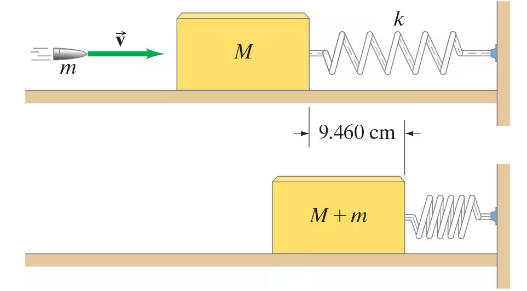
Agent Arlene devised the following method of measuring the muzzle velocity of a rifle (Fig. 14–34). She fires a bullet into a 4.148-kg wooden block resting on a smooth surface, and attached to a spring of spring constant k = 162.7 N/m. The bullet, whose mass is 7.450 g, remains embedded in the wooden block. She measures the maximum distance that the block compresses the spring to be 9.460 cm. What is the speed υ of the bullet?
Diagram showing a bullet impacting a block attached to a spring, illustrating spring compression and mass variables.

검증된 단계별 안내
1
Convert all given quantities to SI units. The mass of the bullet is 7.450 g = 0.007450 kg, the spring constant k = 162.7 N/m, and the maximum compression of the spring is 9.460 cm = 0.09460 m.
Use the principle of conservation of energy to relate the spring's maximum compression to the kinetic energy of the block-bullet system. The potential energy stored in the spring at maximum compression is given by the formula: \( U = \frac{1}{2} k x^2 \), where \( x \) is the compression of the spring.
Calculate the total mass of the block-bullet system. Since the bullet embeds itself in the block, the total mass is \( m_{\text{total}} = m_{\text{block}} + m_{\text{bullet}} \).
Use the conservation of momentum to relate the initial velocity of the bullet to the velocity of the block-bullet system just after the collision. The equation is: \( m_{\text{bullet}} v_{\text{bullet}} = m_{\text{total}} v_{\text{system}} \), where \( v_{\text{system}} \) is the velocity of the block-bullet system immediately after the collision.
Combine the results from the energy conservation and momentum conservation equations. Solve for the initial velocity of the bullet \( v_{\text{bullet}} \) using the relationship between the spring's potential energy and the system's kinetic energy: \( \frac{1}{2} m_{\text{total}} v_{\text{system}}^2 = \frac{1}{2} k x^2 \). Substitute \( v_{\text{system}} \) from the momentum equation into this energy equation to find \( v_{\text{bullet}} \).

비슷한 문제에 대한 검증된 영상 답변:

이 영상 해법은 위 문제에 도움이 된다고 튜터들이 추천한 것입니다.
영상 길이:
9m
도움이 되었나요?

주요 개념

질문에 올바르게 답하기 위해 반드시 이해해야 하는 핵심 개념들은 다음과 같습니다.

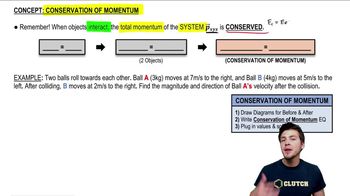
Conservation of Momentum

The principle of conservation of momentum states that in a closed system, the total momentum before an event must equal the total momentum after the event. In this scenario, when the bullet embeds itself in the wooden block, the momentum of the bullet-block system is conserved. This allows us to relate the initial momentum of the bullet to the combined momentum of the bullet and block after the collision.
추천 영상:
가이드 코스
05:58
Conservation Of Momentum

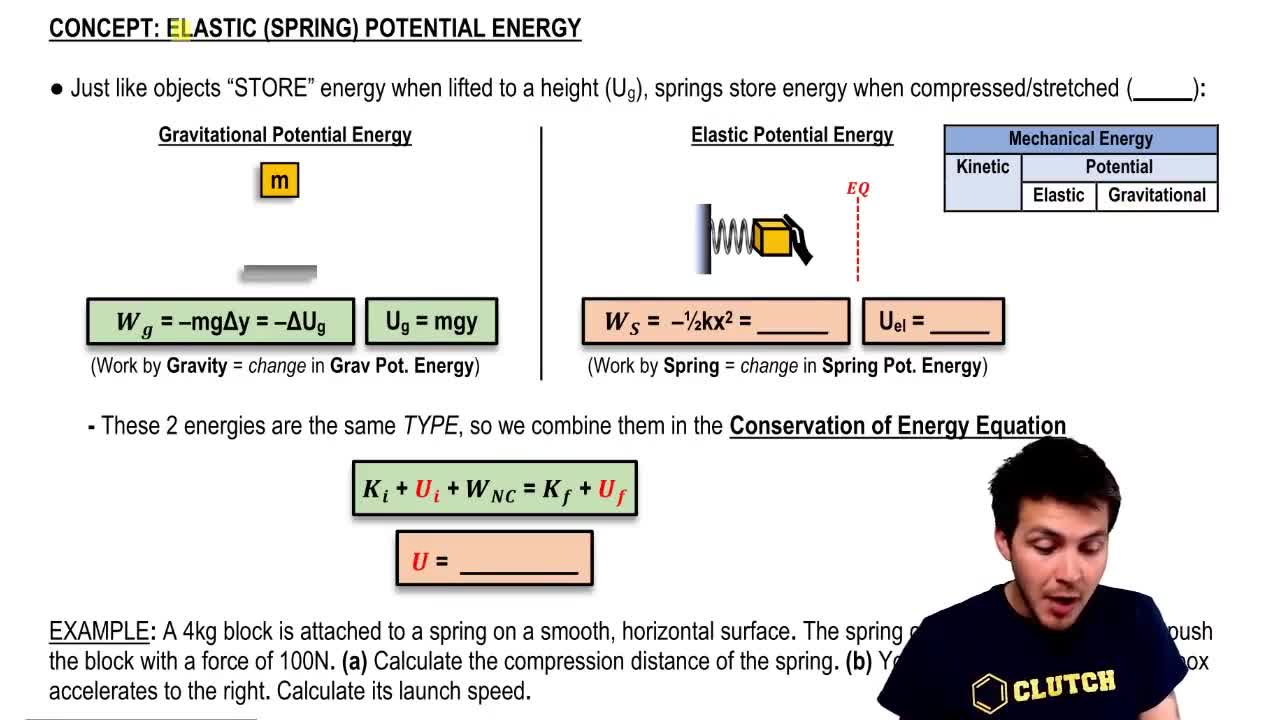
Spring Potential Energy

Spring potential energy is the energy stored in a compressed or stretched spring, calculated using the formula PE = (1/2)kx², where k is the spring constant and x is the displacement from the equilibrium position. In this problem, the maximum compression of the spring indicates the amount of kinetic energy transferred to the spring, which can be equated to the initial kinetic energy of the bullet-block system to find the bullet's speed.
추천 영상:
가이드 코스
06:18
Energy in Horizontal Springs

Kinetic Energy

Kinetic energy is the energy possessed by an object due to its motion, expressed as KE = (1/2)mv², where m is the mass and v is the velocity of the object. In this context, the kinetic energy of the bullet before it strikes the block is converted into potential energy in the spring when the block is compressed, allowing us to calculate the bullet's initial speed based on the energy transfer.
추천 영상:
가이드 코스
06:07
Intro to Rotational Kinetic Energy