

Ch. 14 - Oscillations
Giancoli Douglas - Physics for Scientists and Engineers 5th edition
Giancoli Douglas5th editionPhysics for Scientists and EngineersISBN: 9780137488179당신이 사용하는 게 아니라요?교과서 변경
14장, 문제 34b

An object with mass 2.7 kg is executing simple harmonic motion, attached to a spring with spring constant k = 310 N/m. When the object is 0.020 m from its equilibrium position, it is moving with a speed of 0.60 m/s. Calculate the maximum speed attained by the object.

검증된 단계별 안내
1
Step 1: Recall the total energy in simple harmonic motion (SHM). The total mechanical energy (E) in SHM is the sum of the potential energy (U) stored in the spring and the kinetic energy (K) of the moving object. The formula is: E = U + K, where U = (1/2)kx² and K = (1/2)mv². Here, k is the spring constant, x is the displacement from equilibrium, m is the mass, and v is the velocity.
Step 2: Use the given values to calculate the total energy of the system. Substitute k = 310 N/m, x = 0.020 m, m = 2.7 kg, and v = 0.60 m/s into the formulas for U and K. Compute U = (1/2)kx² and K = (1/2)mv², then add them to find E.
Step 3: Recall that the maximum speed (v_max) occurs when the object passes through the equilibrium position (x = 0). At this point, all the energy is kinetic, so E = (1/2)mv_max². Use the total energy E calculated in Step 2 to solve for v_max.
Step 4: Rearrange the equation E = (1/2)mv_max² to solve for v_max. The formula becomes v_max = sqrt((2E)/m). Substitute the total energy E and the mass m into this equation.
Step 5: Perform the calculation to find v_max. This will give you the maximum speed attained by the object during its motion.

비슷한 문제에 대한 검증된 영상 답변:

이 영상 해법은 위 문제에 도움이 된다고 튜터들이 추천한 것입니다.
영상 길이:
7m
도움이 되었나요?

주요 개념

질문에 올바르게 답하기 위해 반드시 이해해야 하는 핵심 개념들은 다음과 같습니다.

Simple Harmonic Motion (SHM)

Simple Harmonic Motion is a type of periodic motion where an object oscillates around an equilibrium position. The restoring force acting on the object is directly proportional to its displacement from the equilibrium and acts in the opposite direction. This motion can be described by sinusoidal functions, and key parameters include amplitude, frequency, and maximum speed.
추천 영상:
가이드 코스
07:52
Simple Harmonic Motion of Pendulums

Spring Constant (k)

The spring constant, denoted as k, is a measure of a spring's stiffness. It is defined as the force required to compress or extend the spring by a unit distance. In the context of SHM, a higher spring constant results in a stiffer spring, leading to a greater restoring force for a given displacement, which affects the oscillation frequency and maximum speed of the mass attached to the spring.
추천 영상:
가이드 코스
08:59
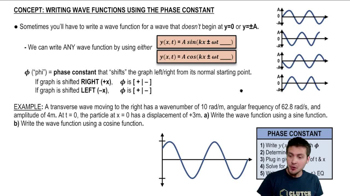
Phase Constant of a Wave Function

Maximum Speed in SHM

The maximum speed of an object in simple harmonic motion occurs as it passes through the equilibrium position. It can be calculated using the formula v_max = Aω, where A is the amplitude and ω is the angular frequency. The angular frequency is related to the spring constant and mass by ω = √(k/m). Understanding this relationship is crucial for determining the maximum speed of the oscillating object.
추천 영상:
가이드 코스
07:59
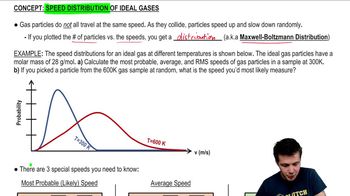
Speed Distribution & Special Speeds of Ideal Gases
관련 실천