
Ch. 18 - Kinetic Theory of Gases
Giancoli Douglas - Physics for Scientists and Engineers 5th edition
Giancoli Douglas5th editionPhysics for Scientists and EngineersISBN: 9780137488179당신이 사용하는 게 아니라요?교과서 변경
18장, 문제 61c

The escape speed from the Earth is 1.12 x 10⁴ m/s (Section 8–7). So a gas molecule traveling away from Earth near the outer boundary of the Earth’s atmosphere would, at this speed, be able to escape from the Earth’s gravitational field and be lost to the atmosphere. Can you explain why our atmosphere contains oxygen but not helium?

검증된 단계별 안내
1
Understand the concept of escape speed: Escape speed is the minimum speed an object must have to escape the gravitational pull of a planet without further propulsion. For Earth, this speed is approximately 1.12 × 10⁴ m/s.
Relate escape speed to the kinetic energy of gas molecules: The kinetic energy of a gas molecule is given by the equation \( KE = \frac{1}{2}mv^2 \), where \( m \) is the mass of the molecule and \( v \) is its speed. The average speed of gas molecules is related to their temperature and mass through the Maxwell-Boltzmann distribution.
Compare the molecular speeds of oxygen and helium: Helium atoms are much lighter than oxygen molecules. According to the Maxwell-Boltzmann distribution, lighter molecules (like helium) move faster on average than heavier molecules (like oxygen) at the same temperature.
Determine the likelihood of escape: Since helium atoms move faster on average, a significant fraction of them can reach or exceed the escape speed of Earth, allowing them to escape Earth's gravitational field. In contrast, oxygen molecules, being heavier, have lower average speeds and are less likely to reach escape velocity.
Conclude why Earth's atmosphere retains oxygen but not helium: Over time, helium atoms escape into space due to their higher speeds, while oxygen molecules remain bound to Earth's atmosphere because their speeds are generally insufficient to overcome Earth's gravitational pull.

비슷한 문제에 대한 검증된 영상 답변:

이 영상 해법은 위 문제에 도움이 된다고 튜터들이 추천한 것입니다.
영상 길이:
10m

주요 개념

질문에 올바르게 답하기 위해 반드시 이해해야 하는 핵심 개념들은 다음과 같습니다.

Escape Velocity

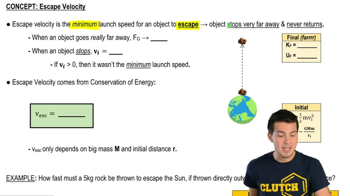
Escape velocity is the minimum speed an object must reach to break free from a celestial body's gravitational pull without further propulsion. For Earth, this speed is approximately 11.2 km/s. If an object, such as a gas molecule, exceeds this speed, it can escape into space, which is crucial for understanding why lighter gases like helium can be lost from the atmosphere.
추천 영상:
가이드 코스
7:27
Escape Velocity

Molecular Mass and Kinetic Energy

The kinetic energy of a gas molecule is directly related to its temperature and mass. Lighter molecules, such as helium, have higher average speeds at a given temperature compared to heavier molecules like oxygen. This means that helium molecules can reach escape velocity more easily, leading to their gradual loss from the atmosphere over time.
추천 영상:
가이드 코스
01:50
Introduction to Kinetic-Molecular Theory

Atmospheric Retention

Atmospheric retention refers to the ability of a planet to hold onto its gases. Factors influencing this include the planet's gravity and the temperature of the atmosphere. Earth’s gravity is sufficient to retain heavier gases like oxygen, while lighter gases like helium can escape more readily, resulting in a composition that favors heavier elements in the atmosphere.
추천 영상:
가이드 코스
17:04
Pressure and Atmospheric Pressure
관련 실천
교과서 질문

A space vehicle returning from the Moon enters the Earth’s atmosphere at a speed of about 42,000 km/h. Molecules (assume nitrogen) striking the nose of the vehicle with this speed correspond to what temperature? (Because of this high temperature, the nose of a space vehicle must be made of special materials; indeed, part of it does vaporize, and this is seen as a bright blaze upon reentry.)

1157
views
교과서 질문

At about what pressure would the mean free path of air molecules be equal to the diameter of air molecules, ≈ 3 x 10⁻¹⁰ m? Assume T = 20° C.

1385
views
교과서 질문

At about what pressure would the mean free path of air molecules be 0.30 m? Assume T = 20° C.

1411
views
교과서 질문

A sauna has 7.8 m³ of air volume, and the temperature is 85°C. The air is perfectly dry. How much water (in kg) should be evaporated if we want to increase the relative humidity from 0% to 10%? (See Table 18–2.)

1522
views
교과서 질문

Estimate the time needed for a glycine molecule (see Table 18–3) to diffuse a distance of 25μm in water at 20°C if its concentration varies over that distance from 1.00 mol/m³ to 0.50 mol/m³. Compare this “speed” to its rms (thermal) speed. The molecular mass of glycine is about 75 u.

72
views
교과서 질문

A scuba tank has a volume of 3100 cm³. For very deep dives, the tank is filled with 50% (by volume) pure oxygen and 50% pure helium. What is the ratio of the average kinetic energies of the two types of molecule?

1262
views