Ch. 25 - Electric Current and Resistance
Giancoli Douglas - Physics for Scientists and Engineers 5th edition
Giancoli Douglas5th editionPhysics for Scientists and EngineersISBN: 9780137488179당신이 사용하는 게 아니라요?교과서 변경
24장, 문제 82

A 100-W, 120-V incandescent lightbulb has a resistance of 12 Ω when cold (20°C) and 150 Ω when on (hot). Calculate its power consumption (a) at the instant it is turned on, and (b) after a few moments when it is hot.

검증된 단계별 안내
1
Step 1: Understand the problem. The power consumption of the lightbulb depends on its resistance and the voltage applied. When the bulb is cold, its resistance is 12 Ω, and when it is hot, its resistance is 150 Ω. Use the formula for power: P = V² / R, where P is power, V is voltage, and R is resistance.
Step 2: For part (a), calculate the power consumption at the instant the bulb is turned on (cold resistance). Substitute the given values into the formula: P = (120²) / 12. Simplify the expression to find the power when the bulb is cold.
Step 3: For part (b), calculate the power consumption after the bulb has been on for a while (hot resistance). Substitute the given values into the formula: P = (120²) / 150. Simplify the expression to find the power when the bulb is hot.
Step 4: Compare the results from part (a) and part (b). Notice that the power consumption is higher when the bulb is cold because the resistance is lower, and it decreases as the bulb heats up and its resistance increases.
Step 5: Reflect on the physical meaning. The change in resistance is due to the temperature dependence of the filament material. As the filament heats up, its resistance increases, which reduces the current and power consumption over time.

비슷한 문제에 대한 검증된 영상 답변:

이 영상 해법은 위 문제에 도움이 된다고 튜터들이 추천한 것입니다.
영상 길이:
9m
도움이 되었나요?

주요 개념

질문에 올바르게 답하기 위해 반드시 이해해야 하는 핵심 개념들은 다음과 같습니다.

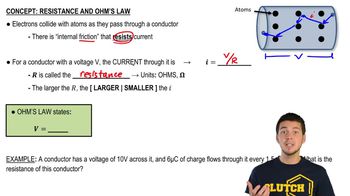
Ohm's Law

Ohm's Law states that the current (I) flowing through a conductor between two points is directly proportional to the voltage (V) across the two points and inversely proportional to the resistance (R) of the conductor. It is mathematically expressed as V = I * R. This principle is essential for calculating the current in the lightbulb when it is turned on and when it is hot.
추천 영상:
가이드 코스
03:07
Resistance and Ohm's Law

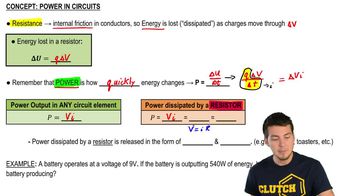
Power in Electrical Circuits

The power (P) consumed by an electrical device is defined as the product of the voltage (V) across it and the current (I) flowing through it, expressed as P = V * I. This concept is crucial for determining the power consumption of the lightbulb at both cold and hot states, as it allows us to calculate how much energy is being used.
추천 영상:
가이드 코스
06:18
Power in Circuits

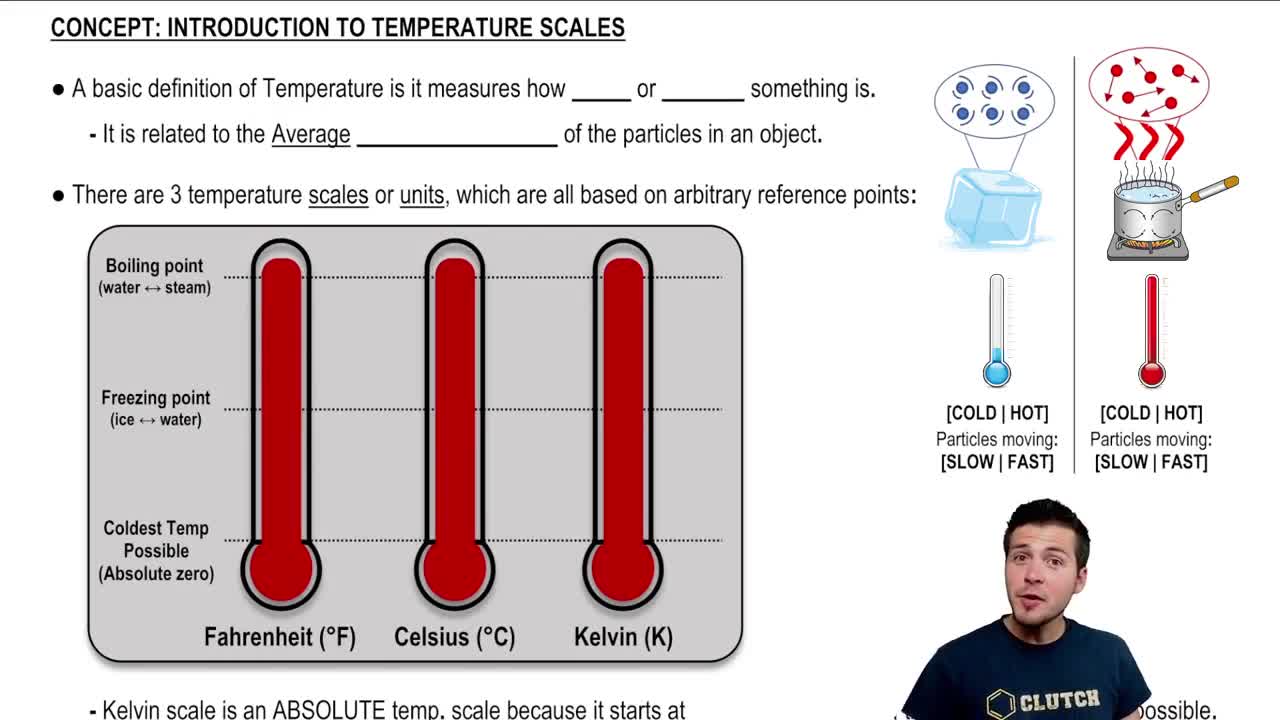
Temperature Dependence of Resistance

The resistance of materials, particularly metals, typically increases with temperature. In the case of the incandescent lightbulb, its cold resistance is 12 Ω at 20°C, but it rises to 150 Ω when the bulb is hot. Understanding this temperature dependence is vital for accurately calculating the power consumption at the moment it is turned on versus after it has warmed up.
추천 영상:
가이드 코스
04:54
Introduction To Temperature Scales