Ch. 25 - Electric Current and Resistance
Giancoli Douglas - Physics for Scientists and Engineers 5th edition
Giancoli Douglas5th editionPhysics for Scientists and EngineersISBN: 9780137488179당신이 사용하는 게 아니라요?교과서 변경
24장, 문제 81b

Suppose a current is given by the equation I = 1.40 sin 210t, where I is in amperes and t in seconds. What is the rms value of the current?

검증된 단계별 안내
1
The given current is expressed as a sinusoidal function: I = 1.40 sin(210t), where the amplitude of the current is 1.40 A. The root mean square (rms) value of a sinusoidal current is related to its amplitude.
The formula for the rms value of a sinusoidal current is: Irms = I2, where I is the peak (amplitude) current.
Substitute the amplitude of the current, I = 1.40 A, into the formula: Irms = 1.402.
Simplify the expression to calculate the rms value. Note that 2 is approximately 1.414, but leave the result in terms of the fraction for now.
The final expression for the rms value of the current is: Irms = 1.402. You can calculate the numerical value if needed.

비슷한 문제에 대한 검증된 영상 답변:

이 영상 해법은 위 문제에 도움이 된다고 튜터들이 추천한 것입니다.
영상 길이:
2m
도움이 되었나요?

주요 개념

질문에 올바르게 답하기 위해 반드시 이해해야 하는 핵심 개념들은 다음과 같습니다.

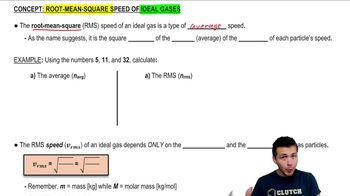
Root Mean Square (RMS) Value

The RMS value of an alternating current (AC) is a measure of the effective value of the current, which is equivalent to a direct current (DC) that would produce the same power in a resistive load. It is calculated by taking the square of the instantaneous values, averaging them over a complete cycle, and then taking the square root of that average.
추천 영상:
가이드 코스
05:21
Root-Mean-Square Speed of Ideal Gases

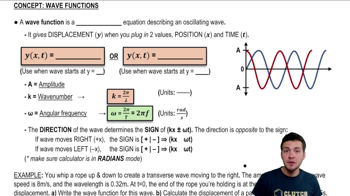
Sine Wave Function

The sine wave function describes how the current varies with time in AC circuits. In the equation I = 1.40 sin(210t), the sine function indicates that the current oscillates between positive and negative values, with a peak amplitude of 1.40 A and a frequency determined by the coefficient of t, which affects the rate of oscillation.
추천 영상:
가이드 코스
08:30
Intro to Wave Functions

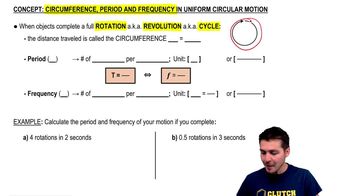
Frequency and Angular Frequency

Frequency refers to the number of cycles a wave completes in one second, measured in hertz (Hz). Angular frequency, denoted by the term inside the sine function (in this case, 210), is related to frequency by the equation ω = 2πf, where ω is the angular frequency in radians per second. This concept is crucial for determining the time period and behavior of the current over time.
추천 영상:
가이드 코스
05:08
Circumference, Period, and Frequency in UCM