Ch. 26 - DC Circuits
Giancoli Douglas - Physics for Scientists and Engineers 5th edition
Giancoli Douglas5th editionPhysics for Scientists and EngineersISBN: 9780137488179당신이 사용하는 게 아니라요?교과서 변경
25장, 문제 16a

[In these Problems neglect the internal resistance of a battery unless the Problem refers to it.]


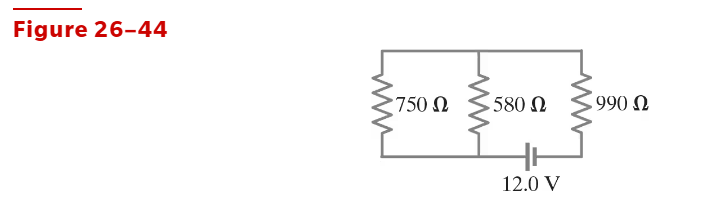
(II) Determine the equivalent resistance of the circuit shown in Fig. 26–44,

검증된 단계별 안내
1
Step 1: Identify the configuration of resistors in the circuit. Determine whether the resistors are connected in series, parallel, or a combination of both. Series resistors have the same current flowing through them, while parallel resistors share the same voltage across them.
Step 2: For resistors in series, calculate the equivalent resistance using the formula: Req=R1+R2+. Add the resistance values directly.
Step 3: For resistors in parallel, calculate the equivalent resistance using the formula: Req=(11/R1+1/R2+). Take the reciprocal of the sum of reciprocals of the individual resistances.
Step 4: Simplify the circuit step by step. If the circuit contains a combination of series and parallel resistors, reduce the parallel sections first, then combine them with series resistors. Repeat this process until you have a single equivalent resistance for the entire circuit.
Step 5: Once the equivalent resistance is determined, verify your calculations by checking the units (ohms) and ensuring that the equivalent resistance makes sense in the context of the circuit configuration.

비슷한 문제에 대한 검증된 영상 답변:

이 영상 해법은 위 문제에 도움이 된다고 튜터들이 추천한 것입니다.
영상 길이:
2m
도움이 되었나요?

주요 개념

질문에 올바르게 답하기 위해 반드시 이해해야 하는 핵심 개념들은 다음과 같습니다.

Equivalent Resistance

Equivalent resistance is the total resistance of a circuit that can replace a combination of resistors without changing the current or voltage across the circuit. It can be calculated differently for resistors in series and parallel. In series, the equivalent resistance is the sum of individual resistances, while in parallel, it is found using the reciprocal formula: 1/R_eq = 1/R1 + 1/R2 + ... + 1/Rn.
추천 영상:
가이드 코스
03:44
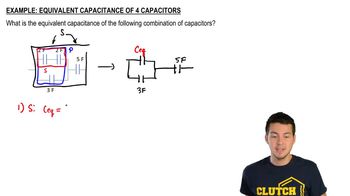
Find Equivalent Capacitance #1

Series and Parallel Circuits

In electrical circuits, resistors can be arranged in series or parallel configurations. In a series circuit, the current is the same through all components, and the total voltage is the sum of the individual voltages. In a parallel circuit, the voltage across each resistor is the same, but the total current is the sum of the currents through each branch, affecting how equivalent resistance is calculated.
추천 영상:
가이드 코스
09:51
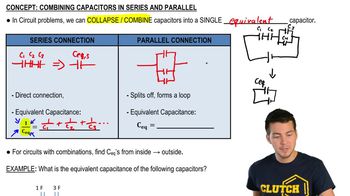
Combining Capacitors in Series & Parallel

Ohm's Law

Ohm's Law is a fundamental principle in electronics that relates voltage (V), current (I), and resistance (R) in a circuit, expressed as V = IR. This law is essential for analyzing circuits, as it allows for the calculation of one variable if the other two are known. Understanding Ohm's Law is crucial for determining how voltage and current behave in both series and parallel circuits.
추천 영상:
가이드 코스
03:07
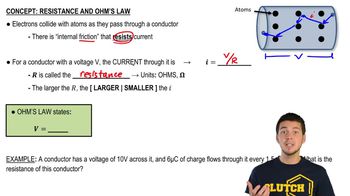
Resistance and Ohm's Law