
Ch. 26 - DC Circuits
Giancoli Douglas - Physics for Scientists and Engineers 5th edition
Giancoli Douglas5th editionPhysics for Scientists and EngineersISBN: 9780137488179당신이 사용하는 게 아니라요?교과서 변경
25장, 문제 16c

[In these Problems neglect the internal resistance of a battery unless the Problem refers to it.]


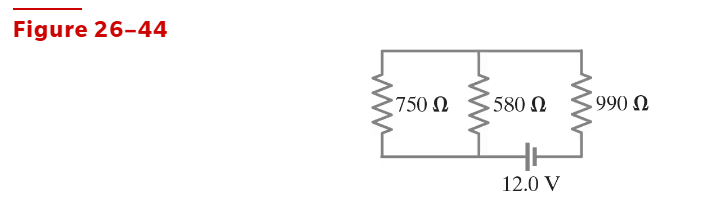
(II) Determine the current through each resistor.

검증된 단계별 안내
1
Step 1: Analyze the circuit diagram provided in the problem. Identify the arrangement of resistors (series, parallel, or a combination) and note the values of each resistor and the voltage of the battery.
Step 2: For resistors in series, calculate the equivalent resistance using the formula: Req=R1+R2+R3. For resistors in parallel, calculate the equivalent resistance using the formula: Req=(1R1+1R2+1R3)1.
Step 3: Once the equivalent resistance is determined, calculate the total current in the circuit using Ohm's Law: I=VReq, where V is the voltage of the battery.
Step 4: For each resistor, determine the current flowing through it. If the resistors are in series, the current is the same through all resistors. If the resistors are in parallel, use the formula: I=VR, where V is the voltage across the resistor and R is the resistance of the individual resistor.
Step 5: Verify your results by ensuring that the sum of currents in parallel branches equals the total current in the circuit and that the voltage drops across resistors in series add up to the total voltage of the battery.

비슷한 문제에 대한 검증된 영상 답변:

이 영상 해법은 위 문제에 도움이 된다고 튜터들이 추천한 것입니다.
영상 길이:
6m
도움이 되었나요?

주요 개념

질문에 올바르게 답하기 위해 반드시 이해해야 하는 핵심 개념들은 다음과 같습니다.

Ohm's Law

Ohm's Law states that the current (I) flowing through a conductor between two points is directly proportional to the voltage (V) across the two points and inversely proportional to the resistance (R) of the conductor. This relationship is expressed mathematically as V = IR. Understanding this law is essential for analyzing circuits and calculating the current through resistors.
추천 영상:
가이드 코스
03:07
Resistance and Ohm's Law

Series and Parallel Circuits

In electrical circuits, resistors can be arranged in series or parallel configurations. In a series circuit, the total resistance is the sum of individual resistances, and the same current flows through each resistor. In a parallel circuit, the total resistance decreases, and the voltage across each resistor is the same, allowing for different currents to flow through each branch. Recognizing these configurations is crucial for determining the current through each resistor.
추천 영상:
가이드 코스
09:51
Combining Capacitors in Series & Parallel

Kirchhoff's Laws

Kirchhoff's Laws consist of two principles that govern the behavior of electrical circuits. Kirchhoff's Current Law (KCL) states that the total current entering a junction equals the total current leaving it, while Kirchhoff's Voltage Law (KVL) states that the sum of the electrical potential differences around any closed circuit loop must equal zero. These laws are fundamental for analyzing complex circuits and calculating currents through individual components.
추천 영상:
가이드 코스
04:08
Kirchhoff's Junction Rule
관련 실천
교과서 질문

[In these Problems neglect the internal resistance of a battery unless the Problem refers to it.]


(II) A power supply has a fixed output voltage of 12.0 V, but you need VT = 3.0 V output for an experiment. (a) Using the voltage divider shown in Fig. 26–47, what should R₂ be if R₁ is 16.5 Ω? (b) What will the terminal voltage VT be if you connect a load to the 3.0-V output, assuming the load has a resistance of 7.0Ω?

141
views
교과서 질문

[In these Problems neglect the internal resistance of a battery unless the Problem refers to it.]


(II) Determine the voltage across each resistor

650
views
교과서 질문

[In these Problems neglect the internal resistance of a battery unless the Problem refers to it.]


(II) Determine the equivalent resistance of the circuit shown in Fig. 26–44,

757
views
교과서 질문

Neglect the internal resistance of a battery unless the problem refers to it. Eight bulbs are connected in parallel to a 120-V source by two long leads of total resistance 1.4 Ω. If 210 mA flows through each bulb, what is the resistance of each, and what fraction of the total power is wasted in the leads?

1255
views
교과서 질문

[In these Problems neglect the internal resistance of a battery unless the Problem refers to it.]


(III) You are designing a wire resistance heater to heat an enclosed container of gas. For the apparatus to function properly, this heater must transfer heat to the gas at a very constant rate. While in operation, the resistance of the heater will always be close to the value R = R₀, but may fluctuate slightly causing its resistance to vary a small amount ∆R ( << R₀ ). To maintain the heater at constant power, you design the circuit shown in Fig. 26–50, which includes two resistors, each of resistance R′. Determine the value for R′ so that the heater power P will remain constant even if its resistance R fluctuates by a small amount. [Hint: If ∆R << R₀ , then ΔPΔRdPdRR=R0\(\Delta\) P\(\approx\) \(\Delta\) R\(\left\). \(\frac{dP}{dR}\]\right\)|_{R=R_{0}}]

765
views
교과서 질문

[In these Problems neglect the internal resistance of a battery unless the Problem refers to it.]


(II) What is the net resistance of the circuit connected to the battery in Fig. 26–46?

776
views