

Ch. 28 - Sources of Magnetic Field
Giancoli Douglas - Physics for Scientists and Engineers 5th edition
Giancoli Douglas5th editionPhysics for Scientists and EngineersISBN: 9780137488179당신이 사용하는 게 아니라요?교과서 변경
27장, 문제 80

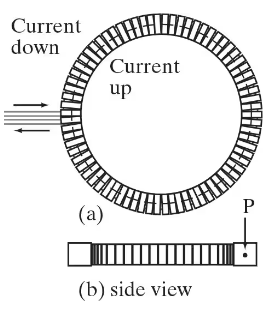
A toroid is fabricated with a circular shape and loops with a square cross section as shown in Fig. 28–69. The cross-section of a loop is a square of side 6.0 cm. The inner radius of the whole circular toroid is 3.0 m. There are 320 loops of wire which carry a 45-A dc current using a nearby power supply at 20.0 V. The arrows show the current flow in and out of the toroid. The current flows up at the inner diameter and down at the outer diameter. (a) Calculate the strength of the magnetic field at the center of the square’s cross section at point P. (b) Is the magnetic field pointing clockwise or counterclockwise? (c) The square cross-sectional area of the wire is uniformly 0.10 cm2. What is the resistivity of the wire?

검증된 단계별 안내
1
Step 1: To calculate the magnetic field strength at point P (part a), use Ampere's Law. The formula for the magnetic field inside a toroid is given by: B=μNI2πr, where μ is the permeability of free space, N is the number of turns, I is the current, and r is the radius at the point of interest. Here, r is the distance from the center of the toroid to point P, which is the inner radius plus half the side length of the square cross-section.
Step 2: Determine the direction of the magnetic field (part b) using the right-hand rule. Curl the fingers of your right hand in the direction of the current in the loops of the toroid. The thumb will point in the direction of the magnetic field inside the toroid. Based on the current flow described, determine whether the field is clockwise or counterclockwise.
Step 3: To calculate the resistivity of the wire (part c), use the formula for resistance: R=ρLA, where R is the resistance, ρ is the resistivity, L is the length of the wire, and A is the cross-sectional area. First, calculate the total length of the wire by multiplying the number of turns by the average circumference of the toroid. Then, rearrange the formula to solve for resistivity: ρ=RAL.
Step 4: Calculate the resistance of the wire using Ohm's Law: R=VI, where V is the voltage and I is the current. Substitute the given values for voltage and current to find the resistance.
Step 5: Combine the results from Steps 3 and 4 to calculate the resistivity of the wire. Use the cross-sectional area of the wire (square of the side length) and the total length of the wire to complete the calculation.

비슷한 문제에 대한 검증된 영상 답변:

이 영상 해법은 위 문제에 도움이 된다고 튜터들이 추천한 것입니다.
영상 길이:
9m
도움이 되었나요?

주요 개념

질문에 올바르게 답하기 위해 반드시 이해해야 하는 핵심 개념들은 다음과 같습니다.

Magnetic Field in a Toroid

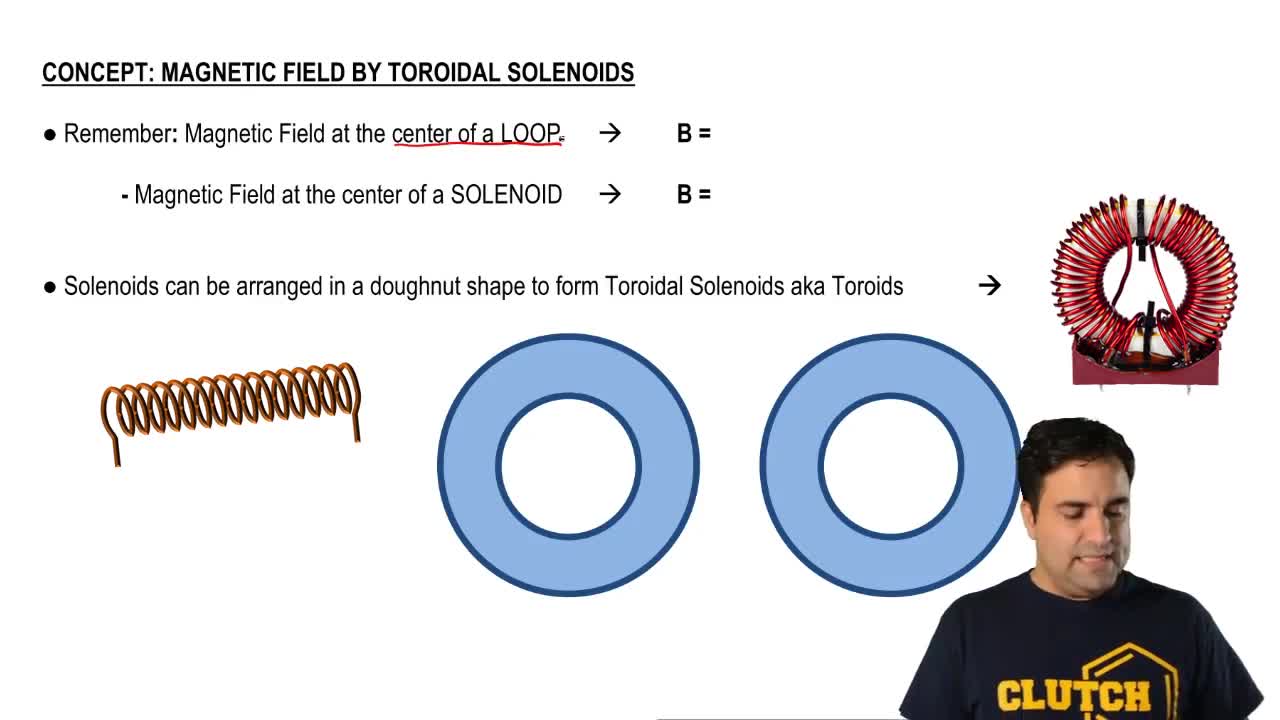
A toroid is a doughnut-shaped coil of wire that generates a magnetic field when an electric current passes through it. The magnetic field inside a toroid is concentrated and follows a circular path, with its strength depending on the number of loops, the current flowing through the wire, and the radius of the toroid. The formula for the magnetic field strength (B) at a distance r from the center is given by B = (μ₀ * N * I) / (2 * π * r), where μ₀ is the permeability of free space, N is the number of loops, and I is the current.
추천 영상:
가이드 코스
11:47
Toroidal Solenoids aka Toroids

Right-Hand Rule

The right-hand rule is a mnemonic used to determine the direction of the magnetic field around a current-carrying conductor. For a toroid, if you curl the fingers of your right hand in the direction of the current flow through the loops, your thumb will point in the direction of the magnetic field. This rule helps in visualizing the orientation of the magnetic field lines, which is essential for answering questions about their direction.
추천 영상:
가이드 코스
19:11
Force on Moving Charges & Right Hand Rule

Resistivity and Resistance

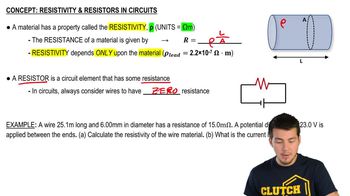
Resistivity is a material property that quantifies how strongly a given material opposes the flow of electric current. It is denoted by the symbol ρ and is measured in ohm-meters (Ω·m). The resistance (R) of a wire can be calculated using the formula R = ρ * (L/A), where L is the length of the wire and A is its cross-sectional area. Understanding resistivity is crucial for calculating the resistance of the wire in the toroid and determining how it affects the current flow.
추천 영상:
가이드 코스
05:25
Resistivity & Resistors in Circuits