
(III) Suppose a conducting rod (mass m, resistance R) rests on two frictionless and resistanceless parallel rails a distance ℓ apart in a uniform magnetic field (⊥ to the rails and to the rod) as in Fig. 29–53. At t = 0, the rod is at rest and a source of emf is connected to the points a and b. Determine the speed of the rod as a function of time if (a) the source puts out a constant current I, (b) the source puts out a constant emf ε₀. (c) Does the rod reach a terminal speed in either case? If so, what is it?
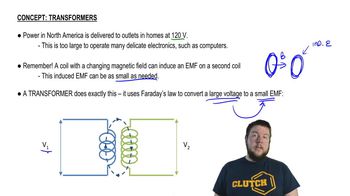
Neon signs require 12 kV for their operation. To operate from a 240-V line, what must be the ratio of secondary to primary turns of the transformer? What would the voltage output be if the transformer were connected in reverse?
검증된 단계별 안내
비슷한 문제에 대한 검증된 영상 답변:
주요 개념
Transformer Basics
Turns Ratio
Reverse Connection of Transformer
If 75 MW of power at 45 kV (rms) arrives at a town from a generator via transmission lines of total resistance 3.0 Ω, calculate (a) the emf at the generator end of the lines, and (b) the fraction of the power generated that is wasted in the lines.
(II) For the electric power transmission system shown in Fig. 29–26, what is the ratio Ns/Np for (a) the step-up transformer, (b) the step-down transformer next to the home?
A model-train transformer plugs into 120-V ac and draws 0.35 A while supplying 6.5 A to the train.
(a) What voltage is present across the tracks?
(b) Is the transformer step-up or step-down?
A transformer has 680 turns in the primary coil and 85 in the secondary coil. What kind of transformer is this, and by what factor does it change the voltage? By what factor does it change the current?
