
교과서 질문
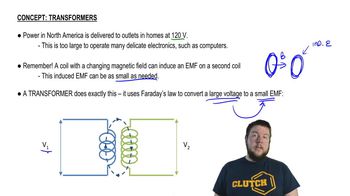
Neon signs require 12 kV for their operation. To operate from a 240-V line, what must be the ratio of secondary to primary turns of the transformer? What would the voltage output be if the transformer were connected in reverse?
1591
views

 검증된 단계별 안내
 03:00
03:00
 05:32
05:32 06:00
06:00Neon signs require 12 kV for their operation. To operate from a 240-V line, what must be the ratio of secondary to primary turns of the transformer? What would the voltage output be if the transformer were connected in reverse?
If 75 MW of power at 45 kV (rms) arrives at a town from a generator via transmission lines of total resistance 3.0 Ω, calculate (a) the emf at the generator end of the lines, and (b) the fraction of the power generated that is wasted in the lines.
The primary windings of a transformer which has an 85% efficiency are connected to 110-V ac. The secondary windings are connected across a 2.4-Ω, 75-W lightbulb.
(a) Calculate the current through the primary windings of the transformer.
(b) Calculate the ratio of the number of primary windings of the transformer to the number of secondary windings of the transformer.
A model-train transformer plugs into 120-V ac and draws 0.35 A while supplying 6.5 A to the train.
(a) What voltage is present across the tracks?
(b) Is the transformer step-up or step-down?
(III) In a circular region, there is a uniform magnetic field pointing into the page (Fig. 29–56). An xy coordinate system has its origin at the circular region’s center. A free positive point charge +Q = 1.0 μC is initially at rest at a position x = +10 cm on the x axis. If the magnitude of the magnetic field is now decreased at a rate of -0.10 T/s, what force (magnitude and direction) will act on +Q?
A circular loop of area 12 m² encloses a magnetic field perpendicular to the plane of the loop; its magnitude is B(t) = (8.0 T/s)t. The loop is connected to a 7.5-Ω resistor and a 6.5-pF capacitor in series. When fully charged, how much charge is stored on the capacitor?