
Ch. 29 - Electromagnetic Induction and Faraday's Law
Giancoli Douglas - Physics for Scientists and Engineers 5th edition
Giancoli Douglas5th editionPhysics for Scientists and EngineersISBN: 9780137488179당신이 사용하는 게 아니라요?교과서 변경
28장, 문제 55

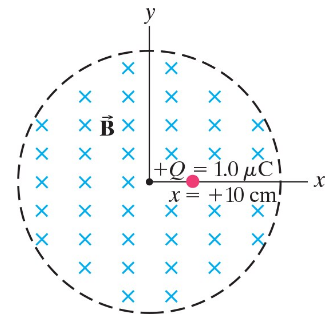
(III) In a circular region, there is a uniform magnetic field B\(\overrightarrow{B}\) pointing into the page (Fig. 29–56). An xy coordinate system has its origin at the circular region’s center. A free positive point charge +Q = 1.0 μC is initially at rest at a position x = +10 cm on the x axis. If the magnitude of the magnetic field is now decreased at a rate of -0.10 T/s, what force (magnitude and direction) will act on +Q?


검증된 단계별 안내
1
Understand the problem: A positive charge +Q is placed in a region where the magnetic field is decreasing at a constant rate. This changing magnetic field induces an electric field according to Faraday's Law of Electromagnetic Induction. The force on the charge is due to this induced electric field.
Apply Faraday's Law of Induction: The induced electric field is related to the rate of change of the magnetic flux. The magnetic flux Φ is given by Φ = B × A, where B is the magnetic field and A is the area of the circular region. Since the magnetic field is uniform and decreasing, the rate of change of flux is dΦ/dt = A × dB/dt.
Determine the induced electric field: The magnitude of the induced electric field E at a distance r from the center of the circular region is given by |E| = (1 / (2πr)) × |dΦ/dt|. Substituting dΦ/dt = A × dB/dt, we get |E| = (1 / (2πr)) × (πR² × dB/dt), where R is the radius of the circular region and r is the distance of the charge from the center.
Calculate the force on the charge: The force on the charge is given by F = Q × E, where Q is the charge and E is the induced electric field. Substituting the expression for E, we get F = Q × (1 / (2πr)) × (πR² × dB/dt). Simplify this expression to find the magnitude of the force.
Determine the direction of the force: The induced electric field forms circular loops around the center of the circular region (as per Lenz's Law). At the position of the charge (x = +10 cm), the electric field will be tangential to the circle and directed counterclockwise (since the magnetic field is decreasing into the page). The force on the positive charge will be in the same direction as the electric field at that point.

비슷한 문제에 대한 검증된 영상 답변:

이 영상 해법은 위 문제에 도움이 된다고 튜터들이 추천한 것입니다.
영상 길이:
15m
도움이 되었나요?

주요 개념

질문에 올바르게 답하기 위해 반드시 이해해야 하는 핵심 개념들은 다음과 같습니다.

Magnetic Field and Force on a Charge

A magnetic field exerts a force on a moving charge, described by the Lorentz force law. The force is given by F = q(v × B), where F is the force, q is the charge, v is the velocity of the charge, and B is the magnetic field. In this scenario, since the charge is initially at rest, the force will be influenced by changes in the magnetic field rather than its motion.
추천 영상:
가이드 코스
10:47
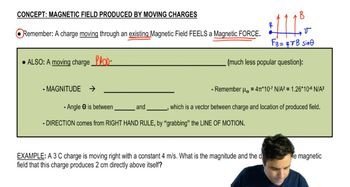
Magnetic Field Produced by Moving Charges

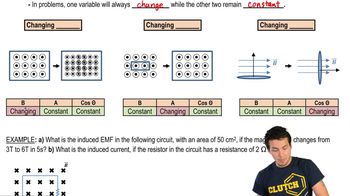
Faraday's Law of Electromagnetic Induction

Faraday's Law states that a change in magnetic flux through a circuit induces an electromotive force (EMF) in the circuit. In this case, as the magnetic field decreases at a rate of -0.10 T/s, it creates a changing magnetic flux, which induces a current and subsequently a force on the charge due to the induced electric field.
추천 영상:

Direction of Induced Force

The direction of the induced force on a charge can be determined using the right-hand rule and Lenz's Law. Lenz's Law states that the induced current will flow in a direction that opposes the change in magnetic flux. For a positive charge in a decreasing magnetic field, the induced electric field will act in a direction that creates a force on the charge, which can be determined by analyzing the orientation of the magnetic field and the charge's position.
추천 영상:
가이드 코스
09:49
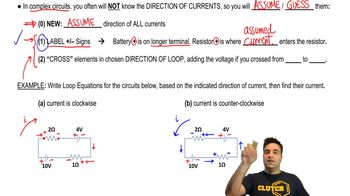
Direction of Current in Loop Equations
관련 실천
교과서 질문

If 75 MW of power at 45 kV (rms) arrives at a town from a generator via transmission lines of total resistance 3.0 Ω, calculate (a) the emf at the generator end of the lines, and (b) the fraction of the power generated that is wasted in the lines.

1956
views
교과서 질문

The primary windings of a transformer which has an 85% efficiency are connected to 110-V ac. The secondary windings are connected across a 2.4-Ω, 75-W lightbulb.

(a) Calculate the current through the primary windings of the transformer.

(b) Calculate the ratio of the number of primary windings of the transformer to the number of secondary windings of the transformer.

1669
views
교과서 질문

(II) For the electric power transmission system shown in Fig. 29–26, what is the ratio Ns/Np for (a) the step-up transformer, (b) the step-down transformer next to the home?

1668
views
교과서 질문

A model-train transformer plugs into 120-V ac and draws 0.35 A while supplying 6.5 A to the train.

(a) What voltage is present across the tracks?

(b) Is the transformer step-up or step-down?

1494
views
교과서 질문

A circular loop of area 12 m² encloses a magnetic field perpendicular to the plane of the loop; its magnitude is B(t) = (8.0 T/s)t. The loop is connected to a 7.5-Ω resistor and a 6.5-pF capacitor in series. When fully charged, how much charge is stored on the capacitor?

1285
views
교과서 질문

A high-intensity desk lamp is rated at 35 W but requires only 12 V. It contains a transformer that converts 120-V household voltage.

(a) Is the transformer step-up or step-down?

(b) What is the current in the secondary coil when the lamp is on?

1758
views