
Ch. 30 - Inductance, Electromagnetic Oscillations, and AC Circuits
Giancoli Douglas - Physics for Scientists and Engineers 5th edition
Giancoli Douglas5th editionPhysics for Scientists and EngineersISBN: 9780137488179당신이 사용하는 게 아니라요?교과서 변경
29장, 문제 72a

For an underdamped LRC circuit, determine a formula for the energy U = UE + UB stored in the electric and magnetic fields as a function of time. Give answer in terms of the initial charge Qo on the capacitor.

검증된 단계별 안내
1
Start by recalling the total energy stored in an LRC circuit, which is the sum of the energy stored in the electric field of the capacitor \( U_E \) and the energy stored in the magnetic field of the inductor \( U_B \). The total energy is given by \( U = U_E + U_B \).
The energy stored in the capacitor is \( U_E = \frac{1}{2} C V^2 \), where \( C \) is the capacitance and \( V \) is the voltage across the capacitor. Since \( V = \frac{Q}{C} \), this can be rewritten as \( U_E = \frac{1}{2} \frac{Q^2}{C} \), where \( Q \) is the charge on the capacitor.
The energy stored in the inductor is \( U_B = \frac{1}{2} L I^2 \), where \( L \) is the inductance and \( I \) is the current through the inductor. Using the relationship \( I = -\frac{dQ}{dt} \), this becomes \( U_B = \frac{1}{2} L \left( \frac{dQ}{dt} \right)^2 \).
For an underdamped LRC circuit, the charge on the capacitor as a function of time is given by \( Q(t) = Q_0 e^{-\gamma t} \cos(\omega_d t) \), where \( Q_0 \) is the initial charge, \( \gamma = \frac{R}{2L} \) is the damping coefficient, and \( \omega_d = \sqrt{\frac{1}{LC} - \gamma^2} \) is the damped angular frequency. Substitute this expression for \( Q(t) \) into the formulas for \( U_E \) and \( U_B \).
Combine \( U_E \) and \( U_B \) to express the total energy \( U(t) \) as a function of time. Simplify the expression to show how the energy decays over time due to the damping factor \( e^{-2\gamma t} \). The final formula will involve \( Q_0 \), \( C \), \( L \), \( \gamma \), and \( \omega_d \).

비슷한 문제에 대한 검증된 영상 답변:

이 영상 해법은 위 문제에 도움이 된다고 튜터들이 추천한 것입니다.
영상 길이:
12m
도움이 되었나요?

주요 개념

질문에 올바르게 답하기 위해 반드시 이해해야 하는 핵심 개념들은 다음과 같습니다.

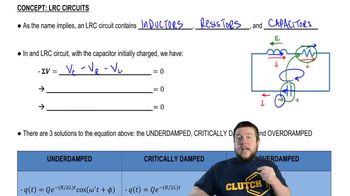
Underdamped LRC Circuit

An underdamped LRC circuit is a type of electrical circuit that consists of an inductor (L), a resistor (R), and a capacitor (C) where the resistance is low enough that the system oscillates rather than quickly settling to equilibrium. In this scenario, the circuit exhibits oscillatory behavior with a gradually decreasing amplitude, allowing for the analysis of energy transfer between the electric and magnetic fields over time.
추천 영상:
09:40
LRC Circuits

Energy in Electric and Magnetic Fields

In an LRC circuit, energy is stored in two forms: electric energy in the capacitor (UE) and magnetic energy in the inductor (UB). The electric energy is given by UE = 1/2 * C * V^2, where V is the voltage across the capacitor, while the magnetic energy is given by UB = 1/2 * L * I^2, where I is the current through the inductor. The total energy U = UE + UB varies over time as energy oscillates between these two forms.
추천 영상:
05:30
Magnetic Fields and Magnetic Dipoles

Initial Charge (Qo) on the Capacitor

The initial charge Qo on the capacitor is a critical parameter that influences the behavior of the LRC circuit. It determines the initial voltage across the capacitor and, consequently, the initial energy stored in the electric field. As the circuit oscillates, this initial charge plays a significant role in calculating the time-dependent energy stored in both the electric and magnetic fields, allowing for the derivation of a formula for U as a function of time.
추천 영상:
06:07
Point Charge Inside Capacitor
관련 실천
교과서 질문

At t = 0, the current through a 60.0-mH inductor is 50.0 mA and is increasing at the rate of 78.0 mA/s. What is the initial energy stored in the inductor, and how long does it take for the energy to increase by a factor of 8.0 from the initial value?

1008
views
교과서 질문

An ac voltage source V = Vo sin (ωt + 90°) is connected across an inductor L and current I = Io sin (ωt) flows in this circuit. Note that the current and source voltage are 90° out of phase.

(a) Directly calculate the average power delivered by the source over one period T of its sinusoidal cycle via the integral P = ∫₀ᵀ VI dt/T.

(b) Apply the relation P = Iᵣₘₛ Vᵣₘₛ cos Φ to this circuit and show that the answer you obtain is consistent with that found in part (a). Comment on your results.

1411
views
교과서 질문

An inductance coil draws 2.2 A dc when connected to a 45-V battery. When connected to a 60.0-Hz 120-V (rms) source, the current drawn is 3.8 A (rms). Determine the inductance and resistance of the coil.

1478
views
교과서 질문

At time t = 0, the switch in the circuit shown in Fig. 30–30 is closed. After a sufficiently long time, steady currents I₁, I₂, and I₃ flow through resistors R₁, R₂, and R₃, respectively. Determine these three currents.

973
views
교과서 질문

A pair of straight parallel thin wires, such as a lamp cord, each of radius r, are a distance 𝓁 apart and carry current to a circuit some distance away. Ignoring the field within each wire, show that the inductance per unit length is (μ₀/π) ln[(𝓁 - r) /r].

1577
views
교과서 질문

Show that the fraction of electromagnetic energy lost (to thermal energy) per cycle in a lightly damped (R² ≪ 4L/C) LRC circuit is approximately ΔUU=2πRLω=2πQ\(\frac{\Delta U}{U}\)=\(\frac{2\pi R}{L\omega}\)=\(\frac{2\pi}{Q}\). The quantity Q can be defined as Q = Lω/R, and is called the Q-value, or quality factor, of the circuit and is a measure of the damping present. A high Q-value means smaller damping and less energy input required to maintain oscillations.

1560
views