

Ch. 32 - Light: Reflection and Refraction
Giancoli Douglas - Physics for Scientists and Engineers 5th edition
Giancoli Douglas5th editionPhysics for Scientists and EngineersISBN: 9780137488179당신이 사용하는 게 아니라요?교과서 변경
31장, 문제 91

A coin lies at the bottom of a 0.95-m-deep pool. If a viewer sees it at a 45° angle, where is the image of the coin, relative to the coin? [Hint: The image is found by tracing back to the intersection of two rays.]

검증된 단계별 안내
1
Identify the given values: depth of the pool (0.95 m), angle of incidence (45°), and the refractive index of water (approximately 1.33).
Understand that light rays from the coin travel upwards and bend away from the normal as they exit the water due to refraction. This bending makes the coin appear shallower than it actually is.
Use Snell's Law, which is given by \( n_1 \sin(\theta_1) = n_2 \sin(\theta_2) \), where \( n_1 \) and \( n_2 \) are the refractive indices of water and air respectively, and \( \theta_1 \) and \( \theta_2 \) are the angles of incidence and refraction.
Calculate the angle of refraction using Snell's Law. Since the angle of incidence inside the water is 45°, and knowing the refractive indices, you can find \( \theta_2 \).
Determine the apparent depth using the formula \( d' = d \cdot \frac{\sin(\theta_2)}{\sin(\theta_1)} \), where \( d \) is the actual depth and \( d' \) is the apparent depth. This will give you the position of the image relative to the actual coin.

비슷한 문제에 대한 검증된 영상 답변:

이 영상 해법은 위 문제에 도움이 된다고 튜터들이 추천한 것입니다.
영상 길이:
8m
도움이 되었나요?

주요 개념

질문에 올바르게 답하기 위해 반드시 이해해야 하는 핵심 개념들은 다음과 같습니다.

Refraction of Light

Refraction is the bending of light as it passes from one medium to another, such as from water to air. This phenomenon occurs because light travels at different speeds in different materials. The change in speed causes the light rays to change direction, which is crucial for understanding how objects appear when viewed through a medium like water.
추천 영상:
가이드 코스
03:46
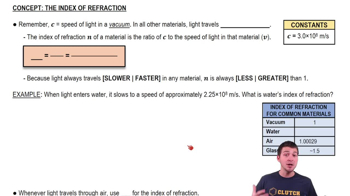
Index of Refraction

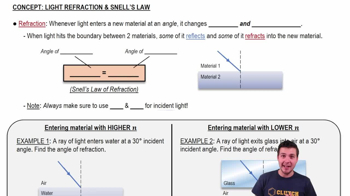
Snell's Law

Snell's Law describes the relationship between the angles of incidence and refraction when light passes through different media. It is mathematically expressed as n1 * sin(θ1) = n2 * sin(θ2), where n represents the refractive indices of the two media. This law helps predict how much the light will bend, which is essential for determining the position of the image of the coin.
추천 영상:

Ray Diagrams

Ray diagrams are visual representations used to illustrate how light travels and interacts with objects. In this context, tracing back the paths of light rays from the coin to the viewer helps locate the image of the coin. By drawing the incident and refracted rays, one can find the point where they appear to converge, indicating the position of the image relative to the actual object.
추천 영상:
가이드 코스
06:37
Ray Diagrams for Converging Lenses
관련 실천
교과서 질문

Suppose Fig. 32–37 shows a cylindrical rod whose end has a radius of curvature R = 2.0 cm, and the rod is immersed in water with index of refraction of 1.33. The rod has index of refraction 1.49. Find the location and height of the image of an object 2.0 mm high located 23 cm away from the rod.

1405
views
교과서 질문

The paint used on highway signs often contains small transparent spheres which provide nighttime illumination of the sign’s lettering by retro-reflecting vehicle headlight beams. Consider a light ray from air incident on one such sphere of radius r and index of refraction n. Let θ be its incident angle, and let the ray follow the path shown in Fig. 32–70, so that the ray exits the sphere in the direction exactly antiparallel to its incoming direction. Considering only rays for which sin θ can be approximated as θ, determine the required value for n.

1292
views
교과서 질문

You hold a small flat mirror 0.50 m in front of you and can see your reflection twice in that mirror because there is a full-length mirror 1.0 m behind you (Fig. 32–71). Determine the distance of each image from you.

<IMAGE>

1185
views
교과서 질문

An object is placed 21 cm from a certain mirror. The image is half the height of the object, inverted, and real. How far is the image from the mirror, and what is the radius of curvature of the mirror?

1454
views
교과서 질문

Figure 33–51 was taken from the NIST Laboratory (National Institute of Standards and Technology) in Boulder, CO, 2.0 km from the hiker in the photo. The Sun’s image was 15 mm across on the film. Estimate the focal length of the camera lens (actually a telescope). The Sun has diameter 1.4 x 10⁶ km, and it is 1.5 x 10⁸ km away.


<IMAGE>

1278
views