
Ch. 32 - Light: Reflection and Refraction
Giancoli Douglas - Physics for Scientists and Engineers 5th edition
Giancoli Douglas5th editionPhysics for Scientists and EngineersISBN: 9780137488179당신이 사용하는 게 아니라요?교과서 변경
31장, 문제 93

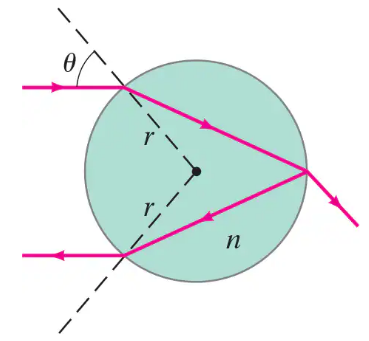
The paint used on highway signs often contains small transparent spheres which provide nighttime illumination of the sign’s lettering by retro-reflecting vehicle headlight beams. Consider a light ray from air incident on one such sphere of radius r and index of refraction n. Let θ be its incident angle, and let the ray follow the path shown in Fig. 32–70, so that the ray exits the sphere in the direction exactly antiparallel to its incoming direction. Considering only rays for which sin θ can be approximated as θ, determine the required value for n.

검증된 단계별 안내
1
Start by understanding the problem: The light ray enters a transparent sphere, refracts, reflects internally, and exits in a direction exactly antiparallel to its incoming direction. This is a retro-reflection phenomenon. We are tasked with finding the required value of the sphere's index of refraction (n) under the small-angle approximation (sin θ ≈ θ).
Apply Snell's Law at the point of entry of the light ray into the sphere. Snell's Law is given by: n1sinθ=n2sinθr, where n₁ is the refractive index of air (approximately 1), θ is the angle of incidence, n₂ is the refractive index of the sphere (n), and θₐ is the angle of refraction. Using the small-angle approximation, this simplifies to: θ=nθr.
Next, consider the internal reflection within the sphere. The light ray travels to the opposite side of the sphere, reflects, and returns. The geometry of the sphere ensures that the total internal angle traversed by the ray is 2θₐ. For the ray to exit antiparallel to its incoming direction, the total phase shift due to refraction and reflection must align with this condition.
At the exit point, apply Snell's Law again. The ray exits the sphere back into air, so the relationship is similar to the entry point: nθr=θ. This ensures that the ray exits at the same angle as it entered, but in the opposite direction.
Combine the relationships derived from Snell's Law and the geometry of the sphere. Using the small-angle approximation and the condition for retro-reflection, solve for the refractive index n. The result will depend on the geometry of the sphere and the angles involved, leading to a specific value for n that satisfies the antiparallel condition.

비슷한 문제에 대한 검증된 영상 답변:

이 영상 해법은 위 문제에 도움이 된다고 튜터들이 추천한 것입니다.
영상 길이:
5m
도움이 되었나요?

주요 개념

질문에 올바르게 답하기 위해 반드시 이해해야 하는 핵심 개념들은 다음과 같습니다.

Refraction

Refraction is the bending of light as it passes from one medium to another with a different index of refraction. This phenomenon occurs due to the change in speed of light in different materials. The relationship between the angles of incidence and refraction is described by Snell's Law, which states that n1 * sin(θ1) = n2 * sin(θ2), where n is the index of refraction and θ is the angle of incidence or refraction.
추천 영상:
가이드 코스
03:46
Index of Refraction

Retro-reflection

Retro-reflection is the property of a surface that reflects light back to its source, regardless of the angle of incidence. This is achieved through specific geometries, such as the use of transparent spheres, which redirect incoming light rays to exit in the opposite direction. This principle is crucial for highway signs, as it enhances visibility at night by ensuring that vehicle headlights illuminate the sign effectively.
추천 영상:
가이드 코스
06:25
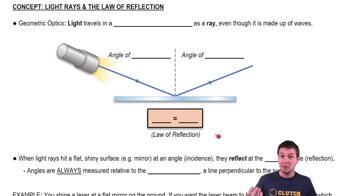
Law of Reflection

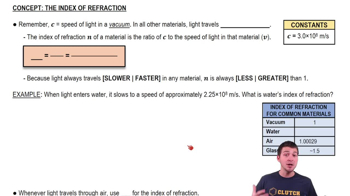
Index of Refraction

The index of refraction (n) is a dimensionless number that describes how much light slows down in a medium compared to its speed in a vacuum. It is defined as n = c/v, where c is the speed of light in a vacuum and v is the speed of light in the medium. A higher index indicates that light travels slower in that medium, which affects how light rays bend when entering or exiting the material, influencing the design of retro-reflective materials.
추천 영상:
가이드 코스
03:46
Index of Refraction