
Ch. 32 - Light: Reflection and Refraction
Giancoli Douglas - Physics for Scientists and Engineers 5th edition
Giancoli Douglas5th editionPhysics for Scientists and EngineersISBN: 9780137488179당신이 사용하는 게 아니라요?교과서 변경
31장, 문제 58

A beam of light is emitted 7.7 cm beneath the surface of a liquid and strikes the surface 7.2 cm from the point directly above the source. If total internal reflection occurs, what can you say about the index of refraction of the liquid?

검증된 단계별 안내
1
Understand the problem: The light beam is emitted from a point beneath the surface of a liquid and strikes the surface at an angle. Total internal reflection occurs, which means the angle of incidence at the surface is greater than or equal to the critical angle. The goal is to determine what this implies about the index of refraction of the liquid.
Define the critical angle: The critical angle \( \theta_c \) is the angle of incidence for which the angle of refraction is 90°. It is related to the index of refraction \( n \) of the liquid and the index of refraction of air (\( n_{\text{air}} \approx 1 \)) by the equation \( \sin(\theta_c) = \frac{n_{\text{air}}}{n} \).
Determine the geometry of the situation: The light travels a horizontal distance of 7.2 cm and a vertical distance of 7.7 cm. Using trigonometry, the angle of incidence \( \theta_i \) can be calculated as \( \tan(\theta_i) = \frac{7.2}{7.7} \), which gives \( \theta_i = \arctan\left(\frac{7.2}{7.7}\right) \).
Relate the angle of incidence to the critical angle: Since total internal reflection occurs, the angle of incidence \( \theta_i \) must satisfy \( \theta_i \geq \theta_c \). Using the relationship \( \sin(\theta_c) = \frac{1}{n} \), this implies \( \sin(\theta_i) \geq \frac{1}{n} \).
Conclude about the index of refraction: From the inequality \( \sin(\theta_i) \geq \frac{1}{n} \), solve for \( n \) to find \( n \geq \frac{1}{\sin(\theta_i)} \). Substitute \( \theta_i = \arctan\left(\frac{7.2}{7.7}\right) \) into this expression to determine the minimum possible value of the index of refraction of the liquid.

비슷한 문제에 대한 검증된 영상 답변:

이 영상 해법은 위 문제에 도움이 된다고 튜터들이 추천한 것입니다.
영상 길이:
4m
도움이 되었나요?

주요 개념

질문에 올바르게 답하기 위해 반드시 이해해야 하는 핵심 개념들은 다음과 같습니다.

Total Internal Reflection

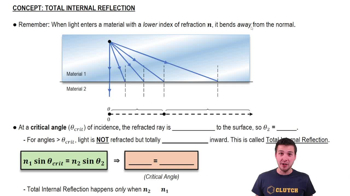
Total internal reflection occurs when a light wave traveling through a medium hits the boundary of a less dense medium at an angle greater than the critical angle, causing the light to reflect entirely back into the denser medium. This phenomenon is crucial in understanding how light behaves at the interface of different materials, particularly in optical fibers and underwater scenarios.
추천 영상:
가이드 코스
05:29
Total Internal Reflection

Index of Refraction

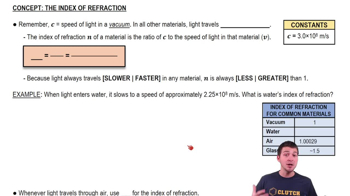
The index of refraction is a dimensionless number that describes how fast light travels in a medium compared to its speed in a vacuum. It is defined as the ratio of the speed of light in vacuum to the speed of light in the medium. A higher index indicates that light travels slower in that medium, which is essential for determining conditions for total internal reflection.
추천 영상:
가이드 코스
03:46
Index of Refraction

Snell's Law

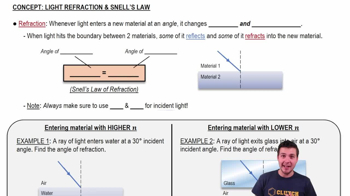
Snell's Law relates the angles of incidence and refraction when light passes between two different media. It is expressed as n1 * sin(θ1) = n2 * sin(θ2), where n is the index of refraction and θ is the angle relative to the normal. This law helps in calculating the critical angle for total internal reflection, which is necessary for analyzing the given scenario.
추천 영상:
관련 실천
교과서 질문

A parallel beam of light containing two wavelengths, λ₁ = 461 nm and λ₂ = 656 nm, enters the silicate flint glass of an equilateral prism as shown in Fig. 32–56. At what angle does each beam leave the prism (give angle with normal to the face)? See Fig. 32–28.

1224
views
교과서 질문

A fish is swimming in water inside a thin spherical glass bowl of uniform thickness. Assuming the radius of curvature of the bowl is 32.0 cm, locate the image of the fish if the fish is located: (a) at the center of the bowl; (b) 20.0 cm from the side of the bowl between the observer and the center of the bowl. Assume the fish is small.

1378
views
교과서 질문

(II) A ray of light, after entering a light fiber, reflects at an angle of 14.5° with the long axis of the fiber, as in Fig. 32–57. Calculate the distance along the axis of the fiber that the light ray travels between successive reflections off the sides of the fiber. Assume that the fiber has an index of refraction of 1.55 and is 1.60 x 10⁻⁴ m in diameter.

1295
views
교과서 질문

The critical angle for a certain liquid–air surface is 52.6°. What is the index of refraction of the liquid?

1367
views
교과서 질문

(III) A beam of light enters the end of an optic fiber as shown in Fig. 32–59. (a) Show that we can guarantee total internal reflection at the side surface of the material (at point A), if the index of refraction is greater than about 1.42. In other words, regardless of the angle α , the light beam reflects back into the material at point A, assuming air outside. (b) What if the fiber is immersed in water?

1206
views
교과서 질문

Two identical concave mirrors are set facing each other 1.0 m apart. A small lightbulb is placed halfway between the mirrors. A small piece of paper placed just to the left of the bulb prevents light from the bulb from directly shining on the left mirror, but light reflected from the right mirror still reaches the left mirror. A good image of the bulb appears on the left side of the piece of paper. What is the focal length of the mirrors?

98
views