
Ch. 32 - Light: Reflection and Refraction
Giancoli Douglas - Physics for Scientists and Engineers 5th edition
Giancoli Douglas5th editionPhysics for Scientists and EngineersISBN: 9780137488179당신이 사용하는 게 아니라요?교과서 변경
31장, 문제 52

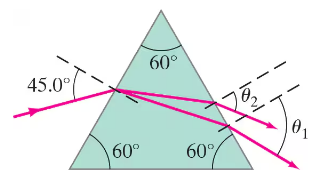
A parallel beam of light containing two wavelengths, λ₁ = 461 nm and λ₂ = 656 nm, enters the silicate flint glass of an equilateral prism as shown in Fig. 32–56. At what angle does each beam leave the prism (give angle with normal to the face)? See Fig. 32–28.
Diagram of an equilateral prism showing light refraction angles θ₁ and θ₂ for two wavelengths entering at 45 degrees.

검증된 단계별 안내
1
Identify the key concepts involved: This problem involves the refraction of light through a prism, which is governed by Snell's Law. The refractive index of the prism material depends on the wavelength of light, leading to dispersion (different angles for different wavelengths).
Apply Snell's Law at the first interface (air to prism): Snell's Law is given by n1sinθ1=n2sinθ2, where n1 is the refractive index of air (approximately 1), n2 is the refractive index of the prism for each wavelength, θ1 is the angle of incidence, and θ2 is the angle of refraction inside the prism. Use the given wavelengths to find the refractive indices for λ₁ = 461 nm and λ₂ = 656 nm from the material's dispersion relation (typically provided in a table or formula).
Determine the path of light inside the prism: Use the geometry of the equilateral prism to calculate the angle of incidence at the second interface (prism to air). The internal angle can be found using the prism's geometry and the angle of refraction from the first interface.
Apply Snell's Law at the second interface (prism to air): Again use n2sinθ2=n1sinθ3, where θ3 is the angle of refraction as the light exits the prism. Solve for θ3 for each wavelength.
Calculate the final angles with respect to the normal: The angle θ3 for each wavelength gives the angle of the exiting beam with respect to the normal to the prism face. Ensure you calculate this separately for λ₁ = 461 nm and λ₂ = 656 nm, as the refractive indices differ for each wavelength.

비슷한 문제에 대한 검증된 영상 답변:

이 영상 해법은 위 문제에 도움이 된다고 튜터들이 추천한 것입니다.
영상 길이:
10m
도움이 되었나요?

주요 개념

질문에 올바르게 답하기 위해 반드시 이해해야 하는 핵심 개념들은 다음과 같습니다.

Refraction

Refraction is the bending of light as it passes from one medium to another with a different density, which changes its speed. This phenomenon is described by Snell's Law, which relates the angles of incidence and refraction to the indices of refraction of the two media. In the context of the prism, the different wavelengths of light will refract at different angles due to their varying speeds in the glass.
추천 영상:
가이드 코스
03:46
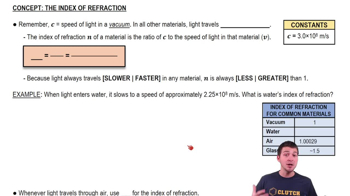
Index of Refraction

Dispersion

Dispersion occurs when different wavelengths of light are refracted by different amounts as they pass through a medium, such as glass. This results in the separation of light into its constituent colors, which is why a prism can create a spectrum. In this problem, the two wavelengths, λ₁ and λ₂, will exit the prism at different angles due to their distinct refractive indices.
추천 영상:
가이드 코스
05:48
Bullet Fired Into Block

Angle of Incidence and Angle of Refraction

The angle of incidence is the angle between the incoming light ray and the normal (a perpendicular line) to the surface at the point of incidence. The angle of refraction is the angle between the refracted ray and the normal. These angles are crucial for calculating how light behaves as it enters and exits the prism, and they are determined using Snell's Law, which is essential for solving the given problem.
추천 영상:
관련 실천
교과서 질문

(III) A light ray is incident on a flat piece of glass with index of refraction n as in Fig. 32–24. Show that if the incident angle θ is small, the emerging ray is displaced a distance d = tθ(n - 1)/n , where t is the thickness of the glass, θ is in radians, and d is the perpendicular distance between the incident ray and the (dashed) line of the emerging ray (Fig. 32–24).

1307
views
교과서 질문

(II) A ray of light, after entering a light fiber, reflects at an angle of 14.5° with the long axis of the fiber, as in Fig. 32–57. Calculate the distance along the axis of the fiber that the light ray travels between successive reflections off the sides of the fiber. Assume that the fiber has an index of refraction of 1.55 and is 1.60 x 10⁻⁴ m in diameter.

1295
views
교과서 질문

The critical angle for a certain liquid–air surface is 52.6°. What is the index of refraction of the liquid?

1367
views
교과서 질문

(II) In searching the bottom of a pool at night, a watchman shines a narrow beam of light from his flashlight, 1.3 m above the water level, onto the surface of the water at a point 2.8 m from his foot at the edge of the pool (Fig. 32–53). Where does the spot of light hit the bottom of the pool which is 2.1 m deep? Measure from the bottom of the wall beneath his foot.


<IMAGE>

1323
views
교과서 질문

A light beam strikes a piece of glass at a 55.00° incident angle. The beam contains two wavelengths, 450.0 nm and 700.0 nm, for which the index of refraction of the glass is 1.4831 and 1.4754, respectively. What is the angle between the two refracted beams?

1378
views
교과서 질문

A beam of light is emitted 7.7 cm beneath the surface of a liquid and strikes the surface 7.2 cm from the point directly above the source. If total internal reflection occurs, what can you say about the index of refraction of the liquid?

1525
views