
Ch. 33 - Lenses and Optical Instruments
Giancoli Douglas - Physics for Scientists and Engineers 5th edition
Giancoli Douglas5th editionPhysics for Scientists and EngineersISBN: 9780137488179당신이 사용하는 게 아니라요?교과서 변경
32장, 문제 60

(II) (a) What is the minimum index of refraction for a glass or plastic prism to be used in binoculars (Fig. 32–34) so that total internal reflection occurs at 45°? (b) Will binoculars work if their prisms (assume n = 1.58) are immersed in water? (c) What minimum n is needed if the prisms are immersed in water?

검증된 단계별 안내
1
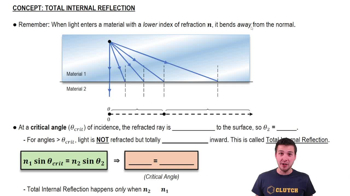
Step 1: Understand the concept of total internal reflection (TIR). TIR occurs when light travels from a medium with a higher refractive index to a medium with a lower refractive index, and the angle of incidence exceeds the critical angle. The critical angle is determined using the formula: θc=sin-1(n2n1), where n1 is the refractive index of the denser medium and n2 is the refractive index of the less dense medium.
Step 2: For part (a), calculate the minimum refractive index of the prism material required for TIR at an angle of 45°. Use the formula for the critical angle: θc=sin-1(n2n1). Here, θc is 45°, n2 is the refractive index of air (approximately 1.00), and n1 is the refractive index of the prism material. Rearrange the formula to solve for n1.
Step 3: For part (b), determine if the binoculars will work when the prisms are immersed in water. The refractive index of water is approximately 1.33. Use the same formula for the critical angle, but now n2 is 1.33 and n1 is 1.58. Calculate the critical angle and check if it is less than or equal to 45° for TIR to occur.
Step 4: For part (c), calculate the minimum refractive index of the prism material required for TIR when the prisms are immersed in water. Use the formula for the critical angle again, with θc as 45° and n2 as 1.33. Rearrange the formula to solve for n1.
Step 5: Summarize the findings for each part. For part (a), state the minimum refractive index required for TIR at 45° in air. For part (b), confirm whether the binoculars will work in water with the given refractive index of 1.58. For part (c), provide the minimum refractive index required for TIR at 45° in water.

비슷한 문제에 대한 검증된 영상 답변:

이 영상 해법은 위 문제에 도움이 된다고 튜터들이 추천한 것입니다.
영상 길이:
12m
도움이 되었나요?

주요 개념

질문에 올바르게 답하기 위해 반드시 이해해야 하는 핵심 개념들은 다음과 같습니다.

Total Internal Reflection

Total internal reflection occurs when a wave traveling through a medium hits a boundary with a less dense medium at an angle greater than the critical angle, causing the wave to reflect entirely back into the denser medium. This phenomenon is crucial in optics, particularly in prisms and fiber optics, as it allows for efficient light transmission without loss.
추천 영상:
가이드 코스
05:29
Total Internal Reflection

Index of Refraction

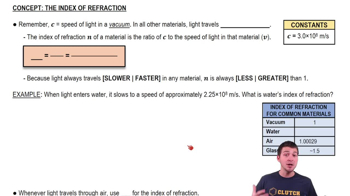
The index of refraction (n) is a dimensionless number that describes how light propagates through a medium. It is defined as the ratio of the speed of light in a vacuum to the speed of light in the medium. A higher index indicates that light travels slower in that medium, which is essential for determining conditions for total internal reflection.
추천 영상:
가이드 코스
03:46
Index of Refraction

Critical Angle

The critical angle is the minimum angle of incidence at which total internal reflection occurs when light travels from a denser medium to a less dense medium. It can be calculated using Snell's Law, and knowing the indices of refraction of the two media involved is essential for determining whether total internal reflection will happen in optical devices like prisms.
추천 영상:
관련 실천
교과서 질문

(II) An aquarium filled with water has flat glass sides whose index of refraction is 1.51. A beam of light from outside the aquarium strikes the glass at a 43.5° angle to the perpendicular (Fig. 32–52). What is the angle of this light ray when it enters (a) the glass, and then (b) the water? (c) What would be the refracted angle if the ray entered the water directly?

1297
views
교과서 질문

"(II) Two plane mirrors meet at a 135° angle, Fig. 32–47. If light rays strike one mirror at 32° as shown, at what angle θ do they leave the second mirror?


<IMAGE>"

1269
views
교과서 질문

An object is placed 96.0 cm from a glass lens (n = 1.52) with one concave surface of radius 22.0 cm and one convex surface of radius 18.5 cm.

(a) Where is the final image?

(b) What is the magnification?

1864
views
교과서 질문

Figure 33–49 is a photograph of an eyeball with the image of a boy in a doorway. (a) Is the eye here acting as a lens or as a mirror? (b) Is the eye being viewed right side up or is the camera taking this photo upside down? (c) Explain, based on all possible images made by a convex mirror or lens.


<IMAGE>

1133
views
교과서 질문

(II) A planoconvex lens (Fig. 33–2a) has one flat surface and the other has R = 15.3 cm. This lens is used to view a red and yellow object which is 62.0 cm away from the lens. The index of refraction of the glass is 1.5106 for red light and 1.5226 for yellow light. What are the locations of the red and yellow images formed by the lens?

1542
views
교과서 질문

A series of polarizers are each rotated 10° from the previous polarizer. Unpolarized light is incident on this series of polarizers. How many polarizers does the light have to go through before it is 1/6 of its original intensity?

63
views