

Ch. 33 - Lenses and Optical Instruments
Giancoli Douglas - Physics for Scientists and Engineers 5th edition
Giancoli Douglas5th editionPhysics for Scientists and EngineersISBN: 9780137488179당신이 사용하는 게 아니라요?교과서 변경
32장, 문제 32.3.

"(II) Two plane mirrors meet at a 135° angle, Fig. 32–47. If light rays strike one mirror at 32° as shown, at what angle θ do they leave the second mirror?


<IMAGE>"

검증된 단계별 안내
1
Identify the angle of incidence on the first mirror. The angle of incidence is given as 32°.
Apply the law of reflection on the first mirror, which states that the angle of incidence is equal to the angle of reflection. Therefore, the angle of reflection on the first mirror is also 32°.
Determine the angle between the two mirrors. Since the mirrors meet at a 135° angle, the angle between the normal of the first mirror and the second mirror is 135° - 90° = 45°.
Calculate the angle of incidence on the second mirror. This is the angle between the direction of the reflected ray from the first mirror and the normal to the second mirror. Since the reflected ray makes a 32° angle with the normal of the first mirror, and the mirrors are 45° apart, the angle of incidence on the second mirror is 45° - 32° = 13°.
Apply the law of reflection on the second mirror to find the angle of reflection, which is equal to the angle of incidence on the second mirror. Thus, the angle θ at which the light rays leave the second mirror is 13°.

비슷한 문제에 대한 검증된 영상 답변:

이 영상 해법은 위 문제에 도움이 된다고 튜터들이 추천한 것입니다.
영상 길이:
2m
도움이 되었나요?

주요 개념

질문에 올바르게 답하기 위해 반드시 이해해야 하는 핵심 개념들은 다음과 같습니다.

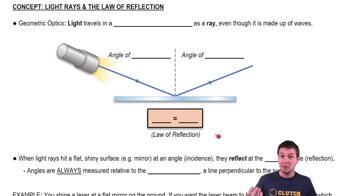
Law of Reflection

The Law of Reflection states that when a light ray strikes a reflective surface, the angle of incidence is equal to the angle of reflection. This principle is fundamental in understanding how light behaves when it encounters mirrors, allowing us to predict the path of light after it reflects off surfaces.
추천 영상:
가이드 코스
06:25
Law of Reflection

Angle Between Mirrors

The angle between two mirrors affects the total number of reflections and the angles at which light exits. In this case, with mirrors meeting at a 135° angle, the geometry of the setup will influence how the light rays are redirected after striking each mirror, requiring careful consideration of the angles involved.
추천 영상:
09:03
Mirror Equation

Geometric Relationships in Reflection

Understanding the geometric relationships in reflection involves analyzing how angles and positions of mirrors interact. For instance, when light strikes the first mirror at a specific angle, the subsequent angle at which it strikes the second mirror can be calculated using the known angles and the properties of triangles formed by the light paths.
추천 영상:
가이드 코스
06:25
Law of Reflection
관련 실천
교과서 질문

(II) A diverging lens is placed next to a converging lens of focal length ƒC , as in Fig. 33–14. If ƒT represents the focal length of the combination, show that the focal length of the diverging lens, ƒD , is given by


1/ƒD = (1/ƒT) - (1/ƒC)

1718
views
교과서 질문

(II) An aquarium filled with water has flat glass sides whose index of refraction is 1.51. A beam of light from outside the aquarium strikes the glass at a 43.5° angle to the perpendicular (Fig. 32–52). What is the angle of this light ray when it enters (a) the glass, and then (b) the water? (c) What would be the refracted angle if the ray entered the water directly?

1297
views
교과서 질문

(II) (a) What is the minimum index of refraction for a glass or plastic prism to be used in binoculars (Fig. 32–34) so that total internal reflection occurs at 45°? (b) Will binoculars work if their prisms (assume n = 1.58) are immersed in water? (c) What minimum n is needed if the prisms are immersed in water?

1299
views
교과서 질문

An object is placed 96.0 cm from a glass lens (n = 1.52) with one concave surface of radius 22.0 cm and one convex surface of radius 18.5 cm.

(a) Where is the final image?

(b) What is the magnification?

1864
views
교과서 질문

A series of polarizers are each rotated 10° from the previous polarizer. Unpolarized light is incident on this series of polarizers. How many polarizers does the light have to go through before it is 1/6 of its original intensity?

63
views
교과서 질문

A diverging lens with ƒ = -36.5 cm is placed 14.0 cm behind a converging lens with ƒ = 20.0cm. Where will an object at infinity be focused?

1771
views