Ch. 35 - Diffraction
Giancoli Douglas - Physics for Scientists and Engineers 5th edition
Giancoli Douglas5th editionPhysics for Scientists and EngineersISBN: 9780137488179당신이 사용하는 게 아니라요?교과서 변경
34장, 문제 45

Red laser light from a He–Ne laser (λ = 632.8 nm) creates a second-order fringe at 53.2° after passing through a grating. What is the wavelength λ of light that creates a first-order fringe at 21.2°?

검증된 단계별 안내
1
Step 1: Recall the diffraction grating equation: d \, \(\sin\) \(\theta\) = m \, \(\lambda\), where d is the spacing between adjacent slits in the grating, \(\theta\) is the diffraction angle, m is the order of the fringe, and \(\lambda\) is the wavelength of the light.
Step 2: Use the given information for the red laser light to calculate the grating spacing d. For the second-order fringe (m = 2) at an angle of \(\theta\) = 53.2^\(\circ\) and wavelength \(\lambda\) = 632.8 \, \(\text{nm}\), rearrange the equation to solve for d: d = \(\frac{m \, \lambda}{\sin \theta}\).
Step 3: Substitute the known values for the red laser light into the equation to calculate d. This value of d will be the same for the second part of the problem, as the grating is unchanged.
Step 4: Use the diffraction grating equation again to find the wavelength \(\lambda\) of the light that creates a first-order fringe (m = 1) at an angle of \(\theta\) = 21.2^\(\circ\). Rearrange the equation to solve for \(\lambda\): \(\lambda\) = \(\frac{d \, \sin \theta}{m}\).
Step 5: Substitute the value of d (calculated in Step 3) and the given values for m and \(\theta\) into the equation to find the wavelength \(\lambda\) of the light.

비슷한 문제에 대한 검증된 영상 답변:

이 영상 해법은 위 문제에 도움이 된다고 튜터들이 추천한 것입니다.
영상 길이:
4m
도움이 되었나요?

주요 개념

질문에 올바르게 답하기 위해 반드시 이해해야 하는 핵심 개념들은 다음과 같습니다.

Diffraction Grating

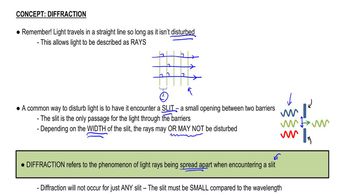
A diffraction grating is an optical component with a periodic structure that disperses light into its component wavelengths. When light passes through or reflects off a grating, it creates interference patterns due to the superposition of light waves. The angles at which these patterns occur depend on the wavelength of the light and the spacing of the grating lines.
추천 영상:

Interference Patterns

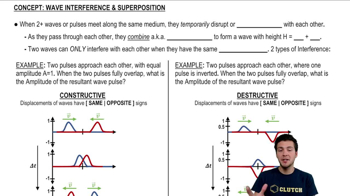
Interference patterns arise when two or more coherent light waves overlap, resulting in regions of constructive and destructive interference. In the context of diffraction gratings, these patterns are characterized by bright and dark fringes, where the position of the fringes is determined by the wavelength of the light and the angle of observation.
추천 영상:
가이드 코스
03:47
Wave Interference & Superposition

Order of Fringes

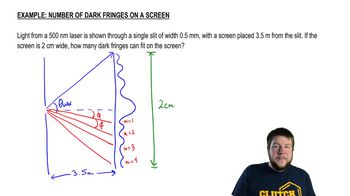
The order of fringes refers to the integer multiples of the wavelength that correspond to specific angles of constructive interference in a diffraction pattern. The first-order fringe (m=1) occurs at a certain angle for a given wavelength, while higher-order fringes (m=2, m=3, etc.) occur at angles that are multiples of the first-order angle, allowing for the calculation of unknown wavelengths based on known angles.
추천 영상:
가이드 코스
09:05
Number of Dark Fringes on a Screen