Ch. 35 - Diffraction
Giancoli Douglas - Physics for Scientists and Engineers 5th edition
Giancoli Douglas5th editionPhysics for Scientists and EngineersISBN: 9780137488179당신이 사용하는 게 아니라요?교과서 변경
34장, 문제 53

(II) X-rays of wavelength 0.138 nm fall on a crystal whose atoms, lying in planes, are spaced 0.315 nm apart. At what angle Φ (relative to the surface, Fig. 35–28) must the X-rays be directed if the first diffraction maximum is to be observed?

검증된 단계별 안내
1
Step 1: Recognize that this problem involves X-ray diffraction, which can be analyzed using Bragg's Law. Bragg's Law is given by: nλ=2dsinΦ, where n is the order of diffraction, λ is the wavelength of the X-rays, d is the spacing between atomic planes, and Φ is the angle of incidence.
Step 2: Identify the given values from the problem. The wavelength of the X-rays is λ=0.138nm, the spacing between atomic planes is d=0.315nm, and the order of diffraction for the first maximum is n=1.
Step 3: Rearrange Bragg's Law to solve for the angle Φ. The equation becomes: sinΦ=nλ/2d.
Step 4: Substitute the known values into the equation. Replace n with 1, λ with 0.138nm, and d with 0.315nm. The equation becomes: sinΦ=10.138/20.315.
Step 5: Calculate the value of sinΦ using the substituted values. Then, use the inverse sine function (sin1) to find the angle Φ. Ensure the angle is expressed in degrees or radians as required.

비슷한 문제에 대한 검증된 영상 답변:

이 영상 해법은 위 문제에 도움이 된다고 튜터들이 추천한 것입니다.
영상 길이:
3m
도움이 되었나요?

주요 개념

질문에 올바르게 답하기 위해 반드시 이해해야 하는 핵심 개념들은 다음과 같습니다.

Bragg's Law

Bragg's Law relates the wavelength of X-rays to the angle of diffraction and the spacing between atomic planes in a crystal. It is expressed as nλ = 2d sin(Φ), where n is the order of the maximum, λ is the wavelength, d is the distance between planes, and Φ is the angle of incidence. This law is fundamental in determining the conditions under which constructive interference occurs, leading to observable diffraction patterns.
추천 영상:

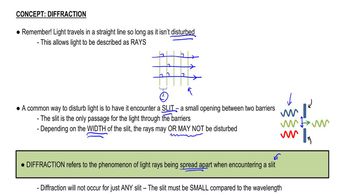
Diffraction

Diffraction is the bending of waves around obstacles and the spreading of waves when they pass through small openings. In the context of X-rays and crystals, diffraction occurs when X-rays interact with the periodic structure of the crystal lattice, resulting in interference patterns. The angles at which these patterns appear depend on the wavelength of the X-rays and the spacing of the crystal planes.
추천 영상:

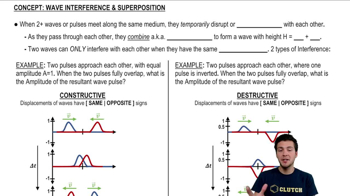
Interference

Interference is a phenomenon that occurs when two or more waves overlap, resulting in a new wave pattern. In X-ray diffraction, constructive interference leads to bright spots (maxima) at specific angles, while destructive interference results in dark spots (minima). Understanding interference is crucial for analyzing diffraction patterns and determining the angles at which maxima occur, as described by Bragg's Law.
추천 영상:
가이드 코스
03:47
Wave Interference & Superposition
관련 실천
교과서 질문

A diffraction grating has 15,000 rulings in its 1.9 cm width. Determine (a) its resolving power in first and second orders, and (b) the minimum wavelength resolution (∆λ) it can yield for λ = 410 nm.

1440
views

교과서 질문

(II) White light passes through a 640-slit/ mm diffraction grating. First-order and second-order visible spectra (“rainbows”) appear on the wall 32 cm away as shown in Fig. 35–40. Determine the widths ℓ₁ and ℓ₂ of the two “rainbows” (400 nm to 700 nm). In which order is the “rainbow” dispersed over a larger distance?

60
views
교과서 질문

What is the highest spectral order that can be seen if a grating with 6800 slits per cm is illuminated with 633-nm laser light? Assume normal incidence.

1593
views
교과서 질문

Red laser light from a He–Ne laser (λ = 632.8 nm) creates a second-order fringe at 53.2° after passing through a grating. What is the wavelength λ of light that creates a first-order fringe at 21.2°?

1389
views
교과서 질문

You want to design a spy satellite to photograph license plate numbers. Assuming it is necessary to resolve points separated by 2 cm with 550-nm light, and that the satellite orbits at a height of 130 km, what minimum lens aperture (diameter) is required?

122
views
교과서 질문

(II) (a) Suppose for a conventional X-ray image that the X-ray beam consists of parallel rays. What would be the magnification of the image? (b) Suppose, instead, that the X-rays come from a point source (as in Fig. 35–31) that is 15 cm in front of a human body which is 25 cm thick, and the film is pressed against the person’s back. Determine and discuss the range of magnifications that result.


<IMAGE>

52
views