
Ch. 35 - Diffraction
Giancoli Douglas - Physics for Scientists and Engineers 5th edition
Giancoli Douglas5th editionPhysics for Scientists and EngineersISBN: 9780137488179당신이 사용하는 게 아니라요?교과서 변경
34장, 문제 22b

(III) Derive an expression for the intensity in the interference pattern for three equally spaced slits. Express in terms of δ = 2πd sin θ / λ where d is the distance between adjacent slits and assume the slit width D ≈ λ . Show that there is only one secondary maximum between principal peaks.

검증된 단계별 안내
1
Start by recalling the general formula for the intensity in an interference pattern for multiple slits. The intensity is proportional to the square of the amplitude of the resultant wave. For three slits, the resultant amplitude is the sum of the amplitudes of the waves from each slit, taking into account their phase differences.
Express the amplitude of the wave from each slit. If the amplitude of the wave from a single slit is A, the total amplitude for three slits can be written as: A_total = A[1 + e^(iδ) + e^(2iδ)], where δ = (2πd sin θ) / λ is the phase difference between adjacent slits.
Simplify the expression for the total amplitude using the formula for the sum of a geometric series. For three terms, the sum is: A_total = A * (1 - e^(i3δ)) / (1 - e^(iδ)).
Calculate the intensity by taking the square of the magnitude of the total amplitude. Use the property |e^(iθ)| = 1 to simplify the magnitude. The intensity becomes proportional to: I ∝ |A_total|^2 = A^2 * [(sin(3δ/2))^2 / (sin(δ/2))^2].
For part (b), analyze the condition for secondary maxima. Secondary maxima occur when the numerator (sin(3δ/2))^2 is nonzero, but the denominator (sin(δ/2))^2 does not vanish. By examining the periodicity of the sine function, show that there is only one secondary maximum between the principal maxima, which occur when δ = 2πm (m is an integer).

비슷한 문제에 대한 검증된 영상 답변:

이 영상 해법은 위 문제에 도움이 된다고 튜터들이 추천한 것입니다.
영상 길이:
7m
도움이 되었나요?

주요 개념

질문에 올바르게 답하기 위해 반드시 이해해야 하는 핵심 개념들은 다음과 같습니다.

Interference Pattern

An interference pattern is a series of light and dark bands created when waves, such as light waves from multiple slits, overlap and combine. Constructive interference occurs when waves are in phase, leading to bright spots, while destructive interference occurs when they are out of phase, resulting in dark spots. The pattern's characteristics depend on the wavelength of the light, the distance between the slits, and the angle of observation.
추천 영상:
가이드 코스
03:47
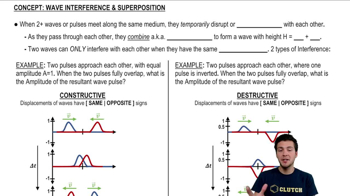
Wave Interference & Superposition

Path Difference

Path difference refers to the difference in distance traveled by two waves arriving at a point from different sources. In the context of multiple slits, the path difference is crucial for determining whether the waves will interfere constructively or destructively. It is often expressed in terms of the phase difference, which can be calculated using the formula δ = 2πd sin θ / λ, where d is the distance between slits, θ is the angle of observation, and λ is the wavelength.
추천 영상:

Secondary Maxima

Secondary maxima are the additional peaks in an interference pattern that occur between the principal maxima (the brightest spots). For three equally spaced slits, the conditions for secondary maxima are derived from the path difference and the resulting phase relationships. The analysis shows that there is only one secondary maximum between each pair of principal peaks, which is a result of the specific geometric arrangement of the slits and the wave nature of light.
추천 영상:
가이드 코스
05:55
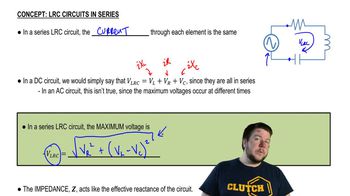
LRC Circuits in Series
관련 실천
교과서 질문

(a) Derive an expression for the intensity in the interference pattern for three equally spaced slits. Express in terms of δ = 2πd sin θ / λ where d is the distance between adjacent slits and assume the slit width D ≈ λ.

(b) Show that there is only one secondary maximum between principal peaks.

1398
views
교과서 질문

In a double-slit experiment, let d = 5.00D = 40.0λ. Compare (as a ratio) the intensity of the third-order interference maximum with that of the zero-order maximum.

1504
views
교과서 질문

The nearest neighboring star to the Sun is about 4 light-years away. If a planet happened to be orbiting this star at an orbital radius equal to that of the Earth–Sun distance, what minimum diameter would an Earth-based telescope’s aperture have to be in order to obtain an image that resolved this star–planet system? Assume the light emitted by the star and planet has a wavelength of 550 nm.

86
views
교과서 질문

When driving at night, your eyes’ pupils have dilated to a 7.5-mm diameter. If your vision is diffraction limited, what would be the greatest distance at which you could resolve the two headlights of an oncoming car, which are spaced 1.5 m apart? Assume a wavelength of 550 nm for the light.

69
views
교과서 질문

Two 0.010-mm-wide slits are 0.030 mm apart (center to center). Determine (a) the spacing between interference fringes for 520-nm light on a screen 1.0 m away and (b) the distance between the two diffraction minima on either side of the central maximum of the envelope.

74
views
교과서 질문

A 3800-slit/cm grating produces a third-order fringe at a 35.0° angle. What wavelength of light is being used?

82
views