

Ch. 35 - Diffraction
Giancoli Douglas - Physics for Scientists and Engineers 5th edition
Giancoli Douglas5th editionPhysics for Scientists and EngineersISBN: 9780137488179당신이 사용하는 게 아니라요?교과서 변경
34장, 문제 14c

Explain why the secondary maxima in the single-slit diffraction pattern do not occur precisely at β/2 = (m + 1/2)π where m = 1, 2, 3, ... Carefully and precisely plot the curves y = β/2 and y = tan β/2. From their intersections, determine the values of β for the first and second secondary maxima. What is the percent difference from β/2 = (m + 1/2)π?

검증된 단계별 안내
1
Step 1: Begin by understanding the single-slit diffraction pattern. The intensity distribution is governed by the equation I = I₀(sin²(β/2)/(β/2)²), where β = (2πa/λ)sinθ, and 'a' is the slit width, 'λ' is the wavelength, and θ is the diffraction angle. Secondary maxima occur where the intensity is locally maximized, but these do not align perfectly with β/2 = (m + 1/2)π due to the nonlinear nature of the intensity function.
Step 2: To analyze why secondary maxima deviate from β/2 = (m + 1/2)π, consider the mathematical behavior of the function y = β/2 and y = tan(β/2). Secondary maxima occur at intersections of these two curves, which are not perfectly aligned with β/2 = (m + 1/2)π because tan(β/2) grows faster than β/2 as β increases, causing a shift in the intersection points.
Step 3: Plot the curves y = β/2 and y = tan(β/2) on the same graph. Use a range of β values to visualize their behavior. The intersections of these curves correspond to the values of β for the secondary maxima. These intersections can be determined numerically or graphically by solving tan(β/2) = β/2.
Step 4: Calculate the values of β for the first and second secondary maxima by solving tan(β/2) = β/2 numerically. Compare these values to β/2 = (m + 1/2)π for m = 1 and m = 2. The deviation arises because the condition for secondary maxima is not strictly tied to the simple harmonic approximation used in β/2 = (m + 1/2)π.
Step 5: Determine the percent difference between the calculated β values for the secondary maxima and the corresponding values of β/2 = (m + 1/2)π. Use the formula Percent Difference = |(Calculated Value - Approximate Value)/Approximate Value| × 100%. This quantifies the deviation and highlights the impact of the nonlinear relationship between β/2 and tan(β/2).

주요 개념

질문에 올바르게 답하기 위해 반드시 이해해야 하는 핵심 개념들은 다음과 같습니다.

Single-Slit Diffraction

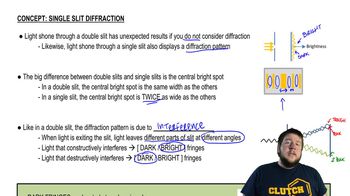
Single-slit diffraction occurs when light passes through a narrow opening, causing it to spread out and create a pattern of bright and dark fringes on a screen. The central maximum is the brightest, with subsequent maxima and minima determined by the slit width and wavelength of light. The positions of these maxima are influenced by the interference of light waves emanating from different parts of the slit.
추천 영상:
가이드 코스
12:33
Single Slit Diffraciton

Beta (β) Parameter

In the context of single-slit diffraction, the parameter β is defined as β = (πa/λ)sin(θ), where 'a' is the slit width, 'λ' is the wavelength of light, and 'θ' is the angle of diffraction. This parameter helps in determining the positions of the diffraction minima and maxima. The relationship between β and the angles of the diffraction pattern is crucial for understanding where the light intensity will be at its maximum or minimum.
추천 영상:
가이드 코스
05:21
Volume Thermal Expansion

Secondary Maxima

Secondary maxima in a single-slit diffraction pattern are the additional bright spots that occur between the primary maxima. Unlike the primary maxima, which occur at specific angles, the secondary maxima do not align perfectly with the theoretical positions given by β/2 = (m + 1/2)π. This discrepancy arises due to the complex interference effects and the finite width of the slit, leading to a need for precise calculations to determine their actual positions.
추천 영상:
가이드 코스
05:55
LRC Circuits in Series
관련 실천
교과서 질문

(a) Derive an expression for the intensity in the interference pattern for three equally spaced slits. Express in terms of δ = 2πd sin θ / λ where d is the distance between adjacent slits and assume the slit width D ≈ λ.

(b) Show that there is only one secondary maximum between principal peaks.

1398
views
교과서 질문

In a double-slit experiment, let d = 5.00D = 40.0λ. Compare (as a ratio) the intensity of the third-order interference maximum with that of the zero-order maximum.

1504
views
교과서 질문

(a) Explain why the secondary maxima in the single-slit diffraction pattern do not occur precisely at β/2 = (m + 1/2)π where m = 1, 2, 3, ... .

(b) By differentiating Eq. 35–7 with respect to β show that the secondary maxima occur when β/2 satisfies the relation tan(β/2) = β/2.

(c) Carefully and precisely plot the curves y = β/2 and y = tan β/2. From their intersections, determine the values of β for the first and second secondary maxima. What is the percent difference from β/2 = (m + 1/2)π?

1503
views
교과서 질문

Light of wavelength 580 nm falls on a slit that is 3.50 x 10⁻³ mm wide. Estimate how far the first brightest diffraction fringe is from the strong central maximum if the screen is 10.0 m away.

68
views
교과서 질문

Monochromatic light of wavelength 633 nm falls on a slit. If the angle between the first bright fringes on either side of the central maximum is 32°, estimate the slit width.

1585
views
교과서 질문

Two 0.010-mm-wide slits are 0.030 mm apart (center to center). Determine (a) the spacing between interference fringes for 520-nm light on a screen 1.0 m away and (b) the distance between the two diffraction minima on either side of the central maximum of the envelope.

74
views