Ch. 36 - The Special Theory of Relativity
Giancoli Douglas - Physics for Scientists and Engineers 5th edition
Giancoli Douglas5th editionPhysics for Scientists and EngineersISBN: 9780137488179당신이 사용하는 게 아니라요?교과서 변경
35장, 문제 70

A healthy astronaut’s heart rate is 60 beats/min . Flight doctors on Earth can monitor an astronaut’s vital signs remotely while in flight. How fast would an astronaut be flying away from Earth if the doctor measured her heart rate as 52 beats/min?

검증된 단계별 안내
1
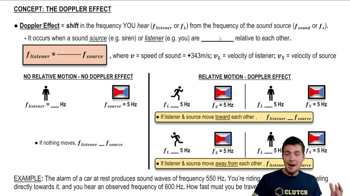
Identify the phenomenon being described, which is the Doppler effect for sound. This effect occurs when there is a relative motion between the source of sound and the observer, causing the frequency of the sound to change.
Understand that the frequency observed by the doctor is lower than the actual frequency of the astronaut's heart rate. This indicates that the astronaut is moving away from the observer (doctor).
Use the formula for the Doppler effect for sound when the source is moving away from the observer: f' = f / (1 + v/c), where f' is the observed frequency, f is the actual frequency, v is the velocity of the source relative to the observer, and c is the speed of sound in the medium.
Convert the heart rates from beats per minute to beats per second to match the standard units used in the Doppler effect formula. This can be done by dividing the heart rate by 60.
Rearrange the Doppler effect formula to solve for v, the velocity of the astronaut relative to Earth, and substitute the values for f' and f to find v.

비슷한 문제에 대한 검증된 영상 답변:

이 영상 해법은 위 문제에 도움이 된다고 튜터들이 추천한 것입니다.
영상 길이:
4m

주요 개념

질문에 올바르게 답하기 위해 반드시 이해해야 하는 핵심 개념들은 다음과 같습니다.

Doppler Effect

The Doppler Effect describes the change in frequency or wavelength of a wave in relation to an observer moving relative to the source of the wave. In this context, it explains how the astronaut's heart rate appears to decrease from 60 beats/min to 52 beats/min due to the relative motion away from the Earth, causing a redshift in the observed frequency.
추천 영상:
가이드 코스
07:40
The Doppler Effect

Relative Velocity

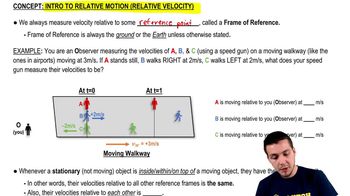
Relative velocity refers to the velocity of an object as observed from a particular reference frame. In this scenario, the astronaut's velocity away from Earth affects how their heart rate is perceived by the flight doctors, who are stationary relative to Earth. Understanding this concept is crucial for calculating the astronaut's speed based on the observed heart rate.
추천 영상:
가이드 코스
04:27
Intro to Relative Motion (Relative Velocity)

Physiological Responses to Motion

Physiological responses to motion include how the body reacts to changes in speed and direction, particularly in a microgravity environment. An astronaut's heart rate can be influenced by factors such as stress, physical exertion, and the effects of acceleration, which must be considered when interpreting the heart rate data in relation to their velocity away from Earth.
추천 영상:
관련 실천
교과서 질문

An atomic clock is taken to the North Pole, while another stays at the Equator. How far will they be out of synchronization after 1.5 years has elapsed? [Hint: Use the binomial expansion, Appendix A–2.]

1018
views

교과서 질문

How much energy would be required to break a helium nucleus into its constituents, two protons and two neutrons? The rest masses of a proton (including an electron), a neutron, and neutral helium are, respectively, 1.00783 u, 1.00867 u, and 4.00260 u. (This energy difference is called the total binding energy of the 24He_2^4\(\text{He}\) nucleus.)

82
views
교과서 질문

The Sun radiates energy at a rate of about 4 x 10²⁶ W.

(a) At what rate is the Sun’s mass decreasing?

(b) How long does it take for the Sun to lose a mass equal to that of Earth?

(c) Estimate how long the Sun could last if it radiated constantly at this rate.

998
views
교과서 질문

A spaceship moving toward Earth at 0.65c transmits radio signals at 95.0 MHz. At what frequency should Earth receivers be tuned?

1253
views
교과서 질문

What minimum amount of electromagnetic energy is needed to produce an electron and a positron together? A positron is a particle with the same mass as an electron, but has the opposite charge. (Note that electric charge is conserved in this process. See Section 37–5.)

990
views
교과서 질문

An electron (m = 9.11 x 10⁻³¹ kg) is accelerated from rest to speed v by a conservative force. In this process, its potential energy decreases by 7.20 x 10⁻¹⁴ J . Determine the electron’s speed, v.

1110
views