
Ch. 36 - The Special Theory of Relativity
Giancoli Douglas - Physics for Scientists and Engineers 5th edition
Giancoli Douglas5th editionPhysics for Scientists and EngineersISBN: 9780137488179당신이 사용하는 게 아니라요?교과서 변경
35장, 문제 81

How much energy would be required to break a helium nucleus into its constituents, two protons and two neutrons? The rest masses of a proton (including an electron), a neutron, and neutral helium are, respectively, 1.00783 u, 1.00867 u, and 4.00260 u. (This energy difference is called the total binding energy of the 24He_2^4\(\text{He}\) nucleus.)

검증된 단계별 안내
1
Step 1: Understand the concept of binding energy. The binding energy of a nucleus is the energy required to separate all its nucleons (protons and neutrons) into individual particles. It is calculated as the difference between the total mass of the individual nucleons and the mass of the nucleus, converted into energy using Einstein's equation, E = mc².
Step 2: Calculate the total mass of the individual nucleons. The helium nucleus consists of two protons and two neutrons. Using the given masses, the total mass of the nucleons is: \( m_{nucleons} = 2 \times 1.00783 \text{ u} + 2 \times 1.00867 \text{ u} \).
Step 3: Subtract the mass of the helium nucleus from the total mass of the nucleons to find the mass defect. The mass defect is given by: \( \Delta m = m_{nucleons} - m_{nucleus} \), where \( m_{nucleus} = 4.00260 \text{ u} \).
Step 4: Convert the mass defect into energy using Einstein's equation \( E = \Delta m \cdot c^2 \). To do this, first convert the mass defect from atomic mass units (u) to kilograms using the conversion factor \( 1 \text{ u} = 1.66054 \times 10^{-27} \text{ kg} \), and then multiply by \( c^2 \), where \( c = 3.00 \times 10^8 \text{ m/s} \).
Step 5: Express the binding energy in units of MeV. To convert the energy from joules to MeV, use the conversion factor \( 1 \text{ MeV} = 1.60218 \times 10^{-13} \text{ J} \). This will give you the total binding energy of the helium nucleus in MeV.

비슷한 문제에 대한 검증된 영상 답변:

이 영상 해법은 위 문제에 도움이 된다고 튜터들이 추천한 것입니다.
영상 길이:
7m
도움이 되었나요?

주요 개념

질문에 올바르게 답하기 위해 반드시 이해해야 하는 핵심 개념들은 다음과 같습니다.

Binding Energy

Binding energy is the energy required to disassemble a nucleus into its individual protons and neutrons. It represents the stability of the nucleus; a higher binding energy indicates a more stable nucleus. In the context of helium, the binding energy quantifies how much energy must be supplied to overcome the attractive forces holding the nucleons together.
추천 영상:
가이드 코스
04:10
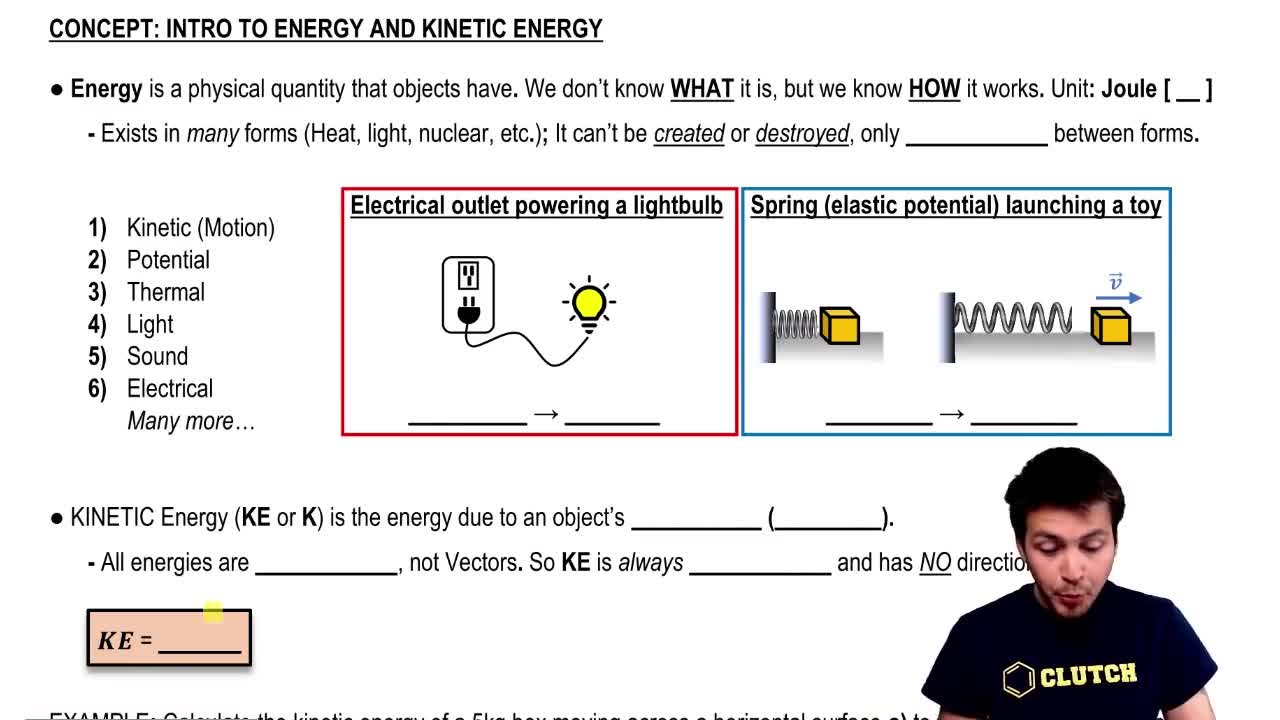
Intro to Energy & Types of Energy

Mass-Energy Equivalence

Mass-energy equivalence, encapsulated in Einstein's equation E=mc², states that mass can be converted into energy and vice versa. In nuclear physics, the mass of a nucleus is often less than the sum of its constituent particles' masses due to the binding energy. This principle is crucial for calculating the energy required to break apart a nucleus, as it relates mass differences to energy.
추천 영상:
가이드 코스
4:52
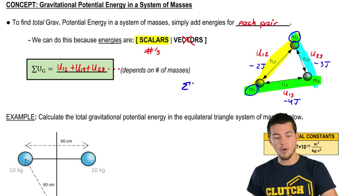
Gravitational Potential Energy for Systems of Masses

Nuclear Mass Defect

The nuclear mass defect is the difference between the mass of a nucleus and the total mass of its individual protons and neutrons when they are free. This defect arises because some mass is converted into binding energy that holds the nucleus together. Understanding the mass defect is essential for calculating the binding energy and, consequently, the energy required to break the nucleus apart.
추천 영상:
가이드 코스
03:55
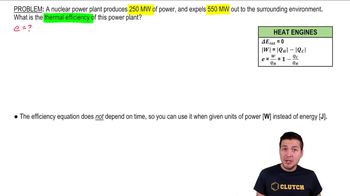
Efficiency of a Nuclear Power Plant
관련 실천
교과서 질문

The Sun radiates energy at a rate of about 4 x 10²⁶ W.

(a) At what rate is the Sun’s mass decreasing?

(b) How long does it take for the Sun to lose a mass equal to that of Earth?

(c) Estimate how long the Sun could last if it radiated constantly at this rate.

998
views
교과서 질문

A quasar emits familiar hydrogen lines whose wavelengths are 8.5% longer than what we measure in the laboratory.

(a) Using the Doppler formula for light, estimate the speed of this quasar.

(b) What result would you obtain if you used the “classical” Doppler shift discussed in Chapter 16?

60
views
교과서 질문

A healthy astronaut’s heart rate is 60 beats/min . Flight doctors on Earth can monitor an astronaut’s vital signs remotely while in flight. How fast would an astronaut be flying away from Earth if the doctor measured her heart rate as 52 beats/min?

887
views
교과서 질문

What minimum amount of electromagnetic energy is needed to produce an electron and a positron together? A positron is a particle with the same mass as an electron, but has the opposite charge. (Note that electric charge is conserved in this process. See Section 37–5.)

990
views
교과서 질문

A pi meson of mass mπ decays at rest into a muon (mass mμ) and a neutrino of negligible or zero mass. Show that the kinetic energy of the muon is Kμ = (mπ - mμ)² c² / (2mπ).

1238
views
교과서 질문

Two protons, each having a speed of 0.945c in the laboratory, are moving toward each other. Determine (a) the momentum of each proton in the laboratory, (b) the total momentum of the two protons in the laboratory, and (c) the momentum of one proton as seen by the other proton.

56
views