Ch. 44 - Astrophysics and Cosmology
Giancoli Douglas - Physics for Scientists and Engineers 5th edition
Giancoli Douglas5th editionPhysics for Scientists and EngineersISBN: 9780137488179당신이 사용하는 게 아니라요?교과서 변경
39장, 문제 63b

Use special relativity and Newton’s law of gravitation to show that a photon of mass m = E/c² just grazing the Sun will be deflected by an angle ∆θ given by ∆θ = 2GM/c²R, where G is the gravitational constant, R and M are the radius and mass of the Sun, and c is the speed of light. Put in values and show ∆θ = 0.87". (General Relativity predicts an angle twice as large, 1.74".)

검증된 단계별 안내
1
Step 1: Start by understanding the problem. The goal is to derive the deflection angle (∆θ) of a photon grazing the Sun using Newtonian gravity and special relativity. The photon is treated as having an equivalent mass m = E/c², where E is its energy and c is the speed of light.
Step 2: Use Newton's law of gravitation to calculate the gravitational force acting on the photon. The gravitational force is given by F = GMm/R², where G is the gravitational constant, M is the mass of the Sun, R is the radius of the Sun, and m is the photon's equivalent mass (m = E/c²). Substituting m = E/c² into the equation gives F = GME/(c²R²).
Step 3: Relate the force to the photon's deflection. The deflection angle ∆θ can be approximated by considering the transverse acceleration of the photon due to the gravitational force as it passes near the Sun. The transverse acceleration is a = F/m = GM/R². Since the photon travels at the speed of light c, the time it spends near the Sun is approximately t = 2R/c (assuming a straight-line path). The transverse displacement is then d = (1/2)at² = (1/2)(GM/R²)(2R/c)².
Step 4: Use the small-angle approximation to find the deflection angle. The deflection angle ∆θ is approximately the transverse displacement divided by the distance of closest approach (R). Substituting d and simplifying gives ∆θ = 2GM/(c²R). This is the desired result for the deflection angle using Newtonian gravity and special relativity.
Step 5: To verify the numerical value of ∆θ, substitute the known values: G = 6.674 × 10⁻¹¹ m³/kg·s², M = 1.989 × 10³⁰ kg (mass of the Sun), R = 6.96 × 10⁸ m (radius of the Sun), and c = 3.00 × 10⁸ m/s. Calculate ∆θ in radians and convert to arcseconds (1 radian = 206,265 arcseconds). The result should be approximately 0.87 arcseconds, which matches the prediction from Newtonian gravity. Note that General Relativity predicts a deflection angle twice as large, 1.74 arcseconds.

비슷한 문제에 대한 검증된 영상 답변:

이 영상 해법은 위 문제에 도움이 된다고 튜터들이 추천한 것입니다.
영상 길이:
12m
도움이 되었나요?

주요 개념

질문에 올바르게 답하기 위해 반드시 이해해야 하는 핵심 개념들은 다음과 같습니다.

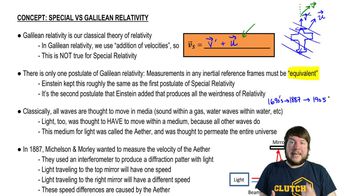
Special Relativity

Special relativity, formulated by Albert Einstein, describes the physics of objects moving at constant speeds, particularly those approaching the speed of light. It introduces the idea that the laws of physics are the same for all observers, regardless of their relative motion, and that the speed of light is constant in a vacuum. This theory leads to phenomena such as time dilation and length contraction, which are crucial for understanding the behavior of light and particles in high-energy environments.
추천 영상:
가이드 코스
17:25
Special Vs. Galilean Relativity

Newton's Law of Gravitation

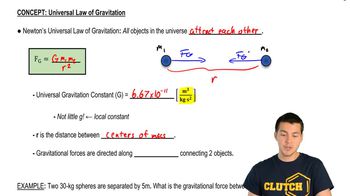
Newton's law of gravitation states that every point mass attracts every other point mass with a force that is directly proportional to the product of their masses and inversely proportional to the square of the distance between their centers. This law provides a framework for understanding gravitational interactions and is essential for calculating the gravitational force exerted by massive bodies like the Sun on objects passing nearby, such as photons.
추천 영상:
가이드 코스
04:05
Universal Law of Gravitation

Deflection of Light by Gravity

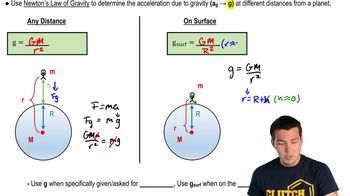
The deflection of light by gravity refers to the bending of light rays as they pass near a massive object, such as the Sun. According to both Newtonian physics and general relativity, light is affected by gravitational fields, leading to observable phenomena such as gravitational lensing. The angle of deflection can be calculated using the mass of the object and the distance from its center, illustrating the interplay between light and gravity in the context of astrophysics.
추천 영상:
가이드 코스
05:20
Acceleration Due to Gravity