
Ch. 44 - Astrophysics and Cosmology
Giancoli Douglas - Physics for Scientists and Engineers 5th edition
Giancoli Douglas5th editionPhysics for Scientists and EngineersISBN: 9780137488179당신이 사용하는 게 아니라요?교과서 변경
39장, 문제 66

Determine the radius of a neutron star using the same argument as in Problem 65 but for N neutrons only. Show that the radius of a neutron star, of 1.5 solar masses, is about 11 km.

검증된 단계별 안내
1
Start by understanding the concept of a neutron star. A neutron star is an extremely dense remnant of a massive star that has undergone a supernova explosion. Its density is so high that it is composed almost entirely of neutrons. The radius of a neutron star can be estimated using the balance between gravitational forces and the degeneracy pressure of neutrons.
The mass of the neutron star is given as 1.5 solar masses. Convert this mass into kilograms using the solar mass value: \( M_{\odot} = 1.989 \times 10^{30} \, \text{kg} \). Thus, the mass of the neutron star is \( M = 1.5 \times M_{\odot} \).
Assume the neutron star is a sphere of uniform density. The density \( \rho \) can be expressed as \( \rho = \frac{M}{\frac{4}{3} \pi R^3} \), where \( R \) is the radius of the neutron star. Rearrange this equation to express \( R \) in terms of \( M \) and \( \rho \): \( R = \left( \frac{3M}{4\pi \rho} \right)^{1/3} \).
The density of a neutron star is approximately equal to the nuclear density, which is \( \rho \approx 2.8 \times 10^{17} \, \text{kg/m}^3 \). Substitute this value, along with the mass \( M \), into the equation for \( R \) to calculate the radius.
Simplify the expression and compute \( R \) to find that the radius of the neutron star is approximately 11 km. This result is consistent with the typical size of neutron stars observed in astrophysics.

비슷한 문제에 대한 검증된 영상 답변:

이 영상 해법은 위 문제에 도움이 된다고 튜터들이 추천한 것입니다.
영상 길이:
3m
도움이 되었나요?

주요 개념

질문에 올바르게 답하기 위해 반드시 이해해야 하는 핵심 개념들은 다음과 같습니다.

Neutron Star Structure

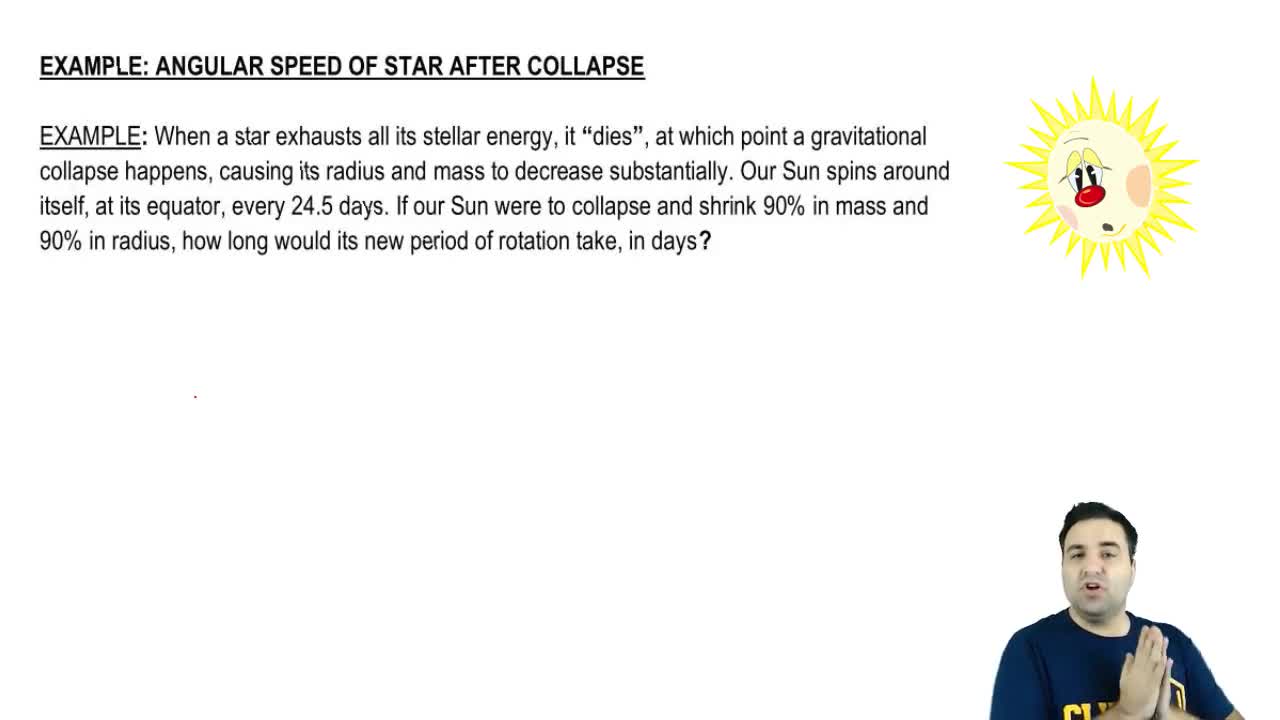
A neutron star is the remnants of a supernova explosion, primarily composed of neutrons. It is incredibly dense, with a mass greater than that of the Sun compressed into a sphere with a radius of about 10-12 kilometers. The balance between gravitational collapse and neutron degeneracy pressure defines its structure, where neutrons resist further compression.
추천 영상:

Gravitational Binding Energy

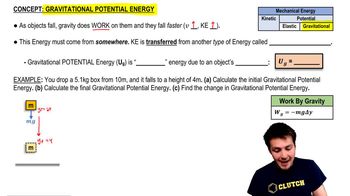
The gravitational binding energy is the energy required to disassemble a celestial body into its constituent parts, overcoming the gravitational forces holding it together. For neutron stars, this energy is significant due to their high mass and density, influencing their stability and radius. It can be calculated using the mass and radius of the star, providing insights into its physical properties.
추천 영상:
가이드 코스
06:35
Gravitational Potential Energy

Mass-Radius Relationship

The mass-radius relationship for neutron stars indicates that there is a correlation between the mass of the star and its radius. As the mass increases, the radius typically decreases due to the intense gravitational forces at play. This relationship is crucial for understanding the physical limits of neutron stars and can be derived from equations of state for neutron-rich matter.
추천 영상:
가이드 코스
06:18
Calculating Radius of Nitrogen