Ch 19: Work, Heat, and the First Law of Thermodynamics
Knight Calc - Physics for Scientists and Engineers 5th Edition
Knight Calc5th EditionPhysics for Scientists and EngineersISBN: 9780137344796당신이 사용하는 게 아니라요?교과서 변경
19장, 문제 30b

A gas cylinder holds 0.10 mol of O₂ at 150°C and a pressure of 3.0 atm. The gas expands adiabatically until the pressure is halved. What are the final temperature?

검증된 단계별 안내
1
Step 1: Recognize that the problem involves an adiabatic process. In an adiabatic process, no heat is exchanged with the surroundings, and the relationship between pressure, volume, and temperature is governed by the adiabatic condition: \( P V^\gamma = \text{constant} \), where \( \gamma \) is the adiabatic index (ratio of specific heats, \( C_p / C_v \)). For diatomic gases like O₂, \( \gamma \approx 1.4 \).
Step 2: Use the ideal gas law \( P V = n R T \) to express the initial volume \( V_1 \) in terms of the given quantities: \( V_1 = \frac{n R T_1}{P_1} \). Here, \( n = 0.10 \; \text{mol} \), \( R = 8.314 \; \text{J/(mol·K)} \), \( T_1 = 150 + 273 = 423 \; \text{K} \), and \( P_1 = 3.0 \; \text{atm} \) (convert to Pascals if needed).
Step 3: Apply the adiabatic condition \( P_1 V_1^\gamma = P_2 V_2^\gamma \). Since \( P_2 = \frac{P_1}{2} \), substitute this into the equation to find the relationship between \( V_1 \) and \( V_2 \): \( V_2 = V_1 \left( \frac{P_1}{P_2} \right)^{1/\gamma} \).
Step 4: Use the ideal gas law again to relate the final temperature \( T_2 \) to the final volume \( V_2 \): \( T_2 = \frac{P_2 V_2}{n R} \). Substitute \( V_2 \) from Step 3 into this equation to express \( T_2 \) in terms of known quantities: \( T_2 = T_1 \left( \frac{P_2}{P_1} \right)^{(\gamma - 1)/\gamma} \).
Step 5: Simplify the expression for \( T_2 \) using the given values: \( T_2 = 423 \; \text{K} \times \left( \frac{1}{2} \right)^{(1.4 - 1)/1.4} \). This will give the final temperature after the adiabatic expansion.

비슷한 문제에 대한 검증된 영상 답변:

이 영상 해법은 위 문제에 도움이 된다고 튜터들이 추천한 것입니다.

주요 개념

질문에 올바르게 답하기 위해 반드시 이해해야 하는 핵심 개념들은 다음과 같습니다.

Adiabatic Process

An adiabatic process is one in which no heat is exchanged with the surroundings. In the context of gases, this means that any change in internal energy is solely due to work done on or by the gas. For an ideal gas undergoing adiabatic expansion, the relationship between pressure, volume, and temperature can be described by specific equations, such as the adiabatic condition, which relates these variables without heat transfer.
추천 영상:
가이드 코스
06:13
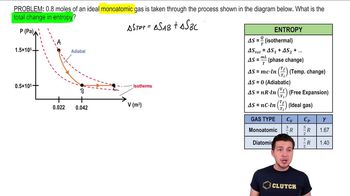
Entropy & Ideal Gas Processes

Ideal Gas Law

The Ideal Gas Law is a fundamental equation in thermodynamics that relates the pressure, volume, temperature, and number of moles of a gas. It is expressed as PV = nRT, where P is pressure, V is volume, n is the number of moles, R is the ideal gas constant, and T is temperature in Kelvin. This law is essential for calculating changes in state variables during processes like expansion or compression.
추천 영상:
가이드 코스
07:21
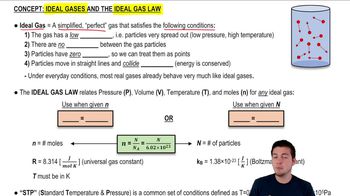
Ideal Gases and the Ideal Gas Law

Temperature and Pressure Relationship in Gases

In gases, temperature and pressure are directly related through the Ideal Gas Law. When a gas expands adiabatically and its pressure decreases, its temperature also changes. For an ideal gas, the relationship can be further analyzed using the adiabatic equations, which show how temperature decreases as pressure drops during expansion, allowing for the calculation of the final temperature after the process.
추천 영상:
가이드 코스
08:10
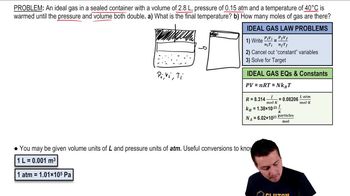
Doubling Pressure & Temperature