Ch 19: Work, Heat, and the First Law of Thermodynamics
Knight Calc - Physics for Scientists and Engineers 5th Edition
Knight Calc5th EditionPhysics for Scientists and EngineersISBN: 9780137344796당신이 사용하는 게 아니라요?교과서 변경
19장, 문제 31b

The volume of a gas is halved during an adiabatic compression that increases the pressure by a factor of 2.5. By what factor does the temperature increase?

검증된 단계별 안내
1
Step 1: Recall the relationship for an adiabatic process, which is governed by the equation \( PV^\gamma = \text{constant} \), where \( \gamma \) (gamma) is the adiabatic index or ratio of specific heats \( \gamma = \frac{C_p}{C_v} \). This equation implies that pressure, volume, and temperature are interrelated during an adiabatic process.
Step 2: Use the ideal gas law \( PV = nRT \) to relate pressure, volume, and temperature. Since \( nR \) is constant, the temperature can be expressed as \( T = \frac{PV}{nR} \). This means that changes in pressure and volume will directly affect the temperature.
Step 3: For an adiabatic process, the temperature ratio can be derived using the relationship \( T_2 / T_1 = (V_1 / V_2)^{\gamma - 1} \). Here, \( V_1 \) is the initial volume, \( V_2 \) is the final volume, and \( \gamma \) is the adiabatic index. Substitute \( V_2 = \frac{V_1}{2} \) (since the volume is halved).
Step 4: Substitute the given pressure ratio \( P_2 / P_1 = 2.5 \) into the adiabatic relationship \( P_1 V_1^\gamma = P_2 V_2^\gamma \). This allows you to confirm the consistency of the pressure and volume changes with the adiabatic process.
Step 5: Combine the pressure and volume relationships to calculate the temperature ratio \( T_2 / T_1 \). Use the formula \( T_2 / T_1 = (P_2 / P_1)^{(\gamma - 1)/\gamma} \) and substitute \( P_2 / P_1 = 2.5 \). The value of \( \gamma \) depends on the type of gas (e.g., \( \gamma = 1.4 \) for diatomic gases like air).

비슷한 문제에 대한 검증된 영상 답변:

이 영상 해법은 위 문제에 도움이 된다고 튜터들이 추천한 것입니다.
영상 길이:
6m

주요 개념

질문에 올바르게 답하기 위해 반드시 이해해야 하는 핵심 개념들은 다음과 같습니다.

Adiabatic Process

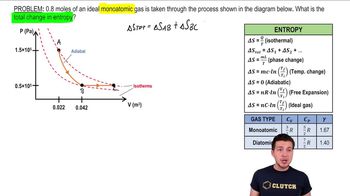
An adiabatic process is a thermodynamic process in which no heat is exchanged with the surroundings. In such processes, any change in the internal energy of the system is due solely to work done on or by the system. This concept is crucial for understanding how gases behave under compression or expansion without heat transfer.
추천 영상:
가이드 코스
06:13
Entropy & Ideal Gas Processes

Ideal Gas Law

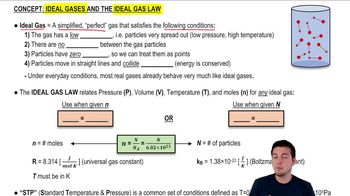
The Ideal Gas Law relates the pressure, volume, temperature, and number of moles of a gas through the equation PV = nRT. This law provides a foundational understanding of gas behavior and is essential for calculating changes in state variables during processes like adiabatic compression, where pressure and volume change while maintaining a constant number of moles.
추천 영상:
가이드 코스
07:21
Ideal Gases and the Ideal Gas Law

Temperature and Pressure Relationship in Adiabatic Processes

In an adiabatic process, the relationship between temperature and pressure can be described by the equation T1 * V1^(γ-1) = T2 * V2^(γ-1), where γ (gamma) is the heat capacity ratio (Cp/Cv). This relationship indicates how temperature changes in response to pressure and volume changes, allowing us to determine the factor by which temperature increases when the volume is halved and pressure is increased.
추천 영상:
가이드 코스
08:10
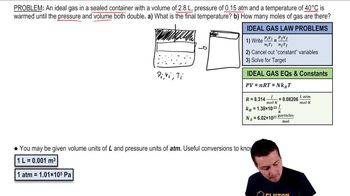
Doubling Pressure & Temperature