
Ch 01: Units, Physical Quantities & Vectors
Young & Freedman Calc - University Physics 14th Edition
Young & Freedman Calc14th EditionUniversity PhysicsISBN: 9780321973610당신이 사용하는 게 아니라요?교과서 변경
1장, 문제 32

A postal employee drives a delivery truck over the route shown in Fig. E1.25. Use the method of components to determine the magnitude and direction of her resultant displacement. In a vector-addition diagram (roughly to scale), show that the resultant displacement found from your diagram is in qualitative agreement with the result you obtained by using the method of components.
Map showing delivery route with distances and angles for vector addition in physics.

검증된 단계별 안내
1
Identify the vectors involved in the problem. The postal employee's route consists of three segments: 2.6 km north, 4.0 km east, and 3.1 km at a 45-degree angle north of east.
Break down each vector into its components. For the first vector (2.6 km north), the components are: x-component = 0 km, y-component = 2.6 km. For the second vector (4.0 km east), the components are: x-component = 4.0 km, y-component = 0 km.
For the third vector (3.1 km at 45 degrees north of east), use trigonometry to find the components: x-component = 3.1 km * cos(45°), y-component = 3.1 km * sin(45°).
Add the components of all vectors to find the resultant vector. Sum the x-components: 0 km + 4.0 km + (3.1 km * cos(45°)). Sum the y-components: 2.6 km + 0 km + (3.1 km * sin(45°)).
Calculate the magnitude of the resultant displacement using the Pythagorean theorem: magnitude = sqrt((sum of x-components)^2 + (sum of y-components)^2). Determine the direction using the arctangent function: direction = arctan((sum of y-components) / (sum of x-components)).

비슷한 문제에 대한 검증된 영상 답변:

이 영상 해법은 위 문제에 도움이 된다고 튜터들이 추천한 것입니다.
영상 길이:
4m
도움이 되었나요?

주요 개념

질문에 올바르게 답하기 위해 반드시 이해해야 하는 핵심 개념들은 다음과 같습니다.

Vector Addition

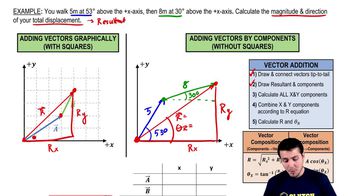
Vector addition involves combining two or more vectors to determine a resultant vector. This process can be visualized graphically by placing the tail of one vector at the head of another, forming a triangle or polygon. The resultant vector is drawn from the tail of the first vector to the head of the last vector, representing the overall effect of the individual vectors.
추천 영상:
가이드 코스
07:30
Vector Addition By Components

Components of a Vector

Vectors can be broken down into their components along the axes of a coordinate system, typically the x and y axes. This method simplifies calculations, as each component can be treated as a separate scalar quantity. The magnitude of the resultant vector can be found using the Pythagorean theorem, while the direction can be determined using trigonometric functions such as sine and cosine.
추천 영상:
가이드 코스
07:30
Vector Addition By Components

Resultant Displacement

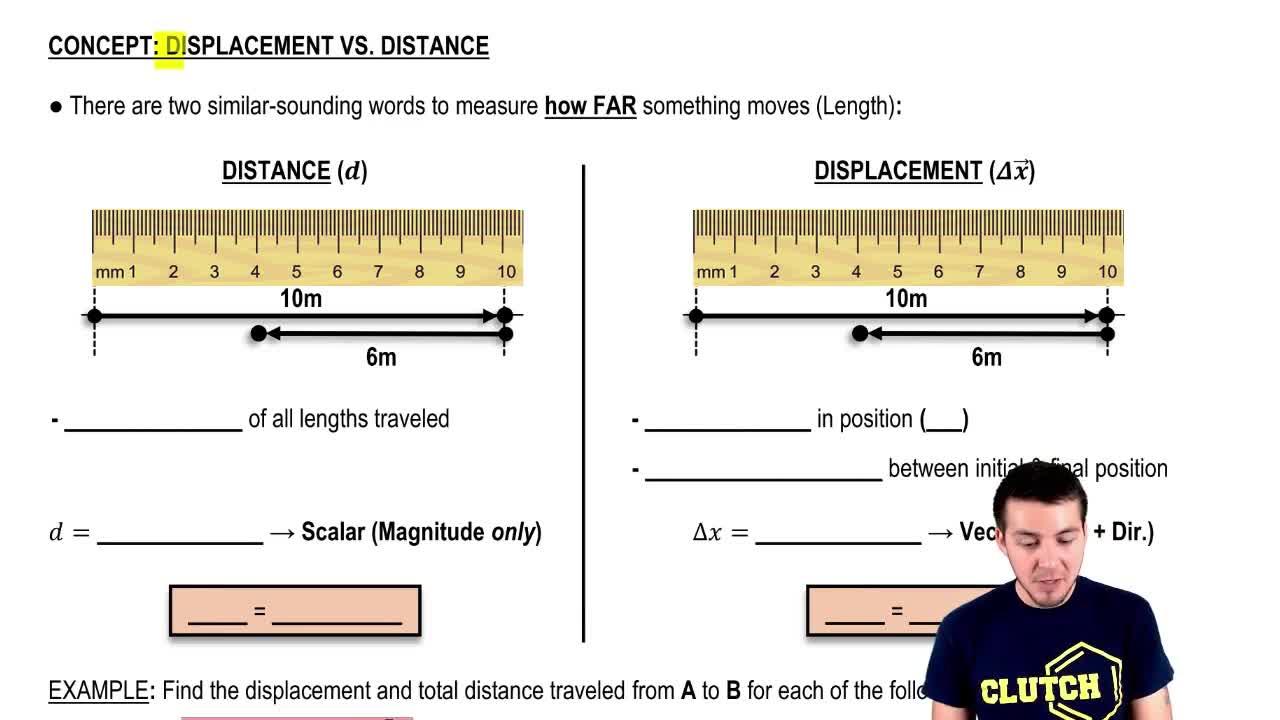
Resultant displacement is the overall change in position from the starting point to the endpoint, represented as a single vector. It accounts for both the distance traveled and the direction of travel. In this context, calculating the resultant displacement involves summing the individual displacements along the route and determining the final position relative to the starting point.
추천 영상:
가이드 코스
06:13
Displacement vs. Distance