For the vectors A and B in Fig. E1.24, use a scale drawing to find the magnitude and direction of the vector difference A − B.
Ch 01: Units, Physical Quantities & Vectors
1장, 문제 26
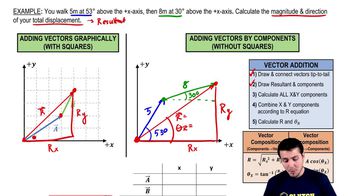
A spelunker is surveying a cave. She follows a passage 180 m straight west, then 210 m in a direction 45° east of south, and then 280 m at 30° east of north. After a fourth displacement, she finds herself back where she started. Use a scale drawing to determine the magnitude and direction of the fourth displacement.
검증된 단계별 안내1
Begin by understanding the problem: The spelunker makes three displacements and returns to her starting point after a fourth displacement. We need to find the magnitude and direction of this fourth displacement.
Break down each displacement into its vector components. For the first displacement, 180 m straight west, the vector is (-180, 0) in Cartesian coordinates, assuming east is positive x and north is positive y.
For the second displacement, 210 m at 45° east of south, calculate the components using trigonometry. The x-component is 210 * sin(45°) and the y-component is -210 * cos(45°), as it is southward.
For the third displacement, 280 m at 30° east of north, calculate the components similarly. The x-component is 280 * sin(30°) and the y-component is 280 * cos(30°), as it is northward.
Add the components of the three displacements to find the resultant vector. The fourth displacement will be the negative of this resultant vector, as it brings the spelunker back to the starting point. Calculate the magnitude and direction using the Pythagorean theorem and inverse tangent function.

비슷한 문제에 대한 검증된 영상 답변:
이 영상 해법은 위 문제에 도움이 된다고 튜터들이 추천한 것입니다.
영상 길이:
20m도움이 되었나요?
주요 개념
질문에 올바르게 답하기 위해 반드시 이해해야 하는 핵심 개념들은 다음과 같습니다.
Vector Addition
Vector addition is the process of combining vectors to determine a resultant vector. In this problem, the spelunker's movements can be represented as vectors, each with a magnitude and direction. By adding these vectors graphically or mathematically, we can find the resultant vector that returns her to the starting point.
추천 영상:
가이드 코스
Vector Addition By Components
Trigonometry in Physics
Trigonometry is essential for resolving vectors into their components, especially when dealing with angles. The spelunker's movements involve directions given in degrees, requiring the use of sine and cosine functions to break down each vector into horizontal and vertical components, facilitating accurate vector addition.
추천 영상:
가이드 코스
Trigonometry
Scale Drawing
A scale drawing is a graphical representation that maintains proportionality between the actual distances and the drawn distances. In this problem, a scale drawing helps visualize the spelunker's path and determine the magnitude and direction of the fourth displacement by accurately plotting each vector and measuring the resultant vector.
추천 영상:
가이드 코스
Introduction To Temperature Scales
관련 실천
교과서 질문
2411
views
교과서 질문
Vector A has y-component Ay = +9.60 m. A makes an angle of 32.0° counterclockwise from the +y-axis. (a) What is the x-component of A? (b) What is the magnitude of A?
2434
views
교과서 질문
Compute the x- and y-components of the vectors A, B, C, and D in Fig. E1.24.
4160
views
교과서 질문
Let θ be the angle that the vector A makes with the +x-axis, measured counterclockwise from that axis. Find angle θ for a vector that has these components: Ax = 2.00m, Ay = −1.00 m
2592
views
교과서 질문
You are using water to dilute small amounts of chemicals in the laboratory, drop by drop. How many drops of water are in a 1.0-L bottle?
1309
views
교과서 질문
For the vectors A and B in Fig. E1.24, use a scale drawing to find the magnitude and direction of the vector sum A + B
6185
views