Ch 01: Units, Physical Quantities & Vectors
Young & Freedman Calc - University Physics 14th Edition
Young & Freedman Calc14th EditionUniversity PhysicsISBN: 9780321973610당신이 사용하는 게 아니라요?교과서 변경
1장, 문제 46a

For the two vectors in Fig. E1.35, find the magnitude and direction of the vector product A x B
Diagram showing vectors A and B with magnitudes and angles in a Cartesian plane.

검증된 단계별 안내
1
First, understand that the vector product, also known as the cross product, of two vectors \( \mathbf{A} \) and \( \mathbf{B} \) is given by \( \mathbf{A} \times \mathbf{B} = |\mathbf{A}| |\mathbf{B}| \sin(\theta) \mathbf{n} \), where \( \theta \) is the angle between the vectors and \( \mathbf{n} \) is a unit vector perpendicular to the plane containing \( \mathbf{A} \) and \( \mathbf{B} \).
Calculate the magnitudes of vectors \( \mathbf{A} \) and \( \mathbf{B} \) from the given lengths: \( |\mathbf{A}| = 2.80 \text{ cm} \) and \( |\mathbf{B}| = 1.90 \text{ cm} \).
Determine the angle \( \theta \) between the vectors \( \mathbf{A} \) and \( \mathbf{B} \). From the diagram, both vectors make an angle of \( 60.0^\circ \) with the x-axis, so the angle between them is \( 120.0^\circ \).
Substitute the values into the cross product formula: \( |\mathbf{A} \times \mathbf{B}| = (2.80 \text{ cm})(1.90 \text{ cm}) \sin(120.0^\circ) \). Use the fact that \( \sin(120.0^\circ) = \sin(60.0^\circ) = \frac{\sqrt{3}}{2} \).
The direction of the vector product \( \mathbf{A} \times \mathbf{B} \) is given by the right-hand rule. Point your fingers in the direction of \( \mathbf{A} \) and curl them towards \( \mathbf{B} \); your thumb will point in the direction of \( \mathbf{A} \times \mathbf{B} \), which is perpendicular to the plane containing \( \mathbf{A} \) and \( \mathbf{B} \). In this case, it will be out of the page.

비슷한 문제에 대한 검증된 영상 답변:

이 영상 해법은 위 문제에 도움이 된다고 튜터들이 추천한 것입니다.
영상 길이:
3m
도움이 되었나요?

주요 개념

질문에 올바르게 답하기 위해 반드시 이해해야 하는 핵심 개념들은 다음과 같습니다.

Vector Product (Cross Product)

The vector product, or cross product, of two vectors A and B, denoted as A x B, results in a third vector that is perpendicular to the plane formed by A and B. The magnitude of the cross product is given by |A||B|sin(θ), where θ is the angle between the two vectors. This operation is essential in physics for determining torque, angular momentum, and the magnetic force on a charged particle.
추천 영상:
가이드 코스
10:30
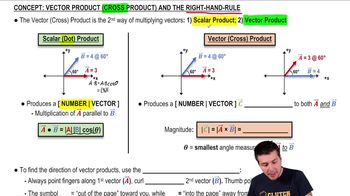
Vector (Cross) Product and the Right-Hand-Rule

Magnitude of a Vector

The magnitude of a vector is a measure of its length and is calculated using the Pythagorean theorem in Cartesian coordinates. For a vector represented in two dimensions, the magnitude can be found using the formula |A| = √(Ax² + Ay²), where Ax and Ay are the vector's components along the x and y axes. Understanding the magnitude is crucial for calculating the vector product and interpreting physical quantities.
추천 영상:
가이드 코스
03:59
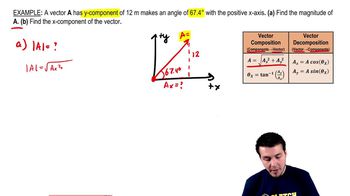
Calculating Magnitude & Components of a Vector

Direction of a Vector

The direction of a vector indicates the orientation of the vector in space and is often expressed in terms of angles relative to a reference axis. In the context of the vector product, the direction of the resulting vector A x B is determined by the right-hand rule, which states that if the fingers of the right hand curl from vector A to vector B, the thumb points in the direction of A x B. This concept is vital for visualizing and solving problems involving vector interactions.
추천 영상:
가이드 코스
06:44
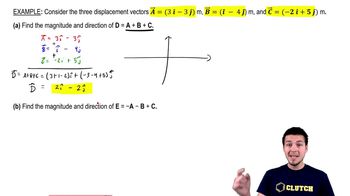
Adding 3 Vectors in Unit Vector Notation